CapitalAshgabat (Ashkhabad)
LanguagesTurkmen constitutes , followed by Russian at, Uzbek at, and other languages at.
CurrencyTurkmenistani manat
Governmenta presidential republic characterized by authoritarian governance
Bamwor Indexes
Turkmenistan — Q1 2026
IBEUBamwor Urban Scale Index
12.67%
Rank #139 of 237
View full ranking →
IBCPBamwor Population Concentration Index
23.25%
Rank #143 of 237
View full ranking →
IBDABamwor Settlement Density Index
3.03per 1K km²
Rank #230 of 241
View full ranking →
IBCXBamwor Country Complexity Index
58.09/100
Rank #124 of 234
View full ranking →
IBEEBamwor Economic Stability Index
88.56/100
Rank #84 of 220
View full ranking →
IBFMBamwor Military Strength Index
51.12/100
Rank #67 of 124
View full ranking →
IBDIBamwor Digital Infrastructure Index
58.39/100
Rank #155 of 206
View full ranking →
IBEDBamwor Education Index
74.06/100
Rank #42 of 119
View full ranking →
IBSABamwor Healthcare Index
68.78/100
Rank #114 of 218
View full ranking →
Turkmenistan Intelligence Report
Download PDF with 20+ statistics, rankings & proprietary indices
Introduction
Background
Present-day Turkmenistan has been at the crossroads of civilizations for centuries. Various Persian empires ruled the area in antiquity, and Alexander the Great, Muslim armies, the Mongols, Turkic warriors, and eventually the Russians conquered it. In medieval times, Merv (located in present-day Mary province) was one of the great cities of the Islamic world and an important stop on the Silk Road. Annexed by Russia in the late 1800s, Turkmen territories later figured prominently in the anti-Bolshevik resistance in Central Asia. In 1924, Turkmenistan became a Soviet republic; it achieved independence when the USSR dissolved in 1991.
President for Life Saparmurat NIYAZOV died in 2006, and Gurbanguly BERDIMUHAMEDOV, a deputy chairman under NIYAZOW, emerged as the country's new president. BERDIMUHAMEDOV won Turkmenistan's first multi-candidate presidential election in 2007, and again in 2012 and 2017 with over 97% of the vote in elections widely regarded as undemocratic. In 2022, BERDIMUHAMEDOV announced that he would step down from the presidency and called for an election to replace him. His son, Serdar BERDIMUHAMEDOV, won the ensuing election with 73% of the vote. Gurbanguly BERDIMUHAMEDOV, although no longer head of state, maintains an influential political position as head of the Halk Maslahaty (People’s Council) and as National Leader of the Turkmen People, a title that provides additional privileges and immunity for him and his family. Since Gurbanguly BERDIMUHAMEDOV stepped down from the presidency, state-controlled media upgraded his honorific from Arkadag (protector) to Hero-Arkadag, and began referring to Serdar BERDIMUHAMEDOV as Arkadagly Serdar, which can be translated as "Serdar who has a protector to support him."
Turkmenistan has sought new export markets for its extensive hydrocarbon/natural gas reserves, which have yet to be fully exploited. Turkmenistan's reliance on gas exports has made the economy vulnerable to fluctuations in the global energy market, and economic hardships since the drop in energy prices in 2014 have led many citizens of Turkmenistan to emigrate, mostly to Turkey.
Geography
Area
land
469,930 sq km
water
18,170 sq km
total
488,100 sq km
Climate
subtropical desert
Terrain
a predominantly flat-to-rolling sandy desert characterized by dunes that ascend to mountains in the southern region; features low mountain ranges along its border with Iran and extends to the Caspian Sea in the west
Land use
other
10.7% (2023 est.)
forest
5% (2023 est.)
agricultural land
84.2% (2023 est.)
agricultural land: arable land
arable land: 3.4% (2023 est.)
agricultural land: permanent crops
permanent crops: 0.1% (2023 est.)
agricultural land: permanent pasture
permanent pasture: 80.8% (2023 est.)
Location
Central Asia, situated alongside the Caspian Sea, positioned between Iran and Kazakhstan
Coastline
0 km (landlocked)
Elevation
lowest point
Vpadina Akchanaya (Sarygamysh Koli represents a lake located in northern Turkmenistan, with its water levels fluctuating both above and below the elevation of Vpadina Akchanaya, having been recorded as low as -110 m) -81 m
highest point
Gora Ayribaba 3,139 m
mean elevation
230 m
Irrigated land
16,459 sq km (2012)
Map references
Asia
Land boundaries
total
4,158 km
border countries
Afghanistan 804 km; Iran 1,148 km; Kazakhstan 413 km; Uzbekistan 1,793 km
Maritime claims
none (landlocked)
Natural hazards
earthquakes; mudslides; droughts; dust storms; floods
Geography - note
landlocked; the vast western and central low-lying barren regions of the nation constitute the extensive Garagum (Kara-Kum) desert, which covers more than 80% of the territory; the eastern section is dominated by plateau
Natural resources
petroleum, natural gas, sulfur, salt
Area - comparative
slightly more than three times the area of Georgia; marginally larger than California
Geographic coordinates
40 00 N, 60 00 E
Population distribution
the most densely populated regions are the southern, eastern, and northeastern oases; around 50% of the population resides in and near the capital city of Ashgabat
Major lakes (area sq km)
salt water lake(s)
Caspian Sea (shared with Iran, Azerbaijan, Russia, and Kazakhstan) - 374,000 sq km
Major watersheds (area sq km)
Internal (endorheic basin) drainage
(Aral Sea basin) Amu Darya (534,739 sq km)
Major rivers (by length in km)
Amu Darya (shared with Tajikistan [s], Afghanistan, and Uzbekistan [m]) - 2,620 km
note: [s] following the country name indicates the river source; [m] following the country name denotes the river mouth
People & Society
Literacy
male
99.9% (2022 est.)
female
99.9% (2022 est.)
total population
99.9% (2022 est.)
Languages
Languages
Turkmen constitutes 72% (official language), followed by Russian at 12%, Uzbek at 9%, and other languages at 7%.
major-language sample(s)
Dünýä Faktlar Kitaby – esasy maglumatlaryň wajyp çeşmesidir (Turkmen)
The World Factbook, the indispensable source for basic information.
Religions
In terms of religion, 93% identify as Muslim, 6.4% as Christian, while Buddhists, followers of folk religions, Jews, and others each represent less than 1% (2020 estimate).
Sex ratio
at birth
1.05 male(s)/female
0-14 years
1.03 male(s)/female
15-64 years
0.99 male(s)/female
total population
0.98 male(s)/female (2024 est.)
65 years and over
0.78 male(s)/female
Birth rate
16.43 births/1,000 population (2025 est.)
Death rate
5.99 deaths/1,000 population (2025 est.)
Median age
male
30.7 years
total
31.6 years (2025 est.)
female
31.7 years
Population
male
2,842,870
total
5,744,151 (2024 est.)
female
2,901,281
Nationality
noun
Turkmenistani(s)
adjective
Turkmenistani
Tobacco use
male
9.4% (2025 est.)
total
4.8% (2025 est.)
female
0.5% (2025 est.)
Urbanization
urban population
54% of total population (2023)
rate of urbanization
2.23% annual rate of change (2020-25 est.)
Age structure
0-14 years
24.5% (male 711,784/female 692,967)
15-64 years
68.6% (male 1,956,740/female 1,984,333)
65 years and over
6.9% (2024 est.) (male 174,346/female 223,981)
Ethnic groups
The ethnic composition includes 85% Turkmen, 5% Uzbek, 4% Russian, and other groups making up 6% (2003 estimate).
Child marriage
women married by age 15
0.2% (2019)
women married by age 18
6.1% (2019)
Dependency ratios
total dependency ratio
45.8 (2024 est.)
youth dependency ratio
35.6 (2024 est.)
potential support ratio
9.9 (2024 est.)
elderly dependency ratio
10.1 (2024 est.)
Physician density
1.93 physicians/1,000 population (2023)
Health expenditure
Health expenditure (as % of GDP)
5.6% of GDP (2021)
Health expenditure (as % of national budget)
8.5% of national budget (2022 est.)
Net migration rate
-1.66 migrant(s)/1,000 population (2025 est.)
Hospital bed density
4 beds/1,000 population (2021 est.)
Total fertility rate
2.02 children born/woman (2025 est.)
Drinking water source
improved: rural
rural: 100% of population (2022 est.)
improved: total
total: 100% of population (2022 est.)
improved: urban
urban: 100% of population (2022 est.)
unimproved: rural
rural: 0% of population (2022 est.)
unimproved: total
total: 0% of population (2022 est.)
unimproved: urban
urban: 0% of population (2022 est.)
Education expenditure
Education expenditure (% GDP)
2.7% of GDP (2023 est.)
Education expenditure (% national budget)
29.6% national budget (2024 est.)
Infant mortality rate
male
43.6 deaths/1,000 live births
total
35 deaths/1,000 live births (2025 est.)
female
27.7 deaths/1,000 live births
Population growth rate
0.88% (2025 est.)
Gross reproduction rate
0.99 (2025 est.)
Population distribution
The most densely populated regions are the southern, eastern, and northeastern oases, with around 50% of the populace residing in and near the capital city, Ashgabat.
Life expectancy at birth
male
69.4 years
female
75.5 years
total population
72.4 years (2024 est.)
Maternal mortality ratio
5 deaths/100,000 live births (2023 est.)
Sanitation facility access
improved: rural
rural: 100% of population (2022 est.)
improved: total
total: 99.9% of population (2022 est.)
improved: urban
urban: 99.8% of population (2022 est.)
unimproved: rural
rural: 0% of population (2022 est.)
unimproved: total
total: 0.1% of population (2022 est.)
unimproved: urban
urban: 0.2% of population (2022 est.)
Alcohol consumption per capita
beer
0.65 liters of pure alcohol (2019 est.)
wine
1.25 liters of pure alcohol (2019 est.)
total
2.88 liters of pure alcohol (2019 est.)
spirits
0.98 liters of pure alcohol (2019 est.)
other alcohols
0 liters of pure alcohol (2019 est.)
Major urban areas - population
902,000 ASHGABAT (capital) (2023)
Obesity - adult prevalence rate
18.6% (2016)
Mother's mean age at first birth
24.2 years (2019)
Currently married women (ages 15-49)
65% (2019 est.)
Children under the age of 5 years underweight
3.1% (2019 est.)
School life expectancy (primary to tertiary education)
male
12 years (2022 est.)
total
13 years (2023 est.)
female
12 years (2022 est.)
Environment
Climate
subtropical desert
Land use
other
10.7% (2023 est.)
forest
5% (2023 est.)
agricultural land
84.2% (2023 est.)
agricultural land: arable land
arable land: 3.4% (2023 est.)
agricultural land: permanent crops
permanent crops: 0.1% (2023 est.)
agricultural land: permanent pasture
permanent pasture: 80.8% (2023 est.)
Urbanization
urban population
54% of total population (2023)
rate of urbanization
2.23% annual rate of change (2020-25 est.)
Methane emissions
other
1.1 kt (2019-2021 est.)
waste
44.1 kt (2019-2021 est.)
energy
5,451.4 kt (2022-2024 est.)
agriculture
294.9 kt (2019-2021 est.)
Waste and recycling
municipal solid waste generated annually
500,000 tons (2024 est.)
percent of municipal solid waste recycled
15.3% (2022 est.)
Environmental issues
contamination of soil and groundwater from agricultural chemicals and pesticides; salinization, waterlogging of soil resulting from inadequate irrigation techniques; pollution of the Caspian Sea; diversion of rivers for irrigation purposes; soil degradation; desert expansion
Total water withdrawal
municipal
453.5 million cubic meters (2022 est.)
industrial
806.765 million cubic meters (2022 est.)
agricultural
16.12 billion cubic meters (2022 est.)
Carbon dioxide emissions
total emissions
106.215 million metric tonnes of CO2 (2023 est.)
from consumed natural gas
88.153 million metric tonnes of CO2 (2023 est.)
from coal and metallurgical coke
100 metric tonnes of CO2 (2023 est.)
from petroleum and other liquids
18.062 million metric tonnes of CO2 (2023 est.)
Particulate matter emissions
28.1 micrograms per cubic meter (2019 est.)
Total renewable water resources
24.765 billion cubic meters (2022 est.)
International environmental agreements
party to
Biodiversity, Climate Change, Climate Change-Kyoto Protocol, Climate Change-Paris Agreement, Comprehensive Nuclear Test Ban, Desertification, Hazardous Wastes, Ozone Layer Protection, Ship Pollution, Wetlands
signed, but not ratified
none of the selected agreements
Government
Flag
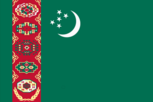
description: a green field featuring a vertical red stripe positioned toward the left; the stripe displays five tribal guls (designs utilized in carpet making) arranged above two crossed olive branches; in the upper left corner of the main field, there are five white five-pointed stars along with a white crescent moon
meaning: the green hue and crescent moon symbolize Islam, the five stars represent the regions of the country, while the guls signify national identity
Capital
name
Ashgabat (Ashkhabad)
etymology
the name originates from the Turkmen words ushq, which translates to "love," and abad, meaning "inhabited place" or "town;" the city began as a military outpost established in 1881, named after an ancient settlement located at the same site
time difference
UTC+5 (10 hours ahead of Washington, DC, during Standard Time)
geographic coordinates
37 57 N, 58 23 E
Suffrage
18 years of age; universal
Citizenship
citizenship by birth
no
citizenship by descent only
at least one parent must be a citizen of Turkmenistan
dual citizenship recognized
yes
residency requirement for naturalization
7 years
Constitution
history
several previous; latest adopted 14 September 2016
amendment process
initiated by the Assembly or Mejlis; to be enacted, it requires a two-thirds majority vote or an absolute majority in a referendum
Country name
former
Turkmen Soviet Socialist Republic
etymology
the suffix -stan translates to "land," thereby making the country's name mean the "Land of the Turkmen [people];" the term for the people means "Turk-like," derived from the Persian words tork and mandan, which refer to their historically nomadic way of life, distinct from the settled Turks of Turkey
local long form
none
local short form
Turkmenistan
conventional long form
none
conventional short form
Turkmenistan
Independence
27 October 1991 (from the Soviet Union)
Legal system
a civil law system influenced by Islamic (sharia) law
Government type
a presidential republic characterized by authoritarian governance
Judicial branch
highest court(s)
Supreme Court of Turkmenistan (comprising the court president and 21 associate judges, organized into civil, criminal, and military chambers)
subordinate courts
High Commercial Court; appellate courts; provincial, district, and city courts; military courts
judge selection and term of office
judges appointed by the president for 5-year terms
Executive branch
cabinet
Cabinet of Ministers appointed by the president
chief of state
President Serdar BERDIMUHAMEDOV (since 19 March 2022)
election results
2022: Serdar BERDIMUHAMEDOV was elected president; vote percentage - Serdar BERDIMUHAMEDOV (DPT) 73%, Khydyr NUNNAYEV (independent) 11.1%, Agadzhan BEKMYRADOV (IAP) 7.2%, others 8.7%
2017: Gurbanguly BERDIMUHAMEDOV was reelected president in the first round; vote percentage - Gurbanguly BERDIMUHAMEDOV (DPT) 97.7%, others 2.3%
head of government
President Serdar BERDIMUHAMEDOV (since 19 March 2022)
most recent election date
12 March 2022
election/appointment process
the president is elected directly by popular vote requiring an absolute majority over two rounds, if necessary, serving a 7-year term (with no term limits)
expected date of next election
2029
National holiday
Independence Day, 27 October (1991)
National color(s)
green, white
National heritage
total World Heritage Sites
5 (4 cultural, 1 natural)
selected World Heritage Site locales
Ancient Merv (c); Kunya-Urgench (c); Parthian Fortresses of Nisa (c); Cold Winter Deserts of Turan (n); Silk Roads: Zarafshan-Karakum Corridor (c)
Political parties
Agrarian Party of Turkmenistan or TAP
Party of Industrialists and Entrepreneurs of Turkmenistan or TSTP
The Democratic Party of Turkmenistan or TDP
Legislative branch
term in office
5 years
number of seats
56 (48 indirectly elected; 8 appointed)
electoral system
plurality/majority
legislature name
Assembly (Mejlis)
scope of elections
full renewal
legislative structure
unicameral
most recent election date
3/28/2021
expected date of next election
March 2028
percentage of women in chamber
25.5%
parties elected and seats per party
Democratic Party of Turkmenistan (DPT) (65); Groups of citizens of Turkmenistan (28); Agrarian Party (24); Party of Industrialists and Entrepreneurs (8)
National anthem(s)
title
"Garaşsyz, Bitarap Türkmenistanyň" (State Anthem of Independent, Neutral Turkmenistan)
history
adopted in 1997; lyrics were amended in 2008 to remove references to the late President Saparmurat NYYAZOW
lyrics/music
collective/Veli MUKHATOV
National symbol(s)
Akhal-Teke horse
Administrative divisions
5 provinces (velayatlar, singular - velayat) and 1 independent city*: Ahal Velayat (Arkadag), Ashgabat*, Balkan Velayat (Balkanabat), Dashoguz Velayat, Lebap Velayat (Turkmenabat), Mary Velayat
Diplomatic representation in the US
FAX
[1] (202) 588-1500
chancery
2207 Massachusetts Avenue NW, Washington, DC 20008
telephone
[1] (202) 588-1500
chief of mission
Ambassador Meret ORAZOV (since 14 February 2001)
email address and website
[email protected]
https://usa.tmembassy.gov.tm/en
Diplomatic representation from the US
FAX
[993] (12) 94-26-14
embassy
9 1984 Street (formerly Pushkin Street), Ashgabat 744000
telephone
[993] (12) 94-00-45
mailing address
7070 Ashgabat Place, Washington, DC 20521-7070
chief of mission
Ambassador Elizabeth ROOD (since 31 July 2024)
email address and website
[email protected]
https://tm.usembassy.gov/
International organization participation
ADB, CIS (associate member, has not ratified the 1993 CIS charter although it participates in meetings and held the chairmanship of the CIS in 2012), EAPC, EBRD, ECO, FAO, G-77, IBRD, ICAO, ICRM, IDA, IDB, IFC, IFRCS, ILO, IMF, IMO, Interpol, IOC, IOM (observer), ISO (correspondent), ITU, MIGA, NAM, OIC, OPCW, OSCE, PFP, UN, UNCTAD, UNESCO, UNHCR, UNIDO, UNWTO, UPU, WCO, WFTU (NGOs), WHO, WIPO, WMO
International law organization participation
has not issued a declaration of ICJ jurisdiction; is a non-party state to the ICCt
Economy
Budget
revenues
$5.954 billion (2019 est.)
expenditures
$6.134 billion (2019 est.)
Exports
Exports 2021
$10.282 billion (2021 est.)
Exports 2022
$14.67 billion (2022 est.)
Exports 2023
$13.111 billion (2023 est.)
Imports
Imports 2021
$6.25 billion (2021 est.)
Imports 2022
$7.362 billion (2022 est.)
Imports 2023
$7.563 billion (2023 est.)
Industries
natural gas, oil, petroleum products, textiles, food processing
Labor force
2.445 million (2024 est.)
Public debt
Public debt 2016
24.1% of GDP (2016 est.)
Remittances
Remittances 2021
0% of GDP (2021 est.)
Remittances 2022
0% of GDP (2022 est.)
Remittances 2023
0% of GDP (2023 est.)
Exchange rates
Currency
Turkmenistani manat (TMM) per US dollar -
Exchange rates 2014
3.5 (2014 est.)
Exchange rates 2015
3.5 (2015 est.)
Exchange rates 2016
3.5 (2016 est.)
Exchange rates 2017
4.125 (2017 est.)
Debt - external
Debt - external 2023
$3.696 billion (2023 est.)
Economic overview
upper-middle-income nation in Central Asia; possesses the fourth-largest reserves of natural gas and abundant natural resources; characterized by an authoritarian regime with a focus on state-owned enterprises; faces challenges such as an overvalued currency, significant inflation risks, and limited economic diversification resulting from extensive state control and bureaucracy
Unemployment rate
Unemployment rate 2022
4.2% (2022 est.)
Unemployment rate 2023
4.1% (2023 est.)
Unemployment rate 2024
4.4% (2024 est.)
Exports - partners
China 63%, Turkey 11%, Greece 7%, Uzbekistan 6%, Azerbaijan 4% (2023)
Imports - partners
Turkey 21%, UAE 21%, China 20%, Kazakhstan 8%, Germany 5% (2023)
Real GDP per capita
Real GDP per capita 2022
$17,100 (2022 est.)
Real GDP per capita 2023
$17,900 (2023 est.)
Real GDP per capita 2024
$18,000 (2024 est.)
Real GDP growth rate
Real GDP growth rate 2022
6.2% (2022 est.)
Real GDP growth rate 2023
6.3% (2023 est.)
Real GDP growth rate 2024
2.3% (2024 est.)
Agricultural products
milk, wheat, potatoes, cotton, watermelons, tomatoes, grapes, barley, beef, lamb/mutton (2023)
Exports - commodities
natural gas, refined petroleum, fertilizers, crude petroleum, electricity (2023)
Imports - commodities
broadcasting equipment, cars, wheat, computers, iron pipes (2023)
GDP (official exchange rate)
$64.24 billion (2024 est.)
Average household expenditures
on food
36.5% of household expenditures (2023 est.)
on alcohol and tobacco
2.2% of household expenditures (2023 est.)
Inflation rate (consumer prices)
Inflation rate (consumer prices) 2020
6.1% (2020 est.)
Inflation rate (consumer prices) 2021
19.5% (2021 est.)
Inflation rate (consumer prices) 2022
11.5% (2022 est.)
Real GDP (purchasing power parity)
Real GDP (purchasing power parity) 2022
$123.778 billion (2022 est.)
Real GDP (purchasing power parity) 2023
$131.576 billion (2023 est.)
Real GDP (purchasing power parity) 2024
$134.555 billion (2024 est.)
Youth unemployment rate (ages 15-24)
male
14.7% (2024 est.)
total
9.6% (2024 est.)
female
6% (2024 est.)
GDP - composition, by sector of origin
industry
39.3% (2023 est.)
services
49.4% (2023 est.)
agriculture
11.3% (2023 est.)
Energy
Coal
imports
200 metric tons (2023 est.)
proven reserves
799.999 million metric tons (2023 est.)
Petroleum
total petroleum production
272,000 bbl/day (2023 est.)
crude oil estimated reserves
600 million barrels (2021 est.)
refined petroleum consumption
152,000 bbl/day (2023 est.)
Electricity
exports
9 billion kWh (2023 est.)
consumption
21.526 billion kWh (2023 est.)
installed generating capacity
6.512 million kW (2023 est.)
transmission/distribution losses
3.258 billion kWh (2023 est.)
Natural gas
exports
41.334 billion cubic meters (2023 est.)
production
84.277 billion cubic meters (2023 est.)
consumption
44.936 billion cubic meters (2023 est.)
proven reserves
11.327 trillion cubic meters (2021 est.)
Electricity access
electrification - total population
100% (2022 est.)
Energy consumption per capita
Total energy consumption per capita 2023
261.142 million Btu/person (2023 est.)
Electricity generation sources
fossil fuels
100% of total installed capacity (2023 est.)
Communications
Internet users
percent of population
21% (2017 est.)
Broadcast media
broadcast media under state control; 7 television networks and 4 radio networks owned by the state; availability of satellite dishes for alternative broadcasts; authorities occasionally restrict access to satellite television by confiscating satellite dishes.
Internet country code
.tm
Telephones - fixed lines
total subscriptions
802,000 (2021 est.)
subscriptions per 100 inhabitants
10 (2022 est.)
Telephones - mobile cellular
total subscriptions
6.25 million (2021 est.)
subscriptions per 100 inhabitants
99 (2021 est.)
Broadband - fixed subscriptions
total
377,000 (2022 est.)
subscriptions per 100 inhabitants
5 (2022 est.)
Transportation
Airports
23 (2025)
Railways
total
5,113 km (2017)
broad gauge
5,113 km (2017) 1.520-m gauge
Heliports
25 (2025)
Merchant marine
total
73 (2023)
by type
general cargo 6, oil tanker 8, other 59
Civil aircraft registration country code prefix
EZ
Military & Security
Military - note
The military is tasked with external defense and collaborates closely with the Border Service to safeguard the nation's frontiers; primary focuses of the military encompass border security, competition in the Caspian Sea, regional stability, and the modernization of military capabilities. Although Turkmenistan adheres to a policy of permanent and "positive" neutrality and has opted out of participating in post-Soviet military alliances such as the Collective Security Treaty Organization and the Shanghai Cooperation Organization, it has engaged in multinational exercises and bilateral training with nearby nations, including Russia and Uzbekistan. Turkmenistan became a member of NATO's Partnership for Peace program in 1994; however, it does not contribute any military personnel to NATO-led missions (2025).
Military expenditures
Military Expenditures 2015
1.5% of GDP (2015 est.)
Military Expenditures 2016
1.8% of GDP (2016 est.)
Military Expenditures 2017
1.8% of GDP (2017 est.)
Military Expenditures 2018
1.8% of GDP (2018 est.)
Military Expenditures 2019
1.9% of GDP (2019 est.)
Military and security forces
Armed Forces of Turkmenistan (also known as Turkmen National Army): Ground Forces, Air Force, Navy
Ministry of Internal Affairs: Internal Troops, Turkmen (National) Police, Federal/State Border Guard Service (2025).
Military service age and obligation
Mandatory military service for males is required between the ages of 18 to 27, while both men and women may volunteer; the conscription period lasts for 24 months (2025).
Military equipment inventories and acquisitions
The military's arsenal predominantly consists of armaments from the Russian/Soviet era, supplemented by smaller amounts from vendors such as Brazil, China, Italy, and Türkiye (2025).
Military and security service personnel strengths
estimated 35,000 active Armed Forces (2025)
Transnational Issues
Trafficking in persons
tier rating
Tier 2 Watch List — Turkmenistan has not completely satisfied the minimum criteria for the eradication of trafficking; however, it is making notable strides toward this goal. As a result, Turkmenistan has been elevated to the Tier 2 Watch List; for additional information, please visit: https://www.state.gov/reports/2025-trafficking-in-persons-report/turkmenistan/
Refugees and internally displaced persons
refugees
3,409 (2024 est.)
Space
Space agency/agencies
The Turkmenistan National Space Agency, founded in 2011 and later transitioned to the Space Department of the Ministry of Communications in 2019, is set for developments in 2025.
Space program overview
It maintains a modest space initiative centered on the procurement of satellites and the establishment of necessary infrastructure for satellite construction and operation. Its primary focus lies in communications and remote sensing satellites, and it has engaged in collaboration with the space agencies and/or space sectors of France, Italy, Russia, South Korea, and the United States, as of 2025.
Key space-program milestones
2015 - first commercial telecommunications satellite (Turkmen Sat 52E) built by European company and launched by US
2024 - announced beginning of program to develop or acquire a second communications satellite