CapitalNgerulmud
LanguagesPalauan, other Micronesian languages, English, Filipino, Chinese, other languages
Governmenta presidential republic in free association with the United States
Bamwor Indexes
Palau — Q1 2026
IBEUBamwor Urban Scale Index
63.79%
Rank #16 of 237
View full ranking →
IBCPBamwor Population Concentration Index
144.62%
Rank #6 of 237
View full ranking →
IBDABamwor Settlement Density Index
187.36per 1K km²
Rank #78 of 241
View full ranking →
IBCXBamwor Country Complexity Index
38.45/100
Rank #191 of 234
View full ranking →
IBEEBamwor Economic Stability Index
87.45/100
Rank #103 of 220
View full ranking →
IBEDBamwor Education Index
75.95/100
Rank #35 of 119
View full ranking →
IBSABamwor Healthcare Index
67.60/100
Rank #130 of 218
View full ranking →
Palau Intelligence Report
Download PDF with 20+ statistics, rankings & proprietary indices
Introduction
Background
Humans arrived in the Palauan archipelago from Southeast Asia around 1000 B.C. and developed a complex, highly organized matrilineal society where high-ranking women picked the chiefs. The islands were the westernmost part of the widely scattered Pacific islands north of New Guinea that Spanish explorers named the Caroline Islands in the 17th century. The 18th and 19th centuries saw occasional visits of whalers and traders as Spain gained some influence in the islands and administered it from the Philippines. Spain sold Palau to Germany in 1899 after losing the Philippines in the Spanish-American War.
Japan seized Palau in 1914, was granted a League of Nations mandate to administer the islands in 1920, and made Koror the capital of its South Seas Mandate in 1922. By the outbreak of World War II, there were four times as many Japanese living in Koror as Palauans. In 1944, the US invasion of the island of Peleliu was one of the bloodiest island fights of the Pacific War. After the war, Palau became part of the US-administered Trust Territory of the Pacific Islands.
Palau voted against joining the Federated States of Micronesia in 1978 and adopted its own constitution in 1981, which stated that Palau was a nuclear-free country. In 1982, Palau signed a Compact of Free Association (COFA) with the US, which granted Palau financial assistance and access to many US domestic programs in exchange for exclusive US military access and defense responsibilities. However, many Palauans saw the COFA as incompatible with the Palauan Constitution because of the US military’s nuclear arsenal, and seven referenda failed to achieve ratification. Following a constitutional amendment and eighth referendum in 1993, the COFA was ratified and entered into force in 1994 when the islands gained their independence. Its funding was renewed in 2010.
Palau has been on the frontlines of combatting climate change and protecting marine resources. In 2011, Palau banned commercial shark fishing and created the world’s first shark sanctuary. In 2017, Palau began stamping the Palau Pledge into passports, reminding visitors to act in ecologically and culturally responsible ways. In 2020, Palau banned coral reef-toxic sunscreens and expanded its fishing prohibition to include 80% of its exclusive economic zone.
Geography
Area
land
459 sq km
water
0 sq km
total
459 sq km
Climate
tropical; characterized by hot and humid conditions; wet season spans from May to November
Terrain
diverse topography ranging from the high, mountainous main island of Babelthuap to low-lying coral islands typically bordered by extensive barrier reefs
Land use
other
0% (2023 est.)
forest
90.6% (2023 est.)
agricultural land
9.3% (2023 est.)
agricultural land: arable land
arable land: 0.7% (2023 est.)
agricultural land: permanent crops
permanent crops: 4.3% (2023 est.)
agricultural land: permanent pasture
permanent pasture: 4.3% (2023 est.)
Location
Oceania, a collection of islands situated in the North Pacific Ocean, to the southeast of the Philippines
Coastline
1,519 km
Elevation
lowest point
Pacific Ocean 0 m
highest point
Mount Ngerchelchuus 242 m
Irrigated land
0 sq km (2022)
Map references
Oceania
Land boundaries
total
0 km
Maritime claims
contiguous zone
24 nm
territorial sea
12 nm
continental shelf
200 nm
exclusive economic zone
200 nm
Natural hazards
typhoons occur from June to December
Geography - note
the westernmost group of islands in the Caroline archipelago, comprising six island groups with over 300 islands; famous for the renowned Rock Islands
Natural resources
forests, minerals (notably gold), marine resources, and deep-seabed minerals
Area - comparative
approximately 2.5 times larger than Washington, D.C.
Geographic coordinates
7 30 N, 134 30 E
Population distribution
the majority of the population resides in the southern region of the main island of Babelthuap
People & Society
Literacy
male
100% (2020 est.)
female
100% (2020 est.)
total population
100% (2020 est.)
Languages
Palauan (official in the majority of islands) 65.2%, other Micronesian languages 1.9%, English (official) 19.1%, Filipino 9.9%, Chinese 1.2%, other languages 2.8% (2015 est.)
Religions
Roman Catholic 46.9%, Protestant 30.9% (Evangelical 24.6%, Seventh Day Adventist 5%, other Protestant 1.4%), Modekngei 5.1% (indigenous to Palau), Muslim 4.9%, other religions 12.3% (2020 est.)
Sex ratio
at birth
1.06 male(s)/female
0-14 years
1.07 male(s)/female
15-64 years
1.25 male(s)/female
total population
1.06 male(s)/female (2024 est.)
65 years and over
0.33 male(s)/female
Birth rate
11.53 births/1,000 population (2025 est.)
Death rate
8.52 deaths/1,000 population (2025 est.)
Median age
male
34.1 years
total
35.5 years (2025 est.)
female
37.4 years
Population
male
11,257
total
21,947 (2025 est.)
female
10,690
Nationality
noun
Palauan(s)
adjective
Palauan
Tobacco use
male
25.2% (2025 est.)
total
16.3% (2025 est.)
female
6.8% (2025 est.)
Urbanization
urban population
82.4% of total population (2023)
rate of urbanization
1.59% annual rate of change (2020-25 est.)
Age structure
0-14 years
17.5% (male 1,976/female 1,849)
15-64 years
71.3% (male 8,647/female 6,935)
65 years and over
11.2% (2024 est.) (male 612/female 1,845)
Ethnic groups
Palauan (Micronesian with influences from Malayan and Melanesian ancestry) 70.6%, Carolinian 1.2%, Asian 26.5%, other 1.7% (2020 est.)
Dependency ratios
total dependency ratio
41.6 (2025 est.)
youth dependency ratio
24.9 (2025 est.)
potential support ratio
6 (2025 est.)
elderly dependency ratio
16.7 (2025 est.)
Physician density
1.81 physicians/1,000 population (2023)
Health expenditure
Health expenditure (as % of GDP)
16.4% of GDP (2021)
Health expenditure (as % of national budget)
9.5% of national budget (2022 est.)
Net migration rate
0.77 migrant(s)/1,000 population (2025 est.)
Total fertility rate
1.7 children born/woman (2025 est.)
Drinking water source
improved: rural
rural: 99.4% of population (2022 est.)
improved: total
total: 99.6% of population (2022 est.)
improved: urban
urban: 99.6% of population (2022 est.)
unimproved: rural
rural: 0.6% of population (2022 est.)
unimproved: total
total: 0.4% of population (2022 est.)
unimproved: urban
urban: 0.4% of population (2022 est.)
Education expenditure
Education expenditure (% GDP)
3.5% of GDP (2023 est.)
Education expenditure (% national budget)
9.8% national budget (2023 est.)
Infant mortality rate
male
12.7 deaths/1,000 live births
total
10.6 deaths/1,000 live births (2025 est.)
female
8.8 deaths/1,000 live births
Population growth rate
0.38% (2025 est.)
Gross reproduction rate
0.83 (2025 est.)
Population distribution
a majority of the populace resides in the southern region of the main island, Babelthuap
Life expectancy at birth
male
72 years
female
78.5 years
total population
75.2 years (2024 est.)
Maternal mortality ratio
89 deaths/100,000 live births (2023 est.)
Sanitation facility access
improved: rural
rural: 98.4% of population (2022 est.)
improved: total
total: 99% of population (2022 est.)
improved: urban
urban: 99.1% of population (2022 est.)
unimproved: rural
rural: 1.6% of population (2022 est.)
unimproved: total
total: 1% of population (2022 est.)
unimproved: urban
urban: 0.9% of population (2022 est.)
Major urban areas - population
277 NGERULMUD (capital) (2018)
Obesity - adult prevalence rate
55.3% (2016)
Currently married women (ages 15-49)
48.3% (2020 est.)
School life expectancy (primary to tertiary education)
male
14 years (2023 est.)
total
15 years (2023 est.)
female
16 years (2023 est.)
Environment
Climate
tropical climate characterized by high temperatures and humidity; rainy season spans from May to November
Land use
other
0% (2023 est.)
forest
90.6% (2023 est.)
agricultural land
9.3% (2023 est.)
agricultural land: arable land
arable land: 0.7% (2023 est.)
agricultural land: permanent crops
permanent crops: 4.3% (2023 est.)
agricultural land: permanent pasture
permanent pasture: 4.3% (2023 est.)
Urbanization
urban population
82.4% of total population (2023)
rate of urbanization
1.59% annual rate of change (2020-25 est.)
Waste and recycling
municipal solid waste generated annually
9,400 tons (2024 est.)
Environmental issues
insufficient infrastructure for solid waste management; dangers to the marine environment due to sand and coral extraction, unlawful fishing methods, and overfishing; increasing sea levels; coral bleaching phenomena; periods of drought
Particulate matter emissions
7.9 micrograms per cubic meter (2019 est.)
International environmental agreements
party to
Biodiversity, Climate Change, Climate Change-Kyoto Protocol, Climate Change-Paris Agreement, Comprehensive Nuclear Test Ban, Desertification, Endangered Species, Hazardous Wastes, Law of the Sea, Ozone Layer Protection, Ship Pollution, Wetlands, Whaling
signed, but not ratified
none of the selected agreements
Government
Flag
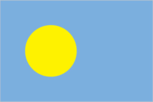
description: light blue featuring a prominent yellow disk on the left side
meaning: the blue symbolizes the ocean, while the disk represents the moon, regarded as an emblem of peace, love, and tranquility
Capital
name
Ngerulmud
etymology
the term originates from a Palauan expression that translates to "place of fermented angelfish;" historically, this location served as the gathering point for women to present fermented angelfish to deities
time difference
UTC+9 (14 hours ahead of Washington, DC, during Standard Time)
geographic coordinates
7 30 N, 134 37 E
Suffrage
18 years of age; universal
Citizenship
citizenship by birth
no
citizenship by descent only
at least one parent must be a citizen of Palau
dual citizenship recognized
no
residency requirement for naturalization
note - no procedure for naturalization
Constitution
history
ratified 9 July 1980, effective 1 January 1981
amendment process
amendments can be proposed through a constitutional convention (held at least once every 15 years with voter consent), a public petition signed by a minimum of 25% of eligible voters, or by a resolution passed by at least three-fourths of the National Congress members; for an amendment to be ratified, it must receive majority approval in at least three-fourths of the states during the subsequent regular general election
Country name
former
Trust Territory of the Pacific Islands, Palau District
etymology
derived from the Palauan term for the islands, Belau, which probably comes from the Palauan word beluu, meaning "village"
local long form
Beluu er a Belau
local short form
Belau
conventional long form
Republic of Palau
conventional short form
Palau
Independence
1 October 1994 (from the US-administered UN trusteeship)
Legal system
a hybrid legal system incorporating civil, common, and customary law
Government type
a presidential republic in free association with the United States
Judicial branch
highest court(s)
Supreme Court (composed of a chief justice and three associate justices, organized into appellate trial divisions; the Supreme Court framework also includes Common Pleas and Land Courts)
subordinate courts
National Court and other inferior courts
judge selection and term of office
justices are appointed by a seven-member independent panel comprising judges, presidential appointees, and lawyers, with appointments made by the president; judges may serve until reaching mandatory retirement age of 65
Executive branch
cabinet
the Cabinet is appointed by the president with the Senate's advice and consent; it also encompasses the vice president; the Council of Chiefs is made up of chiefs from each state who counsel the president on matters related to traditional laws, customs, and their connection to the constitution and laws
chief of state
President Surangel WHIPPS, Jr. (in office since 21 January 2021)
election results
2024: Surangel WHIPPS, Jr. secured the presidency in the second round; vote percentage - Surangel WHIPPS, Jr. (independent) 57.7%, Tommy REMENGESAU (independent) 42.1%, other 0.2%
2020: Surangel WHIPPS, Jr. won the presidency in the second round; vote percentage - Surangel WHIPPS, Jr. (independent) 56.7%, Raynold OILUCH (independent) 43.3%
head of government
President Surangel WHIPPS, Jr. (in office since 21 January 2021)
most recent election date
5 November 2024
election/appointment process
the president and vice president are directly elected via separate ballots by an absolute-majority popular vote in two rounds, if necessary, for a four-year term (eligible for re-election for a second term)
expected date of next election
November 2028
National holiday
Constitution Day, 9 July (1981); Independence Day, 1 October (1994)
National color(s)
blue, yellow
National heritage
total World Heritage Sites
1 (mixed)
selected World Heritage Site locales
Rock Islands Southern Lagoon
Political parties
while not explicitly prohibited by law, Palau lacks political parties or coalitions
Legislative branch
legislature name
National Congress (Olbiil Era Kelulau)
legislative structure
bicameral
National anthem(s)
title
"Belau rekid" (Our Palau)
history
adopted 1980
lyrics/music
multiple/Ymesei O. EZEKIEL
National symbol(s)
bai (native meeting house)
Administrative divisions
16 states; Aimeliik, Airai, Angaur, Hatohobei, Kayangel, Koror, Melekeok, Ngaraard, Ngarchelong, Ngardmau, Ngatpang, Ngchesar, Ngeremlengui, Ngiwal, Peleliu, Sonsorol
Legislative branch - lower chamber
chamber name
House of Delegates
term in office
4 years
number of seats
16 (all directly elected)
electoral system
plurality/majority
scope of elections
full renewal
most recent election date
11/5/2024
expected date of next election
November 2028
percentage of women in chamber
25%
Legislative branch - upper chamber
chamber name
Senate
term in office
4 years
number of seats
15 (all directly elected)
electoral system
plurality/majority
scope of elections
full renewal
most recent election date
11/5/2024
expected date of next election
November 2028
percentage of women in chamber
13.3%
Diplomatic representation in the US
FAX
[1] (202) 452-6281
chancery
1701 Pennsylvania Avenue NW, Suite 200, Washington, DC 20006
telephone
[1] (202) 349-8598
consulate(s)
Tamuning (Guam)
chief of mission
Ambassador Hersey KYOTA (since 12 November 1997)
email address and website
[email protected]
https://www.palauembassy.org/
Diplomatic representation from the US
FAX
[680] 587-2911
embassy
Omsangel/Beklelachieb, Airai 96940
telephone
[680] 587-2920
mailing address
4260 Koror Place, Washington, DC 20521-4260
chief of mission
Ambassador Joel EHRENDREICH (since 29 September 2023)
email address and website
[email protected]
https://pw.usembassy.gov/
International organization participation
ACP, ADB, AOSIS, FAO, IAEA, IBRD, ICAO, ICRM, IDA, IFC, IFRCS, ILO, IMF, IMO, IMSO, IOC, IPU, MIGA, OPCW, PIF, Sparteca, SPC, UN, UNAMID, UNCTAD, UNESCO, WHO, WIPO
International law organization participation
has not made a declaration regarding ICJ jurisdiction; a non-party state to the ICCt
Economy
Budget
revenues
$127.757 million (2020 est.)
expenditures
$152.398 million (2020 est.)
Exports
Exports 2020
$52.897 million (2020 est.)
Exports 2021
$10.566 million (2021 est.)
Exports 2022
$24.48 million (2022 est.)
Imports
Imports 2020
$207.224 million (2020 est.)
Imports 2021
$169.938 million (2021 est.)
Imports 2022
$216.681 million (2022 est.)
Industries
tourism, fishing, subsistence farming
Public debt
Public debt 2019
85.2% of GDP (2019 est.)
Remittances
Remittances 2021
0.8% of GDP (2021 est.)
Remittances 2022
0.8% of GDP (2022 est.)
Remittances 2023
0.7% of GDP (2023 est.)
Exchange rates
the US dollar is utilized
Economic overview
a high-income economy in the Pacific islands; ecologically sensitive; reliant on subsistence farming and fishing industries; dependence on US aid; recovering tourism sector post-pandemic and a growing services industry; exceptionally high living standards and low unemployment rates
Exports - partners
India 41%, Turkey 26%, Taiwan 10%, USA 9%, Japan 5% (2023)
Imports - partners
Italy 32%, China 25%, USA 11%, Turkey 10%, Japan 6% (2023)
Real GDP per capita
Real GDP per capita 2021
$15,700 (2021 est.)
Real GDP per capita 2022
$15,500 (2022 est.)
Real GDP per capita 2023
$15,800 (2023 est.)
Real GDP growth rate
Real GDP growth rate 2021
-13.8% (2021 est.)
Real GDP growth rate 2022
-1.3% (2022 est.)
Real GDP growth rate 2023
1.9% (2023 est.)
Agricultural products
coconuts, cassava (manioc, tapioca), sweet potatoes; fish, pigs, chickens, eggs, bananas, papaya, breadfruit, calamansi, soursop, Polynesian chestnuts, Polynesian almonds, mangoes, taro, guava, beans, cucumbers, various squash/pumpkins, eggplant, green onions, kangkong (watercress), various cabbages, radishes, betel nuts, melons, peppers, noni, okra
Exports - commodities
ships, refined petroleum (2023)
Imports - commodities
ships, refined petroleum, additive manufacturing machines, automobiles, plastic products (2023)
Current account balance
Current account balance 2020
-$115.61 million (2020 est.)
Current account balance 2021
-$115.739 million (2021 est.)
Current account balance 2022
-$135.428 million (2022 est.)
Taxes and other revenues
18.1% (of GDP) (2020 est.)
GDP (official exchange rate)
$281.849 million (2023 est.)
GDP - composition, by end use
household consumption
77.8% (2022 est.)
government consumption
36.3% (2022 est.)
investment in inventories
1.8% (2022 est.)
investment in fixed capital
36.6% (2022 est.)
exports of goods and services
13.5% (2022 est.)
imports of goods and services
-74.3% (2022 est.)
Inflation rate (consumer prices)
Inflation rate (consumer prices) 2022
12.4% (2022 est.)
Inflation rate (consumer prices) 2023
12.8% (2023 est.)
Inflation rate (consumer prices) 2024
2.2% (2024 est.)
Industrial production growth rate
-19.5% (2023 est.)
Real GDP (purchasing power parity)
Real GDP (purchasing power parity) 2021
$278.538 million (2021 est.)
Real GDP (purchasing power parity) 2022
$274.866 million (2022 est.)
Real GDP (purchasing power parity) 2023
$280.025 million (2023 est.)
GDP - composition, by sector of origin
industry
9.9% (2023 est.)
services
76.7% (2023 est.)
agriculture
3% (2023 est.)
Energy
Electricity access
electrification - rural areas
100%
electrification - urban areas
99.9%
electrification - total population
100% (2022 est.)
Communications
Internet users
percent of population
27% (2004 est.)
Broadcast media
There are no television stations that broadcast over the air; however, a cable television network serves the principal islands and offers access to four local cable channels, as well as delayed rebroadcasts of several US television stations and a selection of real-time satellite television channels. Additionally, there are approximately six radio stations, one of which is owned by the government (2019)
Internet country code
.pw
Telephones - fixed lines
total subscriptions
8,000 (2023 est.)
subscriptions per 100 inhabitants
45 (2023 est.)
Telephones - mobile cellular
total subscriptions
24,000 (2023 est.)
subscriptions per 100 inhabitants
135 (2023 est.)
Broadband - fixed subscriptions
total
1,000 (2023 est.)
subscriptions per 100 inhabitants
7 (2023 est.)
Transportation
Ports
large
0
small
0
medium
0
key ports
Malakal Harbor
very small
1
total ports
1 (2024)
ports with oil terminals
1
Airports
3 (2025)
Merchant marine
total
427 (2023)
by type
49 bulk carriers, 8 container ships, 200 general cargo vessels, 52 oil tankers, and 118 other types.
Civil aircraft registration country code prefix
T8
Military & Security
Military - note
According to the Compact of Free Association between Palau and the United States, the defense of Palau falls under the responsibility of the United States, which is also permitted access to the islands for military purposes; additionally, the COFA enables Palauan citizens to enlist in the United States armed forces.
Palau maintains a "shiprider" agreement with the United States, permitting local maritime law enforcement officials to join crews on United States Coast Guard (USCG) and United States Navy (USN) vessels. This includes the authority to board and inspect ships suspected of breaching laws or regulations within Palau's exclusive economic zone (EEZ) or in international waters; further, "shiprider" agreements facilitate collaboration between USCG personnel and USN vessels carrying USCG law enforcement members with host nations to safeguard vital regional resources (2025)
Military and security forces
there are no standing military forces; the Bureau of Public Safety, which is part of the Ministry of Justice, contains divisions dedicated to police duties and maritime security (2025)
Transnational Issues
Refugees and internally displaced persons
refugees
5 (2024 est.)