CapitalBelgrade (Beograd)
LanguagesSerbian, Hungarian, Bosnian, Romani, other, undeclared or unknown
CurrencySerbian dinars
GovernmentParliamentary republic.
Bamwor Indexes
Serbia — Q1 2026
IBEUBamwor Urban Scale Index
19.15%
Rank #93 of 237
View full ranking →
IBCPBamwor Population Concentration Index
30.70%
Rank #116 of 237
View full ranking →
IBDABamwor Settlement Density Index
122.80per 1K km²
Rank #111 of 241
View full ranking →
IBCXBamwor Country Complexity Index
53.69/100
Rank #153 of 234
View full ranking →
IBEEBamwor Economic Stability Index
87.74/100
Rank #98 of 220
View full ranking →
IBDIBamwor Digital Infrastructure Index
80.21/100
Rank #71 of 206
View full ranking →
IBEDBamwor Education Index
79.32/100
Rank #25 of 119
View full ranking →
IBSABamwor Healthcare Index
57.97/100
Rank #178 of 218
View full ranking →
Serbia Intelligence Report
Download PDF with 20+ statistics, rankings & proprietary indices
Introduction
Background
In 1918, the Croats, Serbs, and Slovenes established a kingdom that was referred to as Yugoslavia starting in 1929. This monarchy persisted until 1945, when the communist Partisans led by Josip Broz, known as TITO, gained control and established the Socialist Federal Republic of Yugoslavia (SFRY). Following TITO's death in 1980, communism in Yugoslavia began to decline, giving rise to a resurgence of nationalism. In 1989, Slobodan MILOSEVIC was appointed as president of the Republic of Serbia, and his advocacy for Serbian supremacy sparked the violent dissolution of Yugoslavia along ethnic divisions. In 1991, Croatia, Slovenia, and Macedonia proclaimed their independence, with Bosnia following suit in 1992. The remaining republics of Serbia and Montenegro declared a new Federal Republic of Yugoslavia (FRY) in 1992, where MILOSEVIC directed military efforts to consolidate ethnic Serbs in surrounding republics into a "Greater Serbia." These endeavors ultimately proved unsuccessful, and international intervention culminated in the Dayton Accords being signed in 1995.
In 1998, an insurgency by ethnic Albanians in the previously autonomous Serbian province of Kosovo triggered a fierce counterinsurgency campaign by Serbia. Serbia dismissed a suggested international resolution, prompting NATO to initiate a bombing campaign that compelled Serbian forces to evacuate Kosovo in June 1999. In 2003, the FRY transitioned into the State Union of Serbia and Montenegro, forming a loose federation between the two republics. Montenegro declared its independence in 2006.
In 2008, Kosovo declared its independence as well, a move that Serbia continues to reject. In 2013, Serbia and Kosovo entered into their first agreement outlining principles for normalizing relations between the two nations. Further agreements were established in 2015 and 2023, although their implementation remains unfinished. Since 2012, Serbia has held the status of an official candidate for EU membership, with President Aleksandar VUCIC advocating for the ambitious goal of Serbia joining the EU by 2025.
Geography
Area
land
77,474 sq km
water
0 sq km
total
77,474 sq km
Climate
In the northern regions, the climate is characterized by a continental pattern, featuring frigid winters and hot, humid summers with evenly distributed precipitation; other areas experience both continental and Mediterranean climates, marked by relatively cold winters with significant snowfall and hot, arid summers and autumns.
Terrain
The geography is highly diverse; the northern region boasts fertile plains, the eastern part consists of limestone mountains and valleys, while the southeast is home to ancient hills and mountain ranges.
Land use
other
27.2% (2023 est.)
forest
40.4% (2023 est.)
agricultural land
40.4% (2023 est.)
agricultural land: arable land
arable land: 31% (2023 est.)
agricultural land: permanent crops
permanent crops: 2.5% (2023 est.)
agricultural land: permanent pasture
permanent pasture: 6.6% (2023 est.)
Location
Located in Southeastern Europe, positioned between Macedonia and Hungary.
Coastline
0 km (landlocked)
Elevation
lowest point
Danube and Timok Rivers 35 m
highest point
Midzor 2,169 m
mean elevation
442 m
Irrigated land
550 sq km (2022)
Map references
Europe
Land boundaries
total
2,322 km
border countries
The country shares borders with several nations: Bosnia and Herzegovina (345 km), Bulgaria (344 km), Croatia (314 km), Hungary (164 km), Kosovo (366 km), North Macedonia (101 km), Montenegro (157 km), and Romania (531 km).
Maritime claims
none (landlocked)
Natural hazards
Prone to devastating seismic activity.
Geography - note
It is a landlocked nation that oversees a critical land corridor connecting Western Europe with Turkey and the Near East.
Natural resources
Natural resources include oil, gas, coal, iron ore, copper, zinc, antimony, chromite, gold, silver, magnesium, pyrite, limestone, marble, salt, and arable land.
Area - comparative
Its size is slightly less than that of South Carolina.
Geographic coordinates
44 00 N, 21 00 E
Population distribution
Population distribution is relatively balanced across most of the country, although urban centers tend to have larger and denser populations.
Major watersheds (area sq km)
Atlantic Ocean drainage
(Black Sea) Danube (795,656 sq km)
Major rivers (by length in km)
Dunav (Danube) (shared with Germany [s], Austria, Slovakia, Hungary, Croatia, Bulgaria, Ukraine, Moldova, and Romania [m]) - 2,888 km
note: [s] after country name indicates river source; [m] after country name indicates river mouth
People & Society
Literacy
male
99.6% (2022 est.)
female
99.1% (2022 est.)
total population
99.3% (2022 est.)
Languages
Languages
Serbian (official) 88.1%, Hungarian 3.4%, Bosnian 1.9%, Romani 1.4%, other 3.4%, undeclared or unknown 1.8% (2011 est.)
major-language sample(s)
Knjiga svetskih činjenica, neophodan izvor osnovnih informacija. (Serbian)
The World Factbook, the indispensable source for basic information.
Religions
Serbian Orthodox 81.1%, unknown 5.3%, Islam 4.2%, Catholic 3.9%, no response 2.5%, atheist 1.1%; less than 1%: other Christians, Protestant, agnostic (2022)
Sex ratio
at birth
1.06 male(s)/female
0-14 years
1.06 male(s)/female
15-64 years
1.01 male(s)/female
total population
0.95 male(s)/female (2024 est.)
65 years and over
0.71 male(s)/female
Birth rate
8.72 births/1,000 population (2025 est.)
Death rate
14.66 deaths/1,000 population (2025 est.)
Median age
male
42.4 years
total
44.1 years (2025 est.)
female
45.4 years
Population
male
3,242,751
total
6,652,212 (2024 est.)
female
3,409,461
Nationality
noun
Serb(s)
adjective
Serbian
Tobacco use
male
37.8% (2025 est.)
total
36% (2025 est.)
female
34.5% (2025 est.)
Urbanization
urban population
57.1% of total population (2023)
rate of urbanization
0.04% annual rate of change (2020-25 est.)
Age structure
0-14 years
14.4% (male 492,963/female 463,995)
15-64 years
65.6% (male 2,198,591/female 2,168,113)
65 years and over
20% (2024 est.) (male 551,197/female 777,353)
Ethnic groups
Serb 83.3%, Hungarian 3.5%, Romani 2.1%, Bosniak 2%, other 5.7%, undeclared or unknown 3.4% (2011 est.)
Child marriage
women married by age 15
1.2% (2019)
women married by age 18
5.5% (2019)
Dependency ratios
total dependency ratio
52.3 (2024 est.)
youth dependency ratio
21.9 (2024 est.)
potential support ratio
3.3 (2024 est.)
elderly dependency ratio
30.4 (2024 est.)
Physician density
3.1 physicians/1,000 population (2022)
Health expenditure
Health expenditure (as % of GDP)
10% of GDP (2021)
Health expenditure (as % of national budget)
13.7% of national budget (2022 est.)
Net migration rate
0 migrant(s)/1,000 population (2025 est.)
Hospital bed density
5.4 beds/1,000 population (2020 est.)
Total fertility rate
1.47 children born/woman (2025 est.)
Drinking water source
improved: rural
rural: 96.1% of population (2022 est.)
improved: total
total: 95.7% of population (2022 est.)
improved: urban
urban: 95.4% of population (2022 est.)
unimproved: rural
rural: 3.9% of population (2022 est.)
unimproved: total
total: 4.3% of population (2022 est.)
unimproved: urban
urban: 4.6% of population (2022 est.)
Education expenditure
Education expenditure (% GDP)
3.4% of GDP (2023 est.)
Education expenditure (% national budget)
8.4% national budget (2023 est.)
Infant mortality rate
male
5.1 deaths/1,000 live births
total
4.4 deaths/1,000 live births (2025 est.)
female
3.9 deaths/1,000 live births
Population growth rate
-0.6% (2025 est.)
Gross reproduction rate
0.71 (2025 est.)
Population distribution
The population distribution is relatively uniform across much of the nation, with urban centers drawing in larger and denser communities.
Life expectancy at birth
male
72.7 years
female
78.1 years
total population
75.3 years (2024 est.)
Maternal mortality ratio
11 deaths/100,000 live births (2023 est.)
Sanitation facility access
improved: rural
rural: 95.6% of population (2022 est.)
improved: total
total: 97.9% of population (2022 est.)
improved: urban
urban: 99.7% of population (2022 est.)
unimproved: rural
rural: 4.4% of population (2022 est.)
unimproved: total
total: 2.1% of population (2022 est.)
unimproved: urban
urban: 0.3% of population (2022 est.)
Alcohol consumption per capita
beer
3.24 liters of pure alcohol (2019 est.)
wine
1.62 liters of pure alcohol (2019 est.)
total
7.45 liters of pure alcohol (2019 est.)
spirits
2.37 liters of pure alcohol (2019 est.)
other alcohols
0.22 liters of pure alcohol (2019 est.)
Major urban areas - population
1.408 million BELGRADE (capital) (2023)
Obesity - adult prevalence rate
21.5% (2016)
Mother's mean age at first birth
28.2 years (2020 est.)
Currently married women (ages 15-49)
54.3% (2022 est.)
Children under the age of 5 years underweight
1% (2019 est.)
School life expectancy (primary to tertiary education)
male
14 years (2022 est.)
total
15 years (2022 est.)
female
16 years (2022 est.)
Environment
Climate
In the northern regions, a continental climate is observed, characterized by cold winters and hot, humid summers with evenly distributed rainfall; in various other areas, both continental and Mediterranean climates prevail, featuring relatively cold winters with significant snowfall and hot, dry summers and autumns.
Geoparks
global geoparks and regional networks
Djerdap (2023)
total global geoparks and regional networks
1
Land use
other
27.2% (2023 est.)
forest
40.4% (2023 est.)
agricultural land
40.4% (2023 est.)
agricultural land: arable land
arable land: 31% (2023 est.)
agricultural land: permanent crops
permanent crops: 2.5% (2023 est.)
agricultural land: permanent pasture
permanent pasture: 6.6% (2023 est.)
Urbanization
urban population
57.1% of total population (2023)
rate of urbanization
0.04% annual rate of change (2020-25 est.)
Waste and recycling
municipal solid waste generated annually
2.347 million tons (2024 est.)
percent of municipal solid waste recycled
1% (2022 est.)
Environmental issues
Air quality issues are prominent in Belgrade and other industrial urban centers; waterways suffer from pollution due to industrial effluents; there is insufficient management of domestic, industrial, and hazardous waste.
Total water withdrawal
municipal
702 million cubic meters (2022)
industrial
3.967 billion cubic meters (2022)
agricultural
422 million cubic meters (2022)
Carbon dioxide emissions
total emissions
44.782 million metric tonnes of CO2 (2023 est.)
from consumed natural gas
5.374 million metric tonnes of CO2 (2023 est.)
from coal and metallurgical coke
27.743 million metric tonnes of CO2 (2023 est.)
from petroleum and other liquids
11.665 million metric tonnes of CO2 (2023 est.)
Particulate matter emissions
21.7 micrograms per cubic meter (2019 est.)
Total renewable water resources
162.2 billion cubic meters (2022 est.)
International environmental agreements
party to
Air Pollution, Air Pollution-Heavy Metals, Air Pollution-Persistent Organic Pollutants, Biodiversity, Climate Change, Climate Change-Kyoto Protocol, Climate Change-Paris Agreement, Comprehensive Nuclear Test Ban, Desertification, Endangered Species, Hazardous Wastes, Law of the Sea, Marine Dumping-London Convention, Marine Life Conservation, Nuclear Test Ban, Ozone Layer Protection, Ship Pollution, Wetlands
signed, but not ratified
none of the selected agreements
Government
Flag
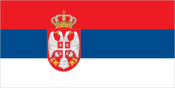
description: The flag consists of three equally sized horizontal stripes of red (top), blue, and white; the national coat of arms is positioned toward the left; the main element of the coat of arms features a two-headed white eagle set against a red shield; a smaller red shield on the eagle is partitioned into four sections by a white cross; a royal crown adorns the top of the coat of arms.
meaning: The colors red, blue, and white symbolize the pan-Slav ideals of freedom and revolution; the eagle on the red shield signifies the government; the smaller shield represents the nation; however, the significance and origin of the curved white symbols in each quarter remain ambiguous.
Capital
name
Belgrade (Beograd)
etymology
The name originates from the Serbian terms beo (meaning white) and grad (meaning city); it likely alluded to the white stone of the city fortress.
time difference
UTC+1 (6 hours ahead of Washington, DC, during Standard Time).
daylight saving time
+1 hour, commencing on the last Sunday in March and concluding on the last Sunday in October.
geographic coordinates
44 50 N, 20 30 E
Suffrage
18 years of age, 16 if employed; universal
Citizenship
citizenship by birth
no
citizenship by descent only
at least one parent must be a citizen of Serbia
dual citizenship recognized
yes
residency requirement for naturalization
3 years
Constitution
history
Numerous prior versions; the most recent was adopted on 30 September 2006, ratified by referendum on 28-29 October 2006, and came into effect on 8 November 2006.
amendment process
Proposals can be made by at least one-third of the deputies in the National Assembly, by the president of the republic, by the government, or through a petition signed by at least 150,000 voters; to pass proposals and draft amendments, a two-thirds majority vote in the Assembly is required; amendments to constitutional articles, including the preamble, principles, and human and minority rights and freedoms, also necessitate a simple majority vote in a referendum.
Country name
former
People's Republic of Serbia, Socialist Republic of Serbia.
etymology
The nation's name is derived from the Serb people; the etymology of their name is uncertain but may trace back to a Caucasian root word ser, meaning "man."
local long form
Republika Srbija
local short form
Srbija
conventional long form
Republic of Serbia
conventional short form
Serbia
Independence
5 June 2006 (independence from the State Union of Serbia and Montenegro); significant earlier dates include: 1217 (establishment of the Serbian Kingdom); 16 April 1346 (foundation of the Serbian Empire); 13 July 1878 (recognition of Serbian independence at the Congress of Berlin); 1 December 1918 (formation of the Kingdom of Serbs, Croats, and Slovenes, later known as Yugoslavia).
Legal system
Civil law system.
Government type
Parliamentary republic.
Judicial branch
highest court(s)
Supreme Court of Cassation (comprising 36 judges, including the court president); Constitutional Court (comprising 15 judges, including the court president and vice president).
subordinate courts
Basic courts, higher courts, appellate courts; special jurisdiction courts include the Administrative Court, commercial courts, and misdemeanor courts.
judge selection and term of office
Supreme Court justices are nominated by the High Judicial Council (HJC), an independent body consisting of 11 members, 8 judges elected by the National Assembly and 3 ex-officio members; justices are appointed by the National Assembly; judges of the Constitutional Court are elected - 5 by the National Assembly, 5 by the president, and 5 by the Supreme Court of Cassation; the initial term for Supreme Court judges appointed by the HJC is 3 years, with subsequent tenure being permanent; Constitutional Court judges serve 9-year terms.
Executive branch
cabinet
Cabinet elected by the National Assembly
chief of state
President Aleksandar VUCIC (since 31 May 2017)
election results
2022: Aleksandar VUCIC reelected in the first round; vote percentages - Aleksandar VUCIC (SNS) 60%, Zdravko PONOS (US) 18.9%, Milos JOVANOVIC (NADA) 6.1%, Bosko OBRADOVIC (Dveri-POKS) 4.5%, Milica DJURDJEVIC STAMENKOVSKI (SSZ) 4.3%, others 6.2%
2017: Aleksandar VUCIC elected president in the first round; vote percentages - Aleksandar VUCIC (SNS) 55.1%, Sasa JANKOVIC (independent) 16.4%, Luka MAKSIMOVIC (independent) 9.4%, Vuk JEREMIC (independent) 5.7%, Vojislav SESELJ (SRS) 4.5%, others 7.3%, invalid/blank 1.6%; Prime Minister Ana BRNABIC was reelected by the National Assembly on 5 October 2020; National Assembly vote - NA.
head of government
Prime Minister Djuro MACUT (since 16 April 2025)
most recent election date
17 December 2023
election/appointment process
The president is directly elected by an absolute-majority popular vote, potentially requiring two rounds, for a term of 5 years (eligible for one additional term); the prime minister is chosen by the National Assembly.
expected date of next election
2028
National holiday
Statehood Day is celebrated on 15 February (1835), marking the adoption of the nation’s first constitution.
National color(s)
red, blue, white
National heritage
total World Heritage Sites
4 (all cultural)
selected World Heritage Site locales
Sites of historical significance include Stari Ras and Sopoćani; Studenica Monastery; Gamzigrad-Romuliana, Palace of Galerius; and the Stećci Medieval Tombstone Graveyards.
Political parties
Alliance of Vojvodina Hungarians or SVM or VMSZ
Democratic Alliance of Croats in Vojvodina or DSHV
Democratic Party or DS
Ecological Uprising or EU
Green - Left Front or ZLF
Greens of Serbia or ZS
Justice and Reconciliation Party or SPP (formerly Bosniak Democratic Union of Sandzak or BDZS)
Movement for Reversal or PZP
Movement for the Restoration of the Kingdom of Serbia or POKS
Movement of Free Citizens or PSG
Movement of Socialists or PS
National Democratic Alternative or NADA (electoral coalition includes NDSS and POKS)
New Communist Party of Yugoslavia or NKPJ
New Democratic Party of Serbia or NDSS or New DSS (formerly Democratic Party of Serbia or DSS)
New Face of Serbia or NLS
Party of Democratic Action of the Sandzak or SDAS
Party of Freedom and Justice or SSP
Party of United Pensioners, Farmers, and Proletarians of Serbia – Solidarity and Justice or PUPS - Solidarity and Justice (formerly Party of United Pensioners of Serbia or PUPS)
People's Movement of Serbia or NPS
People's Movement of Serbs from Kosovo and Metohija or Fatherland
People's Peasant Party or NSS
Political Battle of the Albanians Continues
Russian Party or RS
Serbia Against Violence or SPN (electoral coalition includes DS, SSP, ZLF, Zajedno, NPS, PSG, EU, PZP, USS Sloga, NLS, Fatherland)
Serbia Must Not Stop (electoral coalitions includes SNS, SDPS, PUPS, PSS, SNP, SPO, PS, NSS, USS)
Serbian People's Party or SNP
Serbian Progressive Party or SNS
Serbian Renewal Movement or SPO
Social Democratic Party of Serbia or SDPS
Socialist Party of Serbia or SPS
Strength of Serbia or PSS
Together or ZAJEDNO
United Peasant Party or USS
United Serbia or JS
United Trade Unions of Serbia "Sloga" or USS Sloga
We - The Voice from the People or MI-GIN
Legislative branch
term in office
4 years
number of seats
250 (all directly elected)
electoral system
proportional representation
legislature name
National Assembly (Narodna skupstina)
scope of elections
full renewal
legislative structure
unicameral
most recent election date
12/17/2023
expected date of next election
December 2027
percentage of women in chamber
37.2%
parties elected and seats per party
Aleksandar Vucic – Serbia Must Not Stop (129); Serbia Against Violence (65); Ivica Dacic - Prime Minister of Serbia (18); Dr. Miloš Jovanović - Hope for Serbia (13); We – Voice of the People, Prof. Dr. Branimir Nestorovic (13); Others (12).
National anthem(s)
title
"Boze pravde" (God of Justice)
history
Adopted in 1904; the anthem was originally composed as part of a play in 1872, and has been utilized by the Serbian populace as an anthem throughout the 20th and 21st centuries.
lyrics/music
Jovan DORDEVIC/Davorin JENKO
National symbol(s)
white double-headed eagle
Administrative divisions
117 municipalities (opstine, singular - opstina) and 28 cities (gradovi, singular - grad)
municipalities: Ada*, Aleksandrovac, Aleksinac, Alibunar*, Apatin*, Arandelovac, Arilje, Babusnica, Bac*, Backa Palanka*, Backa Topola*, Backi Petrovac*, Bajina Basta, Batocina, Becej*, Bela Crkva*, Bela Palanka, Beocin*, Blace, Bogatic, Bojnik, Boljevac, Bosilegrad, Brus, Bujanovac, Cajetina, Cicevac, Coka*, Crna Trava, Cuprija, Despotovac, Dimitrov, Doljevac, Gadzin Han, Golubac, Gornji Milanovac, Indija*, Irig*, Ivanjica, Kanjiza*, Kladovo, Knic, Knjazevac, Koceljeva, Kosjeric, Kovacica*, Kovin*, Krupanj, Kucevo, Kula*, Kursumlija, Lajkovac, Lapovo, Lebane, Ljig, Ljubovija, Lucani, Majdanpek, Mali Idos*, Mali Zvornik, Malo Crnice, Medveda, Merosina, Mionica, Negotin, Nova Crnja*, Nova Varos, Novi Becej*, Novi Knezevac*, Odzaci*, Opovo*, Osecina, Paracin, Pecinci*, Petrovac na Mlavi, Plandiste*, Pozega, Presevo, Priboj, Prijepolje, Raca, Raska, Razanj, Rekovac, Ruma*, Secanj*, Senta*, Sid*, Sjenica, Smederevska Palanka, Sokobanja, Srbobran*, Sremski Karlovci*, Stara Pazova*, Surdulica, Svilajnac, Svrljig, Temerin*, Titel*, Topola, Trgoviste, Trstenik, Tutin, Ub, Varvarin, Velika Plana, Veliko Gradiste, Vladicin Han, Vladimirci, Vlasotince, Vrbas*, Vrnjacka Banja, Zabalj*, Zabari, Zagubica, Zitiste*, Zitorada
cities: Beograd (Belgrade), Bor, Cacak, Jagodina, Kikinda*, Kragujevac, Kraljevo, Krusevac, Leskovac, Loznica, Nis, Novi Pazar, Novi Sad*, Pancevo*, Pirot, Pozarevac, Prokuplje, Sabac, Smederevo, Sombor*, Sremska Mitrovica*, Subotica*, Uzice, Valjevo, Vranje, Vrsac*, Zajecar, Zrenjanin*
Diplomatic representation in the US
FAX
[1] (202) 332-3933
chancery
1333 16th Street, NW Washington, D.C. 20036
telephone
[1] (202) 507-8654
chief of mission
Ambassador Dragan ŠUTANOVAC (since 24 July 2025).
consulate(s) general
Chicago, New York
email address and website
[email protected]
http://www.washington.mfa.gov.rs/
Diplomatic representation from the US
FAX
[381] (11) 706-4481
embassy
92 Bulevar kneza Aleksandra Karadjordjevica, 11040 Belgrade.
telephone
[381] (11) 706-4000
mailing address
5070 Belgrade Place, Washington, DC 20521-5070
chief of mission
Ambassador (vacant); Chargé d’Affaires Alexander TITOLO (since January 2025).
email address and website
[email protected]
https://rs.usembassy.gov/
International organization participation
BIS, BSEC, CD, CE, CEI, EAPC, EBRD, EU (candidate country), FAO, G-9, IAEA, IBRD, ICAO, ICC (national committees), ICCt, ICRM, IDA, IFC, IFRCS, IHO, ILO, IMF, IMO, IMSO, Interpol, IOC, IOM, IPU, ISO, ITSO, ITU, ITUC (NGOs), MIGA, MONUSCO, NAM (observer), NSG, OAS (observer), OIF (observer), OPCW, OSCE, PCA, PFP, SELEC, UN, UNCTAD, UNESCO, UNFICYP, UNHCR, UNIDO, UNIFIL, UNMIL, UNOCI, UNTSO, UNWTO, UPU, WCO, WHO, WIPO, WMO, WTO (observer)
International law organization participation
Has not submitted a declaration of jurisdiction to the ICJ; recognizes the jurisdiction of the ICCt.
Economy
Budget
revenues
$26.077 billion (2022 est.)
expenditures
$28.12 billion (2022 est.)
Exports
Exports 2021
$34.035 billion (2021 est.)
Exports 2022
$39.905 billion (2022 est.)
Exports 2023
$44.352 billion (2023 est.)
Imports
Imports 2021
$39.476 billion (2021 est.)
Imports 2022
$47.395 billion (2022 est.)
Imports 2023
$48.158 billion (2023 est.)
Industries
automobiles, base metals, furniture, food processing, machinery, chemicals, sugar, tires, clothing, pharmaceuticals
Labor force
3.23 million (2024 est.)
Public debt
Public debt 2016
73.1% of GDP (2016 est.)
Remittances
Remittances 2021
6.9% of GDP (2021 est.)
Remittances 2022
8.5% of GDP (2022 est.)
Remittances 2023
7.1% of GDP (2023 est.)
Exchange rates
Currency
Serbian dinars (RSD) per US dollar -
Exchange rates 2020
103.163 (2020 est.)
Exchange rates 2021
99.396 (2021 est.)
Exchange rates 2022
111.662 (2022 est.)
Exchange rates 2023
108.403 (2023 est.)
Exchange rates 2024
108.208 (2024 est.)
Debt - external
Debt - external 2023
$21.726 billion (2023 est.)
Economic overview
upper middle-income economy in the Balkans; currently a candidate for EU accession; affected by COVID-19; focusing on sustainable growth; manageable public debt; implementing new anticorruption measures; decreasing unemployment; historical relations with Russia; reliant on energy imports
Unemployment rate
Unemployment rate 2022
8.5% (2022 est.)
Unemployment rate 2023
8.3% (2023 est.)
Unemployment rate 2024
7.4% (2024 est.)
Exports - partners
Germany 15%, Hungary 7%, Bosnia & Herzegovina 5%, Italy 5%, Romania 5% (2023)
Imports - partners
Germany 12%, China 10%, Italy 7%, Turkey 5%, Hungary 5% (2023)
Real GDP per capita
Real GDP per capita 2022
$24,600 (2022 est.)
Real GDP per capita 2023
$25,700 (2023 est.)
Real GDP per capita 2024
$26,900 (2024 est.)
Real GDP growth rate
Real GDP growth rate 2022
2.6% (2022 est.)
Real GDP growth rate 2023
3.8% (2023 est.)
Real GDP growth rate 2024
3.9% (2024 est.)
Agricultural products
maize, wheat, sugar beets, milk, sunflower seeds, soybeans, potatoes, barley, apples, plums (2023)
Exports - commodities
insulated wire, electricity, copper ore, plastic products, electric motors (2023)
Imports - commodities
crude petroleum, natural gas, packaged medicines, plastic products, automobiles (2023)
Current account balance
Current account balance 2021
-$2.654 billion (2021 est.)
Current account balance 2022
-$4.457 billion (2022 est.)
Current account balance 2023
-$1.947 billion (2023 est.)
Taxes and other revenues
23.9% (of GDP) (2022 est.)
GDP (official exchange rate)
$89.084 billion (2024 est.)
GDP - composition, by end use
household consumption
62.7% (2024 est.)
government consumption
17.8% (2024 est.)
investment in inventories
2% (2024 est.)
investment in fixed capital
23.6% (2024 est.)
exports of goods and services
52.7% (2024 est.)
imports of goods and services
-58.8% (2024 est.)
Population below poverty line
20% (2021 est.)
Average household expenditures
on food
24.1% of household expenditures (2023 est.)
on alcohol and tobacco
7.8% of household expenditures (2023 est.)
Inflation rate (consumer prices)
Inflation rate (consumer prices) 2022
12% (2022 est.)
Inflation rate (consumer prices) 2023
12.4% (2023 est.)
Inflation rate (consumer prices) 2024
4.7% (2024 est.)
Industrial production growth rate
2.9% (2024 est.)
Real GDP (purchasing power parity)
Real GDP (purchasing power parity) 2022
$164.166 billion (2022 est.)
Real GDP (purchasing power parity) 2023
$170.482 billion (2023 est.)
Real GDP (purchasing power parity) 2024
$177.093 billion (2024 est.)
Youth unemployment rate (ages 15-24)
male
21.8% (2024 est.)
total
22.7% (2024 est.)
female
24.1% (2024 est.)
Reserves of foreign exchange and gold
Reserves of foreign exchange and gold 2022
$20.68 billion (2022 est.)
Reserves of foreign exchange and gold 2023
$27.569 billion (2023 est.)
Reserves of foreign exchange and gold 2024
$30.484 billion (2024 est.)
GDP - composition, by sector of origin
industry
23.3% (2024 est.)
services
58.5% (2024 est.)
agriculture
3.1% (2024 est.)
Household income or consumption by percentage share
lowest 10%
2.4% (2022 est.)
highest 10%
24.7% (2022 est.)
Gini Index coefficient - distribution of family income
Gini Index coefficient - distribution of family income 2022
32.8 (2022 est.)
Energy
Coal
exports
16,000 metric tons (2023 est.)
imports
4.542 million metric tons (2023 est.)
production
33.219 million metric tons (2023 est.)
consumption
37.828 million metric tons (2023 est.)
proven reserves
7.112 billion metric tons (2023 est.)
Petroleum
total petroleum production
13,000 bbl/day (2023 est.)
crude oil estimated reserves
77.5 million barrels (2021 est.)
refined petroleum consumption
88,000 bbl/day (2023 est.)
Electricity
exports
7.351 billion kWh (2023 est.)
imports
5.395 billion kWh (2023 est.)
consumption
34.413 billion kWh (2023 est.)
installed generating capacity
8.202 million kW (2023 est.)
transmission/distribution losses
4.881 billion kWh (2023 est.)
Natural gas
imports
2.471 billion cubic meters (2023 est.)
production
336.605 million cubic meters (2023 est.)
consumption
2.886 billion cubic meters (2023 est.)
proven reserves
48.139 billion cubic meters (2021 est.)
Electricity access
electrification - total population
100% (2022 est.)
Energy consumption per capita
Total energy consumption per capita 2023
91.884 million Btu/person (2023 est.)
Electricity generation sources
wind
2.6% of total installed capacity (2023 est.)
solar
1% of total installed capacity (2023 est.)
fossil fuels
65.1% of total installed capacity (2023 est.)
hydroelectricity
30.7% of total installed capacity (2023 est.)
biomass and waste
0.6% of total installed capacity (2023 est.)
Communications
Internet users
percent of population
85% (2023 est.)
Internet country code
.rs
Telephones - fixed lines
total subscriptions
2.485 million (2023 est.)
subscriptions per 100 inhabitants
37 (2023 est.)
Telephones - mobile cellular
total subscriptions
8.53 million (2023 est.)
subscriptions per 100 inhabitants
124 (2021 est.)
Broadband - fixed subscriptions
total
2.08 million (2023 est.)
subscriptions per 100 inhabitants
31 (2023 est.)
Transportation
Airports
46 (2025)
Railways
total
3,333 km (2020) 1,274 km electrified
Heliports
11 (2025)
Civil aircraft registration country code prefix
YU
Military & Security
Military - note
The Serbian military is tasked with the defense and deterrence against external threats, participation in international peacekeeping operations, and support for civil authorities regarding internal security. Key concerns for the military encompass ethnic and religious extremism, separatist movements, and the ongoing international acknowledgment of Kosovo. Serbia has engaged in cooperation with NATO since 2006, when it became a member of the Partnership for Peace program, and conducts training exercises alongside NATO nations, especially those in the Balkan region. Additionally, Serbia has taken part in EU-led peacekeeping initiatives, as well as operations under the auspices of the Organization for Security and Cooperation in Europe and the United Nations. Historically, Serbia has maintained strong security connections with Russia and is developing an increasing security partnership with China.
The contemporary Serbian military was founded in 2006, but its heritage can be traced back through significant conflicts, including World War II, World War I, the Balkan Wars of 1912-1913, and the Bulgarian-Serb War of 1885, extending to the First (1804-1813) and Second (1815-1817) Uprisings against the Ottoman Empire (2025).
Military deployments
180 Lebanon (UNIFIL) (2025)
Military expenditures
Military Expenditures 2020
2% of GDP (2020 est.)
Military Expenditures 2021
2.2% of GDP (2021 est.)
Military Expenditures 2022
2.2% of GDP (2022 est.)
Military Expenditures 2023
2.4% of GDP (2023 est.)
Military Expenditures 2024
2.5% of GDP (2024 est.)
Military and security forces
Serbian Armed Forces (Vojska Srbije, VS): Army (also known as Land Forces; encompasses a Riverine Component, which comprises a naval flotilla operating on the Danube), Air and Air Defense Forces, Serbian Guard.
Serbian Ministry of Internal Affairs: Police Directorate (2025).
Military service age and obligation
The minimum age for voluntary military service is 18 years for both men and women; conscription was eliminated in 2011 (2025).
Military equipment inventories and acquisitions
The military's arsenal includes a combination of Soviet and Cold War-era equipment, along with some more contemporary weaponry sourced from nations such as China, France, and Russia. Serbia has developed a defense industry that specializes in armored vehicles, artillery systems, and munitions (2025).
Military and security service personnel strengths
Approximately 25,000 personnel are active in the Armed Forces (15,000 in Land Forces; 5,000 in Air/Air Defense; 5,000 in other units, including the Serbian Guard) (2025).
Transnational Issues
Refugees and internally displaced persons
IDPs
194,171 (2024 est.)
refugees
36,270 (2024 est.)
stateless persons
1,715 (2024 est.)