CapitalPhilipsburg
LanguagesThe primary languages spoken include English at, Spanish at, Creole at, Dutch at, Papiamento at, French at, and other languages at
CurrencyNetherlands Antillean guilders
Governmentoperates as a parliamentary democracy within a constitutional monarchy
Bamwor Indexes
Sint Maarten — Q1 2026
IBEUBamwor Urban Scale Index
18.12%
Rank #102 of 237
View full ranking →
IBCPBamwor Population Concentration Index
68.61%
Rank #35 of 237
View full ranking →
IBDABamwor Settlement Density Index
1823.53per 1K km²
Rank #8 of 241
View full ranking →
IBCXBamwor Country Complexity Index
21.94/100
Rank #225 of 234
View full ranking →
IBEEBamwor Economic Stability Index
93.79/100
Rank #18 of 220
View full ranking →
IBSABamwor Healthcare Index
78.81/100
Rank #36 of 218
View full ranking →
Sint Maarten Intelligence Report
Download PDF with 20+ statistics, rankings & proprietary indices
Introduction
Background
Christopher COLUMBUS claimed Saint Martin for Spain in 1493, naming it after the feast day of St. Martin of Tours, but it was the Dutch who occupied the island in 1631 to exploit its salt deposits. The Spanish retook Saint Martin in 1633, but the Dutch continued to assert their claims. The Spanish finally relinquished the island to the French and Dutch, who divided it between themselves in 1648. The border frequently fluctuated over the next 200 years because of friction between the two countries, with the Dutch eventually holding the smaller portion of the island (about 39%) and adopting the Dutch spelling of the island's name for their territory.
The establishment of cotton, tobacco, and sugar plantations dramatically expanded African slavery on the island in the 18th and 19th centuries; the practice was not abolished in the Dutch half until 1863. The island's economy declined until 1939 when it became a free port; the tourism industry was dramatically expanded beginning in the 1950s. In 1954, Sint Maarten and several other Dutch Caribbean possessions became part of the Kingdom of the Netherlands as the Netherlands Antilles. In a 2000 referendum, the citizens of Sint Maarten voted to become a self-governing country within the Kingdom of the Netherlands, effective in 2010. In 2017, Hurricane Irma hit Saint Martin/Sint Maarten, causing extensive damage to roads, communications, electrical power, and housing; the UN estimated that 90% of the buildings were damaged or destroyed.
Geography
Area
land
34 sq km
water
0 sq km
total
34 sq km
Climate
The tropical marine climate, influenced by northeast trade winds, leads to moderate temperatures; the average annual precipitation is 150 cm; the hurricane season occurs from July through November.
Terrain
Featuring low, hilly geography of volcanic origin.
Land use
other
89.1% (2022 est.)
forest
10.9% (2022 est.)
agricultural land
0% (2022 est.)
Location
Situated in the Caribbean, part of the northern group of the Leeward Islands; the Dutch territory of Sint Maarten is located in the Caribbean Sea, positioned to the east of the US Virgin Islands.
Coastline
58.9 km (for entire island)
Elevation
lowest point
Caribbean Sea 0 m
highest point
250 m SW of Mount Flagstaff summit, 383 m
Map references
Central America and the Caribbean
Land boundaries
total
16 km
border countries
Saint Martin (France) 16 km
Maritime claims
territorial sea
12 nm
exclusive economic zone
200 nm
Natural hazards
Vulnerable to hurricanes during the period from July to November.
Geography - note
note 1: The northern boundary is shared with the French overseas collectivity of Saint Martin; collectively, these two regions constitute the smallest land area in the world that is jointly governed by two independent states.
note 2: Simpson Bay Lagoon (also known as Simson Bay Lagoon or The Great Pond) ranks among the largest inland lagoons in the West Indies; the division between the French and Dutch sectors of the island of Saint Martin traverses the center of the lagoon, which is jointly utilized.
Natural resources
salt, fish
Area - comparative
occupies one-fifth the area of Washington, D.C.
Geographic coordinates
18 4 N, 63 4 W
Population distribution
The most densely populated regions include Lower Prince's Quarter (located north of Philipsburg) and Cul de Sac.
People & Society
Languages
The primary languages spoken include English (official) at 67.5%, Spanish at 12.9%, Creole at 8.2%, Dutch (official) at 4.2%, Papiamento (a dialect combining Spanish, Portuguese, Dutch, and English) at 2.2%, French at 1.5%, and other languages at 3.5% (estimate from 2001)
Religions
Protestant 41.9% (Pentecostal 14.7%, Methodist 10.0%, Seventh Day Adventist 6.6%, Baptist 4.7%, Anglican 3.1%, other Protestant 2.8%), Roman Catholic 33.1%, Hindu 5.2%, Christian 4.1%, Jehovah's Witness 1.7%, Evangelical 1.4%, Muslim/Jewish 1.1%, other 1.3% (includes Buddhist, Sikh, Rastafarian), none 7.9%, no response 2.4% (2011 est.)
Sex ratio
at birth
1.05 male(s)/female
0-14 years
1.07 male(s)/female
15-64 years
0.98 male(s)/female
total population
0.98 male(s)/female (2024 est.)
65 years and over
0.86 male(s)/female
Birth rate
12 births/1,000 population (2025 est.)
Death rate
6.59 deaths/1,000 population (2025 est.)
Median age
male
39 years
total
40.8 years (2025 est.)
female
42.8 years
Population
male
23,071
total
46,738 (2025 est.)
female
23,667
Urbanization
urban population
100% of total population (2023)
rate of urbanization
1.16% annual rate of change (2020-25 est. est.)
Age structure
0-14 years
18.4% (male 4,409/female 4,114)
15-64 years
66.3% (male 15,158/female 15,496)
65 years and over
15.2% (2024 est.) (male 3,250/female 3,788)
Ethnic groups
Saint Maarten 29.9%, Dominican Republic 10.2%, Haiti 7.8%, Jamaica 6.6%, Saint Martin 5.9%, Guyana 5%, Dominica 4.4%, Curacao 4.1%, Aruba 3.4%, Saint Kitts and Nevis 2.8%, India 2.6%, Netherlands 2.2%, US 1.6%, Suriname 1.4%, Saint Lucia 1.3%, Anguilla 1.1%, other 8%, unspecified 1.7% (2011 est.)
Dependency ratios
total dependency ratio
52.8 (2025 est.)
youth dependency ratio
28.1 (2025 est.)
potential support ratio
4.1 (2025 est.)
elderly dependency ratio
24.7 (2025 est.)
Net migration rate
5.63 migrant(s)/1,000 population (2025 est.)
Total fertility rate
1.96 children born/woman (2025 est.)
Infant mortality rate
male
8.4 deaths/1,000 live births
total
7.5 deaths/1,000 live births (2025 est.)
female
6.8 deaths/1,000 live births
Population growth rate
1.1% (2025 est.)
Gross reproduction rate
0.96 (2025 est.)
Population distribution
The areas with the highest population density are Lower Prince's Quarter (located to the north of Philipsburg) and Cul de Sac
Life expectancy at birth
male
77.4 years
female
82.2 years
total population
79.7 years (2024 est.)
Major urban areas - population
1,327 PHILIPSBURG (capital) (2011)
Environment
Climate
The tropical marine climate, influenced by northeast trade winds, leads to moderate temperature conditions; the average annual precipitation is 150 cm; the hurricane season occurs from July through November.
Land use
other
89.1% (2022 est.)
forest
10.9% (2022 est.)
agricultural land
0% (2022 est.)
Urbanization
urban population
100% of total population (2023)
rate of urbanization
1.16% annual rate of change (2020-25 est. est.)
Environmental issues
There is a shortage of drinkable water; insufficient management of solid waste; pollution stemming from construction activities, chemical runoff, and sewage.
Government
Flag
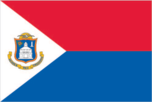
description: features two equal horizontal stripes, red (top) and blue, accompanied by a white isosceles triangle positioned on the left; at the center of the triangle is the national coat of arms, which includes an orange-bordered blue shield depicting the white courthouse in Philipsburg, alongside the yellow sage (the national flower) in the upper left and the outline of a Dutch-French friendship monument in the upper right; above the shield are a yellow rising sun and a brown pelican in flight; beneath the shield, a yellow scroll displays the motto SEMPER PROGREDIENS (Always Progressing)
Capital
name
Philipsburg
etymology
established and named in 1763 by John PHILIPS, a Scottish captain serving in the Dutch navy
time difference
UTC-4 (one hour ahead of Washington, DC, during Standard Time)
geographic coordinates
18 1 N, 63 2 W
Suffrage
18 years of age; universal
Citizenship
see the Netherlands
Constitution
history
previous constitutions were in 1947 and 1955; the most recent one was adopted on 21 July 2010 and came into effect on 10 October 2010 (this framework governs Sint Maarten while remaining subordinate to the Charter for the Kingdom of the Netherlands)
amendment process
proposals can be initiated either by the Government or by Parliament; for a proposal to pass, it requires a minimum of a two-thirds majority from the Parliament members; amendments that pertain to fundamental rights, as well as the powers of the governor and Parliament, must incorporate the "views" of the Government of the Kingdom of the Netherlands before they can be ratified by Parliament
Country name
former
Netherlands Antilles; Curacao and Dependencies
etymology
the island was named by explorer Christopher COLUMBUS in 1493 in honor of Saint MARTIN of Tours, as he arrived on 11 November, coinciding with the saint's feast day
local long form
Land Sint Maarten (Dutch)/ Country of Sint Maarten (English)
local short form
Sint Maarten (Dutch and English)
conventional long form
Country of Sint Maarten
conventional short form
Sint Maarten
Independence
none (part of the Kingdom of the Netherlands)
Legal system
the legal system is based on Dutch civil law, with some influences from English common law
Government type
operates as a parliamentary democracy within a constitutional monarchy
Judicial branch
highest court(s)
the Joint Court of Justice for Aruba, Curacao, Sint Maarten, and Bonaire, Sint Eustatius, and Saba, commonly referred to as the "Joint Court of Justice" (composed of a presiding judge, additional members, and their substitutes); ultimate appeals are adjudicated by the Supreme Court located in The Hague, Netherlands
subordinate courts
Courts in First Instance
judge selection and term of office
Joint Court judges appointed by the monarch serve for life
Executive branch
cabinet
Cabinet nominated by the prime minister and appointed by the governor
chief of state
King WILLEM-ALEXANDER of the Netherlands has reigned since 30 April 2013; he is represented by Governor Ajamu G. BALY, who took office on 10 October 2022
head of government
Prime Minister Luc MERCELINA (since 3 May 2024)
election/appointment process
the position of monarch is hereditary; the governor is appointed by the monarch for a term of six years; following legislative elections, the Parliament typically selects the leader of the majority party to serve as prime minister
National holiday
King's Day, commemorating the birthday of King WILLEM-ALEXANDER, is celebrated on 27 April (since 1967)
Dependency status
one of the four constituent countries of the Kingdom of the Netherlands; granted full autonomy over internal matters in 2010, while the Dutch government retains responsibility for defense and foreign relations
National color(s)
red, white, blue
Political parties
Democratic Party or DP
National Alliance or NA
National Opportunity Wealth or NOW
Party for Progress or PFP
Sint Maarten Christian Party or SMCP
Unified Resilient St Maarten Movement or URSM
United People's Party or UPP
United Sint Maarten Party or US Party
Legislative branch
term in office
4 years
number of seats
15 (directly elected)
electoral system
proportional representation
legislature name
Parliament of Sint Maarten
scope of elections
full renewal
legislative structure
unicameral
most recent election date
1/11/2024
expected date of next election
2028
percentage of women in chamber
46.7%
parties elected and seats per party
NA (4); UPP (3); URSM (2); DP (2); PFP (2); NOW (2)
National anthem(s)
title
“Het Wilhelmus” (The William)
history
adopted 1932
lyrics/music
Philips VAN MARNIX van Sint Aldegonde (presumed)/unknown
National symbol(s)
brown pelican, yellow sage (flower)
Diplomatic representation in the US
none (represented by the Kingdom of the Netherlands)
Diplomatic representation from the US
embassy
the United States does not maintain an embassy in Sint Maarten; instead, the Consul General based in Curacao is accredited to Sint Maarten
International organization participation
Caricom (observer), ILO, Interpol, UNESCO (associate), UPU, WMO
Economy
Exports
Exports 2021
$790.938 million (2021 est.)
Exports 2022
$1.375 billion (2022 est.)
Exports 2023
$1.504 billion (2023 est.)
Imports
Imports 2021
$1.003 billion (2021 est.)
Imports 2022
$1.32 billion (2022 est.)
Imports 2023
$1.489 billion (2023 est.)
Industries
light industry, tourism
Remittances
Remittances 2021
3.4% of GDP (2021 est.)
Remittances 2022
3.2% of GDP (2022 est.)
Remittances 2023
3% of GDP (2023 est.)
Exchange rates
Currency
Netherlands Antillean guilders (ANG) per US dollar -
Exchange rates 2020
1.79 (2020 est.)
Exchange rates 2021
1.79 (2021 est.)
Exchange rates 2022
1.79 (2022 est.)
Exchange rates 2023
1.79 (2023 est.)
Exchange rates 2024
1.79 (2024 est.)
Economic overview
Dutch autonomous constituent economy with a high-income, tourism-centric profile; significant economic downturns due to hurricanes and COVID-19; a multilateral trust fund is aiding in mitigating economic challenges; absence of property taxes; acts as a re-export hub for Saint Martin
Exports - partners
Antigua & Barbuda 28%, USA 16%, France 12%, Netherlands 8%, Morocco 7% (2023)
Imports - partners
USA 82%, Netherlands 7%, France 4%, Brazil 1%, Switzerland 1% (2023)
Real GDP per capita
Real GDP per capita 2022
$43,900 (2022 est.)
Real GDP per capita 2023
$44,900 (2023 est.)
Real GDP per capita 2024
$45,800 (2024 est.)
Real GDP growth rate
Real GDP growth rate 2022
9.8% (2022 est.)
Real GDP growth rate 2023
3.8% (2023 est.)
Real GDP growth rate 2024
3.5% (2024 est.)
Agricultural products
sugar
Exports - commodities
jewelry, refined petroleum, ships, pearl products, diamonds (2023)
Imports - commodities
scrap iron, ships, jewelry, flavored water, liquor (2023)
Current account balance
Current account balance 2021
-$311.463 million (2021 est.)
Current account balance 2022
-$56.984 million (2022 est.)
Current account balance 2023
-$116.693 million (2023 est.)
GDP (official exchange rate)
$1.735 billion (2024 est.)
Inflation rate (consumer prices)
Inflation rate (consumer prices) 2015
0.3% (2015 est.)
Inflation rate (consumer prices) 2016
0.1% (2016 est.)
Inflation rate (consumer prices) 2017
2.2% (2017 est.)
Industrial production growth rate
0.5% (2021 est.)
Real GDP (purchasing power parity)
Real GDP (purchasing power parity) 2022
$1.849 billion (2022 est.)
Real GDP (purchasing power parity) 2023
$1.919 billion (2023 est.)
Real GDP (purchasing power parity) 2024
$1.986 billion (2024 est.)
GDP - composition, by sector of origin
industry
6% (2021 est.)
services
89.3% (2021 est.)
Energy
Electricity access
electrification - total population
100% (2022 est.)
Communications
Internet users
percent of population
89.5% (2022)
Internet country code
.sx
Telephones - mobile cellular
total subscriptions
86,542 (2022 est.)
subscriptions per 100 inhabitants
205 (2022 est.)
Transportation
Ports
large
0
small
2
medium
0
key ports
Coles Bay Oil Terminal, Philipsburg
very small
0
total ports
2 (2024)
ports with oil terminals
1
Airports
1 (2025)
Military & Security
Military - note
The responsibility for defense lies with the Kingdom of the Netherlands. The Royal Netherlands Marechaussee (Gendarmerie), the Dutch Caribbean Police Force (Korps Politie Caribisch Nederland, KPCN), and the Dutch Caribbean Coast Guard (DCCG or Kustwacht Caribisch Gebied (KWCARIB)) provide support to the KPSM.
Military and security forces
There are no standing military forces; the Police Force of Sint Maarten (KPSM) is in place.
Transnational Issues
Trafficking in persons
tier rating
Tier 3 — Sint Maarten fails to fully satisfy the basic criteria for eradicating trafficking and is not undertaking substantial efforts in this regard, consequently, Sint Maarten continues to be classified as Tier 3; for further information, visit: https://www.state.gov/reports/2025-trafficking-in-persons-report/sint-maarten/