CapitalKhartoum
LanguagesArabic , English , Nubian, Ta Bedawie, Fur
CurrencySudanese pounds
Governmentpresidential republic
Bamwor Indexes
Sudan — Q1 2026
IBEUBamwor Urban Scale Index
3.91%
Rank #223 of 237
View full ranking →
IBCPBamwor Population Concentration Index
11.67%
Rank #211 of 237
View full ranking →
IBDABamwor Settlement Density Index
4.37per 1K km²
Rank #224 of 241
View full ranking →
IBCXBamwor Country Complexity Index
71.59/100
Rank #38 of 234
View full ranking →
IBEEBamwor Economic Stability Index
70.07/100
Rank #214 of 220
View full ranking →
IBDIBamwor Digital Infrastructure Index
39.15/100
Rank #187 of 206
View full ranking →
IBSABamwor Healthcare Index
54.01/100
Rank #191 of 218
View full ranking →
Sudan Intelligence Report
Download PDF with 20+ statistics, rankings & proprietary indices
Introduction
Background
Historically known as Nubia, what is now Sudan was home to the Kingdom of Kerma (circa 2500-1500 B.C.) until it became part of the New Kingdom of Egypt. By the 11th century B.C., the Kingdom of Kush achieved autonomy from Egypt and persisted in various forms until the mid-4th century A.D. Following the decline of Kush, the Nubians established three Christian kingdoms: Nobatia, Makuria, and Alodia, with the latter two surviving until approximately 1500. During the 14th and 15th centuries, Arab nomadic groups settled in much of Sudan, which resulted in widespread Islamization from the 16th to the 19th centuries. After early 19th-century Egyptian occupation, a 1899 agreement created a joint British-Egyptian administration in Sudan, which essentially functioned as a British colony.
Since gaining independence from Anglo-Egyptian rule in 1956, Sudan has predominantly been governed by military regimes that support Islamic-oriented administrations. Throughout much of the latter half of the 20th century, the nation experienced two extended civil wars, primarily driven by northern control over the predominantly non-Muslim, non-Arab southern region. The first civil conflict concluded in 1972, but a subsequent war erupted in 1983. Peace negotiations gained traction between 2002 and 2004, culminating in the 2005 North/South Comprehensive Peace Agreement, which granted the southern insurgents autonomy for six years, leading to a referendum on independence for Southern Sudan. South Sudan declared its independence in 2011; however, both Sudan and South Sudan have yet to fully actualize security and economic agreements to normalize their relations. Additionally, Sudan has encountered conflicts in Darfur, Southern Kordofan, and Blue Nile, which began in 2003.
In 2019, following extensive nationwide protests, President Omar Hassan Ahmad al-BASHIR’s 30-year rule came to an end when the military deposed him. Economist and former international civil servant Abdalla HAMDOUK al-Kinani was appointed as the prime minister of a transitional government, with plans for elections in 2022. However, in late 2021, the Sudanese military removed HAMDOUK and his administration and substituted civilian members of the Sovereign Council (Sudan’s collective Head of State) with those chosen by the military. Although HAMDOUK was briefly reinstated, he resigned in January 2022. General Abd-al-Fatah al-BURHAN Abd-al-Rahman, who serves as the Chair of Sudan’s Sovereign Council and Commander-in-Chief of the Sudanese Armed Forces, currently acts as the de facto head of state and government. He oversees a Sovereign Council that includes military leaders, representatives from former armed opposition groups, and civilians appointed by the military. Day-to-day governance is managed by a cabinet of acting ministers.
Geography
Area
land
1,731,671 sq km
water
129,813 sq km
total
1,861,484 sq km
Climate
characterized by hot and arid conditions; predominantly desert; the rainy season varies by area, occurring from April to November
Terrain
generally consists of a level, featureless expanse; desert terrain is prevalent in the northern region
Land use
other
27.7% (2023 est.)
forest
12% (2023 est.)
agricultural land
60.3% (2023 est.)
agricultural land: arable land
arable land: 11.2% (2023 est.)
agricultural land: permanent crops
permanent crops: 0.1% (2023 est.)
agricultural land: permanent pasture
permanent pasture: 49% (2023 est.)
Location
located in northeastern Africa, adjacent to the Red Sea, situated between Egypt and Eritrea
Coastline
853 km
Elevation
lowest point
Red Sea 0 m
highest point
Jabal Marrah 3,042 m
mean elevation
568 m
Irrigated land
15,504 sq km (2019)
Major aquifers
Nubian Aquifer System, Sudd Basin (Umm Ruwaba Aquifer)
Map references
Africa
Land boundaries
total
6,819 km
border countries
Central African Republic 174 km; Chad 1,403 km; Egypt 1,276 km; Eritrea 682 km; Ethiopia 744 km; Libya 382 km; South Sudan 2,158 km
Maritime claims
contiguous zone
18 nm
territorial sea
12 nm
continental shelf
200-m depth or to the depth of exploitation
Natural hazards
frequent dust storms and recurring severe droughts
Geography - note
The Nile serves as the main water source for Sudan; its principal tributaries, the White Nile and the Blue Nile, converge at Khartoum to create the River Nile, which continues northward into Egypt and reaches the Mediterranean Sea
Natural resources
oil; limited deposits of iron ore, copper, chromium ore, zinc, tungsten, mica, silver, and gold; hydropower resources
Area - comparative
slightly under one-fifth the area of the United States
Geographic coordinates
15 00 N, 30 00 E
Population distribution
apart from a narrow strip of habitation along the banks of the Nile, northern Sudan has a low population density; significant population centers are located around Khartoum, in the southeast between the Blue and White Nile Rivers, and across South Darfur, as illustrated in this population distribution map
Major watersheds (area sq km)
Atlantic Ocean drainage
(Mediterranean Sea) Nile (3,254,853 sq km)
Internal (endorheic basin) drainage
Lake Chad (2,497,738 sq km)
Major rivers (by length in km)
An Nīl (Nile) (shared with Rwanda [s], Tanzania, Uganda, South Sudan, and Egypt [m]) - 6,650 km; Blue Nile river mouth (shared with Ethiopia [s]) - 1,600 km
note: [s] indicates river source following the country name; [m] indicates river mouth following the country name
People & Society
Languages
Languages
Arabic (official), English (official), Nubian, Ta Bedawie, Fur
major-language sample(s)
كتاب حقائق العالم، المصدر الذي لا يمكن الاستغناء عنه للمعلومات الأساسية (Arabic)
The World Factbook, the indispensable source for basic information. (English)
Religions
Sunni Muslim, small Christian minority
Sex ratio
at birth
1.05 male(s)/female
0-14 years
1.03 male(s)/female
15-64 years
0.99 male(s)/female
total population
1.01 male(s)/female (2024 est.)
65 years and over
1.07 male(s)/female
Birth rate
32.95 births/1,000 population (2025 est.)
Death rate
6 deaths/1,000 population (2025 est.)
Median age
male
19 years
total
19.5 years (2025 est.)
female
19.6 years
Population
male
25,335,092
total
50,467,278 (2024 est.)
female
25,132,186
Nationality
noun
Sudanese (singular and plural)
adjective
Sudanese
Urbanization
urban population
36.3% of total population (2023)
rate of urbanization
3.43% annual rate of change (2020-25 est.)
Age structure
0-14 years
40.1% (male 10,278,453/female 9,949,343)
15-64 years
56.7% (male 14,211,514/female 14,390,486)
65 years and over
3.2% (2024 est.) (male 845,125/female 792,357)
Ethnic groups
Sudanese Arab (approximately 70%), Fur, Beja, Nuba, Ingessana, Uduk, Fallata, Masalit, Dajo, Gimir, Tunjur, Berti; there are over 500 ethnic groups
Dependency ratios
total dependency ratio
76.4 (2024 est.)
youth dependency ratio
70.7 (2024 est.)
potential support ratio
17.5 (2024 est.)
elderly dependency ratio
5.7 (2024 est.)
Physician density
0.25 physicians/1,000 population (2017)
Health expenditure
Health expenditure (as % of GDP)
2.8% of GDP (2021)
Health expenditure (as % of national budget)
6.7% of national budget (2022 est.)
Net migration rate
-1.55 migrant(s)/1,000 population (2025 est.)
Hospital bed density
0.7 beds/1,000 population (2020 est.)
Total fertility rate
4.41 children born/woman (2025 est.)
Drinking water source
improved: rural
rural: 59.7% of population (2022 est.)
improved: total
total: 64.9% of population (2022 est.)
improved: urban
urban: 74.2% of population (2022 est.)
unimproved: rural
rural: 40.3% of population (2022 est.)
unimproved: total
total: 35.1% of population (2022 est.)
unimproved: urban
urban: 25.8% of population (2022 est.)
Infant mortality rate
male
46 deaths/1,000 live births
total
39.7 deaths/1,000 live births (2025 est.)
female
34.8 deaths/1,000 live births
Population growth rate
2.54% (2025 est.)
Gross reproduction rate
2.15 (2025 est.)
Population distribution
Northern Sudan is largely sparsely inhabited, apart from a strip of habitation along the banks of the Nile; significant population centers exist around Khartoum, in the southeastern region between the Blue and White Nile Rivers, and across South Darfur, as illustrated in this population distribution map.
Life expectancy at birth
male
65.5 years
female
70.2 years
total population
67.8 years (2024 est.)
Maternal mortality ratio
256 deaths/100,000 live births (2023 est.)
Alcohol consumption per capita
beer
0 liters of pure alcohol (2019 est.)
wine
0 liters of pure alcohol (2019 est.)
total
1.93 liters of pure alcohol (2019 est.)
spirits
0.29 liters of pure alcohol (2019 est.)
other alcohols
1.63 liters of pure alcohol (2019 est.)
Major urban areas - population
6.344 million KHARTOUM (capital), 1.057 million Nyala (2023)
Obesity - adult prevalence rate
6.6% (2014)
Children under the age of 5 years underweight
33% (2014)
School life expectancy (primary to tertiary education)
male
7 years (2015 est.)
total
7 years (2015 est.)
female
7 years (2015 est.)
Environment
Climate
characterized by high temperatures and low precipitation; arid landscapes; the timing of the rainy season differs by area (April to November)
Land use
other
27.7% (2023 est.)
forest
12% (2023 est.)
agricultural land
60.3% (2023 est.)
agricultural land: arable land
arable land: 11.2% (2023 est.)
agricultural land: permanent crops
permanent crops: 0.1% (2023 est.)
agricultural land: permanent pasture
permanent pasture: 49% (2023 est.)
Urbanization
urban population
36.3% of total population (2023)
rate of urbanization
3.43% annual rate of change (2020-25 est.)
Methane emissions
other
38.8 kt (2019-2021 est.)
waste
198.7 kt (2019-2021 est.)
energy
218.5 kt (2022-2024 est.)
agriculture
1,509.6 kt (2019-2021 est.)
Waste and recycling
municipal solid waste generated annually
2.831 million tons (2024 est.)
percent of municipal solid waste recycled
8.9% (2022 est.)
Environmental issues
contamination of water sources; insufficient access to drinking water; shortages of water and drought conditions; overexploitation of wildlife; erosion of soil; desert expansion; loss of forest cover; decline in biodiversity
Total water withdrawal
municipal
950 million cubic meters (2022 est.)
industrial
75 million cubic meters (2022 est.)
agricultural
25.91 billion cubic meters (2022 est.)
Carbon dioxide emissions
total emissions
18.242 million metric tonnes of CO2 (2023 est.)
from coal and metallurgical coke
300 metric tonnes of CO2 (2023 est.)
from petroleum and other liquids
18.242 million metric tonnes of CO2 (2023 est.)
Particulate matter emissions
24.4 micrograms per cubic meter (2019 est.)
Total renewable water resources
37.8 billion cubic meters (2022 est.)
International environmental agreements
party to
Biodiversity, Climate Change, Climate Change-Kyoto Protocol, Climate Change-Paris Agreement, Comprehensive Nuclear Test Ban, Desertification, Endangered Species, Hazardous Wastes, Law of the Sea, Nuclear Test Ban, Ozone Layer Protection, Wetlands
signed, but not ratified
none of the selected agreements
Government
Flag
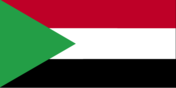
description: three equal horizontal stripes of red (top), white, and black, accompanied by a green isosceles triangle positioned on the left side
meaning: red symbolizes the fight for freedom; white represents peace, light, and love; black signifies the people; green stands for Islam, agriculture, and prosperity
history: the colors and layout are influenced by the Arab Revolt flag from World War I
Capital
name
Khartoum
etymology
the name is derived from the Arabic terms ras (head or end) and al-khurtum (elephant's trunk), which refer to the slender land strip located between the Blue and White Niles where the city is found
time difference
UTC+3 (8 hours ahead of Washington, DC, during Standard Time)
geographic coordinates
15 36 N, 32 32 E
Suffrage
17 years of age; universal
Citizenship
citizenship by birth
no
citizenship by descent only
the father must be a citizen of Sudan
dual citizenship recognized
no
residency requirement for naturalization
10 years
Constitution
history
previous constitutions were established in 1973, 1998, and 2005 (the interim constitution was suspended in April 2019); the most recent initial draft was completed by the Transitional Military Council in May 2019; the revised draft, referred to as the "Draft Constitutional Charter for the 2019 Transitional Period," or the “2019 Constitutional Declaration,” was signed by the Council and the opposition coalition on 4 August 2019
Country name
former
Anglo-Egyptian Sudan, Democratic Republic of the Sudan
etymology
the name comes from the Arabic balad-as-sudan, which translates to "Land of the Black [peoples]"
local long form
Jumhuriyat as-Sudan
local short form
As-Sudan
conventional long form
Republic of the Sudan
conventional short form
Sudan
Independence
1 January 1956 (from Egypt and the UK)
Legal system
a mixed legal system combining Islamic law and English common law
Government type
presidential republic
Judicial branch
highest court(s)
National Supreme Court (composed of 70 judges organized into panels of 3 judges and includes 4 circuits that function outside the capital); a Constitutional Court was mandated by the 2019 Constitutional Declaration, but it has yet to be established
subordinate courts
Court of Appeal; other national courts; public courts; district, town, and rural courts
judge selection and term of office
National Supreme Court and Constitutional Court judges selected by the Supreme Judicial Council
Executive branch
cabinet
the military compelled most members of the Council of Ministers to resign in 2021; a small number of ministers appointed by former armed opposition groups were permitted to keep their positions; currently, most members of the Council are senior civil servants acting in ministerial roles
chief of state
Sovereign Council Chair and Commander-in-Chief of the Sudanese Armed Forces General Abd-al-Fattah al-BURHAN Abd-al-Rahman (since 11 November 2021)
election results
NA
head of government
Sovereign Council Chair and Commander-in-Chief of the Sudanese Armed Forces General Abd-al-Fattah al-BURHAN Abd-al-Rahman (since 11 November 2021)
election/appointment process
military representatives on the Sovereign Council are appointed by the leadership of the security forces; representatives from former armed groups to the Sovereign Council are chosen by the signatories of the Juba Peace Agreement
expected date of next election
intended to occur in 2022 or 2023, but the election process has not yet been established
National holiday
Independence Day, 1 January (1956)
National color(s)
red, white, black, green
National heritage
total World Heritage Sites
3 (2 cultural, 1 natural)
selected World Heritage Site locales
Gebel Barkal and the Sites of the Napatan Region (c); Archaeological Sites of the Island of Meroe (c); Sanganeb Marine National Park and Dungonab Bay – Mukkawar Island Marine National Park (n)
Political parties
Democratic Unionist Party
Democratic Unionist Party or DUP
Federal Umma Party
Muslim Brotherhood or MB
National Congress Party or NCP
National Umma Party or NUP
Popular Congress Party or PCP
Reform Movement Now
Sudan National Front
Sudanese Communist Party or SCP
Sudanese Congress Party or SCoP
Umma Party for Reform and Development
Unionist Movement Party or UMP
Legislative branch
National anthem(s)
title
"Nahnu Djundulla Djundulwatan" (We Are the Army of God and of Our Land)
history
adopted in 1956; initially served as the anthem for the Sudanese military
lyrics/music
Sayed Ahmad Muhammad SALIH/Ahmad MURJAN
National symbol(s)
secretary bird
Administrative divisions
18 states (wilayat, singular - wilayah); Blue Nile, Central Darfur, East Darfur, Gedaref, Gezira, Kassala, Khartoum, North Darfur, North Kordofan, Northern, Red Sea, River Nile, Sennar, South Darfur, South Kordofan, West Darfur, West Kordofan, White Nile
Diplomatic representation in the US
FAX
[1] (202) 667-2406
chancery
2210 Massachusetts Avenue NW, Washington, DC 20008
telephone
[1] (202) 338-8565
chief of mission
Ambassador Mohamed Abdalla IDRIS (since 16 September 2022)
email address and website
[email protected]
https://www.sudanembassy.org/
Diplomatic representation from the US
embassy
P.O. Box 699, Kilo 10, Soba, Khartoum
telephone
[249] 187-0-22000
mailing address
2200 Khartoum Place, Washington DC 20521-2200
chief of mission
Ambassador (vacant); Chargé d'Affaires Colleen Crenwelge (since May 2024)
email address and website
[email protected]
https://sd.usembassy.gov/
International organization participation
ABEDA, ACP, AfDB, AFESD, AMF, AU (suspended), CAEU, COMESA, FAO, G-77, IAEA, IBRD, ICAO, ICC (NGOs), ICRM, IDA, IDB, IFAD, IFC, IFRCS, IGAD, ILO, IMF, IMO, Interpol, IOC, IOM, IPU, ISO, ITSO, ITU, LAS, MIGA, NAM, OIC, OPCW, PCA, UN, UNCTAD, UNESCO, UNHCR, UNHRC, UNIDO, UNOOSA, UNWTO, UPU, WCO, WFTU (NGOs), WHO, WIPO, WMO, WTO (observer)
International law organization participation
accepts compulsory ICJ jurisdiction with reservations; withdrew acceptance of ICCt jurisdiction in 2008
Economy
Budget
revenues
$9.045 billion (2015 est.)
expenditures
$9.103 billion (2015 est.)
Exports
Exports 2020
$5.065 billion (2020 est.)
Exports 2021
$6.664 billion (2021 est.)
Exports 2022
$5.908 billion (2022 est.)
Imports
Imports 2020
$10.52 billion (2020 est.)
Imports 2021
$10.271 billion (2021 est.)
Imports 2022
$11.575 billion (2022 est.)
Industries
oil, cotton ginning, textiles, cement, edible oils, sugar, soap distillation, footwear, petroleum refining, pharmaceuticals, weapons, automobile/light truck assembly, milling
Labor force
10.949 million (2022 est.)
Public debt
Public debt 2016
99.5% of GDP (2016 est.)
Remittances
Remittances 2021
3.3% of GDP (2021 est.)
Remittances 2022
2.9% of GDP (2022 est.)
Remittances 2023
2.5% of GDP (2023 est.)
Exchange rates
Currency
Sudanese pounds (SDG) per US dollar -
Exchange rates 2018
24.329 (2018 est.)
Exchange rates 2019
45.767 (2019 est.)
Exchange rates 2020
53.996 (2020 est.)
Exchange rates 2021
370.791 (2021 est.)
Exchange rates 2022
546.759 (2022 est.)
Debt - external
Debt - external 2023
$21.65 billion (2023 est.)
Economic overview
economy in the low-income Sahel region severely affected by ongoing civil conflict; significant repercussions on rural income, basic commodity prices, industrial output, agricultural supply chains, as well as communications and trade; hyperinflation and currency devaluation exacerbating food security and humanitarian conditions
Unemployment rate
Unemployment rate 2021
11.1% (2021 est.)
Unemployment rate 2022
7.6% (2022 est.)
Unemployment rate 2023
11.45% (2023 est.)
Exports - partners
UAE 21%, China 17%, Saudi Arabia 16%, Malaysia 9%, Egypt 8% (2023)
Imports - partners
China 21%, India 19%, Egypt 16%, UAE 14%, Saudi Arabia 7% (2023)
Real GDP per capita
Real GDP per capita 2022
$3,100 (2022 est.)
Real GDP per capita 2023
$2,200 (2023 est.)
Real GDP per capita 2024
$1,900 (2024 est.)
Real GDP growth rate
Real GDP growth rate 2022
-1% (2022 est.)
Real GDP growth rate 2023
-29.4% (2023 est.)
Real GDP growth rate 2024
-13.5% (2024 est.)
Agricultural products
sugarcane, sorghum, milk, onions, groundnuts, sesame seeds, goat milk, bananas, mangoes/guavas, millet (2023)
Exports - commodities
crude petroleum, gold, oil seeds, sheep and goats, ground nuts (2023)
Imports - commodities
raw sugar, wheat flour, refined petroleum, clothing, packaged medicines (2023)
Current account balance
Current account balance 2020
-$5.841 billion (2020 est.)
Current account balance 2021
-$2.62 billion (2021 est.)
Current account balance 2022
-$4.443 billion (2022 est.)
Taxes and other revenues
7.4% (of GDP) (2016 est.)
GDP (official exchange rate)
$49.91 billion (2024 est.)
GDP - composition, by end use
household consumption
80.7% (2024 est.)
government consumption
16.5% (2024 est.)
investment in inventories
0% (2024 est.)
investment in fixed capital
2.9% (2024 est.)
exports of goods and services
1.2% (2024 est.)
imports of goods and services
-1.3% (2024 est.)
Inflation rate (consumer prices)
Inflation rate (consumer prices) 2020
163.3% (2020 est.)
Inflation rate (consumer prices) 2021
359.1% (2021 est.)
Inflation rate (consumer prices) 2022
138.8% (2022 est.)
Industrial production growth rate
-13.1% (2024 est.)
Real GDP (purchasing power parity)
Real GDP (purchasing power parity) 2022
$154.672 billion (2022 est.)
Real GDP (purchasing power parity) 2023
$109.147 billion (2023 est.)
Real GDP (purchasing power parity) 2024
$94.42 billion (2024 est.)
Youth unemployment rate (ages 15-24)
male
11.8% (2022 est.)
total
12% (2022 est.)
female
13.1% (2022 est.)
Reserves of foreign exchange and gold
Reserves of foreign exchange and gold 2015
$173.516 million (2015 est.)
Reserves of foreign exchange and gold 2016
$168.284 million (2016 est.)
Reserves of foreign exchange and gold 2017
$177.934 million (2017 est.)
GDP - composition, by sector of origin
industry
23% (2024 est.)
services
54.9% (2024 est.)
agriculture
22.1% (2024 est.)
Energy
Coal
exports
15 metric tons (2023 est.)
imports
200 metric tons (2023 est.)
Petroleum
total petroleum production
68,000 bbl/day (2023 est.)
crude oil estimated reserves
1.25 billion barrels (2021 est.)
refined petroleum consumption
129,000 bbl/day (2023 est.)
Electricity
imports
882 million kWh (2023 est.)
consumption
13.983 billion kWh (2023 est.)
installed generating capacity
3.815 million kW (2023 est.)
transmission/distribution losses
3.646 billion kWh (2023 est.)
Natural gas
proven reserves
84.951 billion cubic meters (2021 est.)
Electricity access
electrification - rural areas
49.4%
electrification - urban areas
84%
electrification - total population
63.2% (2022 est.)
Energy consumption per capita
Total energy consumption per capita 2023
6.145 million Btu/person (2023 est.)
Electricity generation sources
solar
0.8% of total installed capacity (2023 est.)
fossil fuels
29.9% of total installed capacity (2023 est.)
hydroelectricity
68.7% of total installed capacity (2023 est.)
biomass and waste
0.6% of total installed capacity (2023 est.)
Communications
Internet users
percent of population
26% (2020 est.)
Broadcast media
state-owned media outlets that engage in self-censorship yet maintain a degree of independence (2022)
Internet country code
.sd
Telephones - fixed lines
total subscriptions
156,000 (2022 est.)
subscriptions per 100 inhabitants
(2022 est.) less than 1
Telephones - mobile cellular
total subscriptions
34.7 million (2022 est.)
subscriptions per 100 inhabitants
74 (2022 est.)
Broadband - fixed subscriptions
total
30,000 (2022 est.)
subscriptions per 100 inhabitants
(2022 est.) less than 1
Transportation
Ports
large
0
small
2
medium
2
key ports
Beshayer Oil Terminal, Al Khair Oil Terminal, Sawakin Harbor, Port Sudan
very small
0
total ports
4 (2024)
ports with oil terminals
3
Airports
45 (2025)
Railways
total
7,251 km (2014)
narrow gauge
5,851 km (2014) 1.067-m gauge
Heliports
8 (2025)
Merchant marine
total
14 (2023)
by type
other 14
Civil aircraft registration country code prefix
ST
Military & Security
Military - note
The main duties of the Sudanese Armed Forces (SAF) encompass border security, external defense, and internal stability. Traditionally, operations of the SAF have been bolstered by militia and paramilitary groups, notably the Rapid Support Forces (RSF). In the spring of 2023, conflict erupted between the SAF and the RSF, particularly in the vicinity of the capital, Khartoum, and the western region of Darfur, amid disagreements regarding an internationally supported initiative for transitioning to civilian governance. The fighting subsequently escalated and persisted into 2025, with reports indicating atrocities, ethnic cleansing, severe food insecurity, high civilian casualties, and millions of internally displaced individuals. Both factions are backed by allied militias and are believed to have received foreign assistance.
Military expenditures
Military Expenditures 2017
3.6% of GDP (2017 est.)
Military Expenditures 2018
2% of GDP (2018 est.)
Military Expenditures 2019
2.4% of GDP (2019 est.)
Military Expenditures 2020
1% of GDP (2020 est.)
Military Expenditures 2021
1% of GDP (2021 est.)
Military and security forces
Components of the Sudanese Armed Forces (SAF) include the Ground Force (Sudanese Army), Sudanese Navy, Sudanese Air Force, and Rapid Support Forces (RSF), as well as Border Guards.
The Ministry of Interior oversees the Sudan Police Forces (SPF) and the Central Reserve Police (CRP) (2025).
Military service age and obligation
Individuals aged 18 to 33 are subject to compulsory or voluntary military service, which lasts between 12 to 24 months (2025).
Military equipment inventories and acquisitions
The inventory of the SAF includes a variety of weapon systems, primarily of Chinese and Russian/Soviet origin, along with some domestically produced arms. Sudan possesses a state-run defense industry that primarily manufactures replicas of foreign-supplied weaponry, such as armored vehicles, under license (2025).
Military and security service personnel strengths
Before the onset of clashes between the SAF and the RSF in 2023, estimates of the size of Sudan's armed forces varied significantly: up to 200,000 for the SAF; up to 100,000 for the RSF; and up to 80,000 for the Central Reserve Police (2023).
Terrorism
Terrorist group(s)
Islamic State of Iraq and ash-Sham (ISIS); al-Qa’ida; Harakat Sawa’d Misr
Transnational Issues
Trafficking in persons
tier rating
Tier 3 — Sudan fails to fully comply with the minimum requirements for the eradication of trafficking and is not making notable progress in this area; consequently, Sudan continues to be classified as Tier 3; for further information, please visit: https://www.state.gov/reports/2025-trafficking-in-persons-report/sudan
Refugees and internally displaced persons
IDPs
11,559,970 (2024 est.)
refugees
837,988 (2024 est.)