CapitalLome
LanguagesFrench serves as the official language and the language of business, while Ewe and Mina are spoken in the southern regions. In the north, Kabye and Dagomba are prevalent.
CurrencyCommunaute Financiere Africaine francs
Governmentpresidential republic
Bamwor Indexes
Togo — Q1 2026
IBEUBamwor Urban Scale Index
23.93%
Rank #65 of 237
View full ranking →
IBCPBamwor Population Concentration Index
28.07%
Rank #125 of 237
View full ranking →
IBDABamwor Settlement Density Index
74.19per 1K km²
Rank #138 of 241
View full ranking →
IBCXBamwor Country Complexity Index
56.46/100
Rank #136 of 234
View full ranking →
IBEEBamwor Economic Stability Index
81.09/100
Rank #181 of 220
View full ranking →
IBDIBamwor Digital Infrastructure Index
44.45/100
Rank #177 of 206
View full ranking →
IBEDBamwor Education Index
52.64/100
Rank #87 of 119
View full ranking →
IBSABamwor Healthcare Index
61.33/100
Rank #160 of 218
View full ranking →
Togo Intelligence Report
Download PDF with 20+ statistics, rankings & proprietary indices
Introduction
Background
Between the 11th and 16th centuries, a variety of ethnic communities established themselves in the Togo area. From the 16th to the 18th centuries, the coastal zone evolved into a significant hub for the slave trade, leading to the designation of the surrounding area as "The Slave Coast." In 1884, Germany proclaimed the territory a protectorate named Togoland, which encompassed what is now Togo. Following World War I, governance of Togo shifted to France. French Togoland achieved independence in 1960, becoming Togo.
General Gnassingbe EYADEMA, who assumed military leadership in 1967, governed Togo authoritatively for nearly forty years. Although multi-party elections were introduced in the early 1990s, EYADEMA predominantly controlled the political landscape. His party, the Rally of the Togolese People (RPT), has held power almost continuously since 1967, with its successor, the Union for the Republic, continuing to secure a majority in the current legislative assembly. Following EYADEMA's passing in 2005, the military appointed his son, Faure GNASSINGBE, as president, subsequently facilitating his official election two months later. Togo conducted its first relatively free and fair legislative elections in 2007. Since that time, GNASSINGBE has initiated a gradual process of democratic reform. The nation has conducted several presidential and legislative elections, and in 2019, it held its inaugural local elections in 32 years.
Despite these advancements, the process of political reconciliation has progressed at a sluggish pace, and the country frequently experiences outbreaks of protests from discontented citizens, resulting in clashes between security forces and demonstrators. Constitutional amendments in 2019 aimed at implementing a runoff system for presidential elections and establishing term limits have not significantly alleviated the discontent felt by many Togolese after over five decades of one-family governance. Under the new regulations, GNASSINGBE has qualified for his current fourth term and an additional fifth term. The upcoming presidential election is scheduled for 2025.
Geography
Area
land
54,385 sq km
water
2,400 sq km
total
56,785 sq km
Climate
tropical; in the south, it is hot and humid; the north experiences a semiarid climate
Terrain
features gently undulating savanna in the north; central hilly regions; a southern plateau; and a low coastal area with vast lagoons and marshlands
Land use
other
7.4% (2023 est.)
forest
22.4% (2023 est.)
agricultural land
70.2% (2023 est.)
agricultural land: arable land
arable land: 48.7% (2023 est.)
agricultural land: permanent crops
permanent crops: 3.1% (2023 est.)
agricultural land: permanent pasture
permanent pasture: 18.4% (2023 est.)
Location
Located in Western Africa, it borders the Bight of Benin, situated between Benin and Ghana
Coastline
56 km
Elevation
lowest point
Atlantic Ocean 0 m
highest point
Mont Agou 986 m
mean elevation
236 m
Irrigated land
70 sq km (2012)
Map references
Africa
Land boundaries
total
1,880 km
border countries
Benin 651 km; Burkina Faso 131 km; Ghana 1,098 km
Maritime claims
territorial sea
30 nm
exclusive economic zone
200 nm
Natural hazards
the harmattan wind, which is hot and dry, can impair visibility in the northern region during winter; droughts occur periodically
Geography - note
extends across six unique geographic areas; the climate ranges from tropical to savanna
Natural resources
resources include phosphates, limestone, marble, and cultivable land
Area - comparative
somewhat smaller than the state of West Virginia
Geographic coordinates
8 00 N, 1 10 E
Population distribution
it ranks among the more densely populated countries in Africa, with a majority of its inhabitants living in rural areas; population density is highest in the southern region along or near the Atlantic coast, as illustrated in this population distribution map
Major watersheds (area sq km)
Atlantic Ocean drainage
Volta (410,991 sq km)
People & Society
Literacy
male
82.8% (2022 est.)
female
63.7% (2022 est.)
total population
72.6% (2022 est.)
Languages
French serves as the official language and the language of business, while Ewe and Mina are spoken in the southern regions. In the north, Kabye (also referred to as Kabiye) and Dagomba are prevalent.
Religions
The religious composition includes Christians at 42.3%, followers of folk religions at 36.9%, Muslims at 14%, Hindus <1%, Buddhists <1%, Jews <1%, others <1%, and those with no affiliation at 6.2% (2020 estimate).
Sex ratio
at birth
1.03 male(s)/female
0-14 years
1.03 male(s)/female
15-64 years
0.96 male(s)/female
total population
0.97 male(s)/female (2024 est.)
65 years and over
0.71 male(s)/female
Birth rate
30.17 births/1,000 population (2025 est.)
Death rate
4.64 deaths/1,000 population (2025 est.)
Median age
male
19.9 years
total
20.9 years (2025 est.)
female
21.4 years
Population
male
4,488,825
total
9,143,439 (2025 est.)
female
4,654,614
Nationality
noun
Togolese (singular and plural)
adjective
Togolese
Tobacco use
male
9.3% (2025 est.)
total
5% (2025 est.)
female
0.7% (2025 est.)
Urbanization
urban population
44.5% of total population (2023)
rate of urbanization
3.6% annual rate of change (2020-25 est.)
Age structure
0-14 years
38.7% (male 1,749,533/female 1,699,084)
15-64 years
57% (male 2,486,142/female 2,597,914)
65 years and over
4.3% (2024 est.) (male 159,596/female 225,725)
Ethnic groups
Adja-Ewe/Mina constitutes 42.4%, Kabye/Tem makes up 25.9%, Para-Gourma/Akan accounts for 17.1%, Akposso/Akebu represents 4.1%, Ana-Ife is at 3.2%, other Togolese comprise 1.7%, foreigners are 5.2%, and no response accounts for 0.4% (2013-14 estimate).
Child marriage
men married by age 18
2.6% (2017)
women married by age 15
6.4% (2017)
women married by age 18
24.8% (2017)
Dependency ratios
total dependency ratio
74.7 (2025 est.)
youth dependency ratio
66.7 (2025 est.)
potential support ratio
12.6 (2025 est.)
elderly dependency ratio
8 (2025 est.)
Physician density
0.08 physicians/1,000 population (2022)
Health expenditure
Health expenditure (as % of GDP)
5.6% of GDP (2021)
Health expenditure (as % of national budget)
2.6% of national budget (2022 est.)
Net migration rate
-1.85 migrant(s)/1,000 population (2025 est.)
Hospital bed density
0.6 beds/1,000 population (2019 est.)
Total fertility rate
4.03 children born/woman (2025 est.)
Drinking water source
improved: rural
rural: 58.5% of population (2022 est.)
improved: total
total: 71% of population (2022 est.)
improved: urban
urban: 87% of population (2022 est.)
unimproved: rural
rural: 41.5% of population (2022 est.)
unimproved: total
total: 29% of population (2022 est.)
unimproved: urban
urban: 13% of population (2022 est.)
Education expenditure
Education expenditure (% GDP)
4.1% of GDP (2023 est.)
Education expenditure (% national budget)
11.6% national budget (2024 est.)
Infant mortality rate
male
43 deaths/1,000 live births
total
34.5 deaths/1,000 live births (2025 est.)
female
33.7 deaths/1,000 live births
Population growth rate
2.37% (2025 est.)
Gross reproduction rate
1.99 (2025 est.)
Population distribution
Togo is recognized as one of the more densely populated countries in Africa, with a majority of its inhabitants living in rural areas; population density is greatest in the southern regions, particularly along or near the Atlantic coastline, as illustrated in this population distribution map.
Life expectancy at birth
male
69.5 years
female
74.7 years
total population
72.1 years (2024 est.)
Maternal mortality ratio
349 deaths/100,000 live births (2023 est.)
Sanitation facility access
improved: rural
rural: 19.2% of population (2022 est.)
improved: total
total: 46.7% of population (2022 est.)
improved: urban
urban: 82% of population (2022 est.)
unimproved: rural
rural: 80.8% of population (2022 est.)
unimproved: total
total: 53.3% of population (2022 est.)
unimproved: urban
urban: 18% of population (2022 est.)
Alcohol consumption per capita
beer
0.78 liters of pure alcohol (2019 est.)
wine
0.09 liters of pure alcohol (2019 est.)
total
1.4 liters of pure alcohol (2019 est.)
spirits
0.2 liters of pure alcohol (2019 est.)
other alcohols
0.33 liters of pure alcohol (2019 est.)
Major urban areas - population
1.982 million LOME (capital) (2023)
Obesity - adult prevalence rate
8.4% (2016)
Mother's mean age at first birth
25 years (2017 est.)
Currently married women (ages 15-49)
63.7% (2017 est.)
Children under the age of 5 years underweight
15.2% (2017 est.)
School life expectancy (primary to tertiary education)
male
13 years (2017 est.)
total
12 years (2017 est.)
female
11 years (2017 est.)
Environment
Climate
tropical; characterized by heat and humidity in the southern regions; semiarid conditions in the northern areas
Land use
other
7.4% (2023 est.)
forest
22.4% (2023 est.)
agricultural land
70.2% (2023 est.)
agricultural land: arable land
arable land: 48.7% (2023 est.)
agricultural land: permanent crops
permanent crops: 3.1% (2023 est.)
agricultural land: permanent pasture
permanent pasture: 18.4% (2023 est.)
Urbanization
urban population
44.5% of total population (2023)
rate of urbanization
3.6% annual rate of change (2020-25 est.)
Methane emissions
other
10.4 kt (2019-2021 est.)
waste
31.3 kt (2019-2021 est.)
energy
43.3 kt (2022-2024 est.)
agriculture
51.8 kt (2019-2021 est.)
Waste and recycling
municipal solid waste generated annually
1.109 million tons (2024 est.)
percent of municipal solid waste recycled
3.5% (2022 est.)
Environmental issues
deforestation caused by slash-and-burn farming practices and the utilization of wood as fuel; minimal rainforest coverage remaining, with much of it severely degraded; desertification; contamination of water sources; air pollution prevalent in metropolitan regions
Total water withdrawal
municipal
140.7 million cubic meters (2022 est.)
industrial
6.3 million cubic meters (2022 est.)
agricultural
76 million cubic meters (2022 est.)
Carbon dioxide emissions
total emissions
2.656 million metric tonnes of CO2 (2023 est.)
from consumed natural gas
343,000 metric tonnes of CO2 (2023 est.)
from coal and metallurgical coke
372,000 metric tonnes of CO2 (2023 est.)
from petroleum and other liquids
1.941 million metric tonnes of CO2 (2023 est.)
Particulate matter emissions
33.9 micrograms per cubic meter (2019 est.)
Total renewable water resources
14.7 billion cubic meters (2022 est.)
International environmental agreements
party to
Biodiversity, Climate Change, Climate Change-Kyoto Protocol, Climate Change-Paris Agreement, Comprehensive Nuclear Test Ban, Desertification, Endangered Species, Hazardous Wastes, Law of the Sea, Nuclear Test Ban, Ozone Layer Protection, Ship Pollution, Tropical Timber 2006, Wetlands, Whaling
signed, but not ratified
none of the selected agreements
Government
Flag
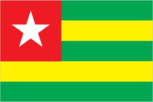
description: five equal horizontal stripes of green (top and bottom) alternating with yellow; a five-pointed white star is placed on a red square located in the upper-left corner
meaning: the five horizontal bands represent the country's regions; red symbolizes the loyalty and patriotism of the people; green signifies hope, fertility, and agriculture; yellow denotes mineral wealth and the belief that diligence and strength will yield prosperity; the star represents life, purity, peace, dignity, and national independence
history: incorporates the colors associated with the Pan-African movement
Capital
name
Lome
etymology
the name comes from a local word meaning "little market"
time difference
UTC 0 (five hours ahead of Washington, DC, during Standard Time)
geographic coordinates
6 07 N, 1 13 E
Suffrage
18 years of age; universal
Citizenship
citizenship by birth
no
citizenship by descent only
at least one parent must be a citizen of Togo
dual citizenship recognized
yes
residency requirement for naturalization
5 years
Constitution
history
several previous versions; the most recent was adopted on 27 September 1992, effective from 14 October 1992; revised on 6 May 2024
amendment process
proposals can be made by the president of the republic or must be supported by at least one-fifth of the National Assembly members; passage necessitates a four-fifths majority vote in the Assembly; a referendum is required if the proposal is approved by only two-thirds of the Assembly or if requested by the president; amendments to constitutional articles regarding the republican and secular form of government are not permitted
Country name
former
French Togoland
etymology
the name is derived from the town of Togodo (currently Togoville) situated on the northern banks of Lake Togo; the town's name likely originates from the lake's name, which is formed from the Ewe terms to ("water") and go ("shore")
local long form
République Togolaise
local short form
none
conventional long form
Togolese Republic
conventional short form
Togo
Independence
27 April 1960 (from French-administered UN trusteeship)
Legal system
customary law system
Government type
presidential republic
Judicial branch
highest court(s)
Supreme Court or Cour Suprême (divided into criminal and administrative chambers, each with its own president and advisors); Constitutional Court (comprised of 9 judges, including the president of the court)
subordinate courts
Court of Assizes (sessions court); Appeal Court; tribunals of first instance (segmented into civil, commercial, and correctional chambers; Court of State Security; military tribunal
judge selection and term of office
the president of the Supreme Court is designated by a decree from the president of the republic based on the recommendation of the Supreme Council of the Magistracy, a 9-member body for judicial, advisory, and disciplinary matters; other judicial appointments and judge tenure details are not applicable; judges of the Constitutional Court are appointed by the National Assembly; judge tenure details are not applicable
Executive branch
cabinet
Council of Ministers appointed by the president on the advice of the president of the council of ministers
chief of state
President Jean-Lucien Kwassi Savi de TOVE (since 3 May 2025)
election results
2020: Faure GNASSINGBE reelected president; percent of vote - Faure GNASSINGBE (UNIR) 70.8%, Agbeyome KODJO (MPDD) 19.5%, Jean-Pierre FABRE (ANC) 4.7%, other 5%
2015: Faure GNASSINGBE reelected president; percent of vote - Faure GNASSINGBE (UNIR) 58.8%, Jean-Pierre FABRE (ANC) 35.2%, Tchaboure GOGUE (ADDI) 4%, other 2%
head of government
President of Council of Ministers Faure GNASSINGBE (since 3 May 2025)
election/appointment process
the president is selected by the national assembly for a single six-year term; the president of the council of ministers is the head of the majority party within the national assembly and is confirmed by the Constitutional Court, with no term limits
National holiday
Independence Day, 27 April (1960)
National color(s)
green, yellow, red, white
National heritage
total World Heritage Sites
1 (cultural)
selected World Heritage Site locales
Koutammakou; the Land of the Batammariba
Political parties
Action Committee for Renewal or CAR
Alliance of Democrats for Integral Development or ADDI
Democratic Convention of African Peoples or CDPA
Democratic Forces for the Republic or FDR
National Alliance for Change or ANC
New Togolese Commitment
Pan-African National Party or PNP
Pan-African Patriotic Convergence or CPP
Patriotic Movement for Democracy and Development or MPDD
Socialist Pact for Renewal or PSR
The Togolese Party
Union of Forces for Change or UFC
Union for the Republic or UNIR
Legislative branch
legislature name
Parliament
legislative structure
bicameral
National anthem(s)
title
"Salut à toi, pays de nos aieux" (Hail to Thee, Land of Our Forefathers)
history
adopted in 1960, reinstated in 1992; the anthem was replaced during the one-party regime from 1979 to 1992
lyrics/music
Alex CASIMIR-DOSSEH
National symbol(s)
lion
Administrative divisions
5 regions (régions, singular - région); Centrale, Kara, Maritime, Plateaux, Savanes
Legislative branch - lower chamber
chamber name
National Assembly (Assemblée nationale)
term in office
6 years
number of seats
113 (all directly elected)
electoral system
proportional representation
scope of elections
full renewal
most recent election date
4/29/2024
expected date of next election
April 2030
percentage of women in chamber
15%
parties elected and seats per party
Union for the Republic (UNIR) (108); Other (5)
Legislative branch - upper chamber
chamber name
Senate (Sénat)
term in office
6 years
number of seats
61 (41 directly elected; 20 appointed)
scope of elections
full renewal
most recent election date
2/15/2025
expected date of next election
February 2031
percentage of women in chamber
24.6%
parties elected and seats per party
Union for the Republic (UNIR) (34); Independents (3); Other (4)
Diplomatic representation in the US
FAX
[1] (202) 232-3190
chancery
2208 Massachusetts Avenue NW, Washington, DC 20008
telephone
[1] (202) 234-4212
chief of mission
Ambassador Frédéric Edem HEGBE (since 24 April 2017)
email address and website
[email protected]
https://embassyoftogousa.com/
Diplomatic representation from the US
FAX
[228] 2261-5501
embassy
Boulevard Eyadema
B.P. 852, Lomé
telephone
[228] 2261-5470
mailing address
2300 Lome Place, Washington, DC 20521-2300
chief of mission
Ambassador (position currently vacant); Chargé d’Affaires Richard C. MICHAELS (since June 2025)
email address and website
[email protected]
https://tg.usembassy.gov/
International organization participation
ACP, AfDB, AIIB, AU, ECOWAS, EITI (compliant country), Entente, FAO, FZ, G-77, IAEA, IBRD, ICAO, ICRM, IDA, IDB, IFAD, IFC, IFRCS, ILO, IMF, IMO, Interpol, IOC, IOM, IPU, ISO (correspondent), ITSO, ITU, ITUC (NGOs), MIGA, MINURSO, NAM, OIC, OIF, OPCW, PCA, UN, UNAMID, UNCTAD, UNESCO, UNHCR, UNIDO, UNMIL, UNOCI, UNWTO, UPU, WADB (regional), WAEMU, WCO, WFTU (NGOs), WHO, WIPO, WMO, WTO
International law organization participation
accepts compulsory ICJ jurisdiction with reservations; not a party state to the ICCt
Economy
Budget
revenues
$1.801 billion (2023 est.)
expenditures
$2.407 billion (2023 est.)
Exports
Exports 2018
$1.703 billion (2018 est.)
Exports 2019
$1.665 billion (2019 est.)
Exports 2020
$1.722 billion (2020 est.)
Imports
Imports 2018
$2.329 billion (2018 est.)
Imports 2019
$2.261 billion (2019 est.)
Imports 2020
$2.389 billion (2020 est.)
Industries
phosphate extraction, agricultural processing, cement production, handicrafts, textile manufacturing, beverage production
Labor force
3.345 million (2024 est.)
Public debt
Public debt 2016
81.6% of GDP (2016 est.)
Remittances
Remittances 2021
7.8% of GDP (2021 est.)
Remittances 2022
8% of GDP (2022 est.)
Remittances 2023
7.1% of GDP (2023 est.)
Exchange rates
Currency
Communaute Financiere Africaine francs (XOF) per US dollar -
Exchange rates 2020
575.586 (2020 est.)
Exchange rates 2021
554.531 (2021 est.)
Exchange rates 2022
623.76 (2022 est.)
Exchange rates 2023
606.57 (2023 est.)
Exchange rates 2024
606.345 (2024 est.)
Debt - external
Debt - external 2023
$1.923 billion (2023 est.)
Economic overview
a low-income economy in West Africa; predominantly agrarian; features a deep-water port; an emerging hub for international shipping; progressing in privatization and enhancing public budgeting transparency; significant phosphate mining sector; extremely high levels of rural poverty
Unemployment rate
Unemployment rate 2022
2% (2022 est.)
Unemployment rate 2023
2% (2023 est.)
Unemployment rate 2024
2% (2024 est.)
Exports - partners
UAE 40%, India 13%, Angola 13%, Burkina Faso 4%, Cote d'Ivoire 3% (2023)
Imports - partners
China 26%, India 26%, Belgium 6%, Netherlands 6%, USA 3% (2023)
Real GDP per capita
Real GDP per capita 2022
$2,700 (2022 est.)
Real GDP per capita 2023
$2,800 (2023 est.)
Real GDP per capita 2024
$2,800 (2024 est.)
Real GDP growth rate
Real GDP growth rate 2022
5.8% (2022 est.)
Real GDP growth rate 2023
6.4% (2023 est.)
Real GDP growth rate 2024
5.3% (2024 est.)
Agricultural products
cassava, maize, yams, sorghum, soybeans, beans, rice, vegetables, oil palm fruit, cotton (2023)
Exports - commodities
gold, refined petroleum, soybeans, phosphates, coconuts/brazil nuts/cashews (2023)
Imports - commodities
refined petroleum, garments, rice, palm oil, motorcycles and cycles (2023)
Current account balance
Current account balance 2018
-$184.852 million (2018 est.)
Current account balance 2019
-$55.444 million (2019 est.)
Current account balance 2020
-$20.738 million (2020 est.)
Taxes and other revenues
14.8% (of GDP) (2023 est.)
GDP (official exchange rate)
$9.926 billion (2024 est.)
GDP - composition, by end use
household consumption
78.3% (2024 est.)
government consumption
13.1% (2024 est.)
investment in inventories
0% (2024 est.)
investment in fixed capital
22.3% (2024 est.)
exports of goods and services
24.4% (2024 est.)
imports of goods and services
-38.1% (2024 est.)
Population below poverty line
45.5% (2018 est.)
Inflation rate (consumer prices)
Inflation rate (consumer prices) 2022
7.6% (2022 est.)
Inflation rate (consumer prices) 2023
5.3% (2023 est.)
Inflation rate (consumer prices) 2024
2.9% (2024 est.)
Industrial production growth rate
4.2% (2024 est.)
Real GDP (purchasing power parity)
Real GDP (purchasing power parity) 2022
$24.199 billion (2022 est.)
Real GDP (purchasing power parity) 2023
$25.75 billion (2023 est.)
Real GDP (purchasing power parity) 2024
$27.115 billion (2024 est.)
Youth unemployment rate (ages 15-24)
male
3.3% (2024 est.)
total
3.4% (2024 est.)
female
3.5% (2024 est.)
GDP - composition, by sector of origin
industry
20% (2024 est.)
services
52% (2024 est.)
agriculture
18% (2024 est.)
Household income or consumption by percentage share
lowest 10%
2.8% (2021 est.)
highest 10%
29.6% (2021 est.)
Gini Index coefficient - distribution of family income
Gini Index coefficient - distribution of family income 2021
37.9 (2021 est.)
Energy
Coal
exports
10 metric tons (2023 est.)
imports
163,000 metric tons (2023 est.)
consumption
163,000 metric tons (2023 est.)
Petroleum
refined petroleum consumption
14,000 bbl/day (2023 est.)
Electricity
imports
1.1 billion kWh (2023 est.)
consumption
1.815 billion kWh (2023 est.)
installed generating capacity
326,000 kW (2023 est.)
transmission/distribution losses
206.938 million kWh (2023 est.)
Natural gas
imports
176.16 million cubic meters (2023 est.)
consumption
176.16 million cubic meters (2023 est.)
Electricity access
electrification - rural areas
25%
electrification - urban areas
96.5%
electrification - total population
57.2% (2022 est.)
Energy consumption per capita
Total energy consumption per capita 2023
4.538 million Btu/person (2023 est.)
Electricity generation sources
solar
11.9% of total installed capacity (2023 est.)
fossil fuels
79.3% of total installed capacity (2023 est.)
hydroelectricity
8.7% of total installed capacity (2023 est.)
biomass and waste
0.1% of total installed capacity (2023 est.)
Communications
Internet users
percent of population
37% (2023 est.)
Broadcast media
One government-owned television channel featuring various transmission locations; five privately owned local television stations; availability of cable television; a state-operated radio network comprising two stations; numerous privately owned radio stations alongside several community radio outlets; broadcasts from various international media outlets accessible (2019)
Internet country code
.tg
Telephones - fixed lines
total subscriptions
67,000 (2023 est.)
subscriptions per 100 inhabitants
1 (2023 est.) less than 1
Telephones - mobile cellular
total subscriptions
7.69 million (2024 est.)
subscriptions per 100 inhabitants
81 (2024 est.)
Broadband - fixed subscriptions
total
114,000 (2023 est.)
subscriptions per 100 inhabitants
1 (2023 est.)
Transportation
Ports
large
0
small
0
medium
1
key ports
Kpeme, Lome
very small
1
total ports
2 (2024)
ports with oil terminals
2
Airports
7 (2025)
Railways
total
568 km (2014)
narrow gauge
568 km (2014) 1.000-m gauge
Merchant marine
total
397 (2023)
by type
1 bulk carrier, 10 container ships, 250 general cargo vessels, 56 oil tankers, and 80 other types
Civil aircraft registration country code prefix
5V
Military & Security
Military - note
The Togolese Armed Forces (FAT) are tasked with both external defense and the maintenance of internal security. Their principal concerns include border security, counter-terrorism efforts, and maritime safety. In recent times, the FAT has intensified operations in the northern border area to safeguard the frontier against banditry, illegal smuggling, and incursions from Jama'at Nasr al-Islam wal Muslimin (JNIM), a coalition of militant groups associated with al-Qa'ida that operates in Mali and extends its activities into neighboring Burkina Faso. Following an assault by JNIM fighters on a Togolese military installation that resulted in the deaths of multiple soldiers, the Togolese Government declared a state of emergency in the northern region in 2022. Additionally, the Navy and Air Force have sharpened their focus on addressing piracy and smuggling incidents in the Gulf of Guinea.
Since its establishment in 1963, the Togolese military has played a significant role in the nation’s political landscape, marked by incidents of assassinations, coups, and a crackdown in 2005 that led to the deaths of hundreds of civilians. Over the last ten years, there have been efforts to reform and professionalize the military, which have included enhancing its participation in UN peacekeeping missions, engaging in multinational exercises, and receiving training from foreign allies, particularly from France and the United States. Furthermore, Togo has set up a regional peacekeeping training facility for military personnel and police in Lome, projected to be operational by 2025.
Military expenditures
Military Expenditures 2020
2.8% of GDP (2020 est.)
Military Expenditures 2021
2.8% of GDP (2021 est.)
Military Expenditures 2022
4% of GDP (2022 est.)
Military Expenditures 2023
3% of GDP (2023 est.)
Military Expenditures 2024
2.2% of GDP (2024 est.)
Military and security forces
Togolese Armed Forces (Forces Armees Togolaise, FAT): Comprising the Togolese Army, Togolese Navy, Togolese Air Force, and National Gendarmerie (Gendarmerie Nationale Togolaise or GNT)
Ministry of Security and Civil Protection: Togolese Police (2025)
Military service age and obligation
Military service for both men and women is mandatory between the ages of 18 and 24, with an initial service commitment of 24 months; there is no conscription as of 2025.
Military equipment inventories and acquisitions
The FAT possesses a limited stock of primarily outdated or older weaponry sourced from various nations including Brazil, France, Russia/former Soviet Union, Türkiye, the United Kingdom, and the United States (2025).
Military and security service personnel strengths
The estimated number of active personnel in the Armed Forces, including the Gendarmerie, is around 20,000 (2025).
Terrorism
Terrorist group(s)
Jama’at Nusrat al Islam wal Muslimeen (JNIM)
Transnational Issues
Refugees and internally displaced persons
IDPs
18,429 (2024 est.)
refugees
48,756 (2024 est.)