CapitalCaracas
LanguagesSpanish, indigenous languages, Portuguese, other languages
Currencybolivars
Governmentfederal presidential republic
Bamwor Indexes
Venezuela — Q1 2026
IBEUBamwor Urban Scale Index
9.45%
Rank #164 of 237
View full ranking →
IBCPBamwor Population Concentration Index
27.05%
Rank #128 of 237
View full ranking →
IBDABamwor Settlement Density Index
28.00per 1K km²
Rank #178 of 241
View full ranking →
IBCXBamwor Country Complexity Index
73.42/100
Rank #27 of 234
View full ranking →
IBEEBamwor Economic Stability Index
58.64/100
Rank #220 of 220
View full ranking →
IBFMBamwor Military Strength Index
51.77/100
Rank #63 of 124
View full ranking →
IBDIBamwor Digital Infrastructure Index
62.99/100
Rank #144 of 206
View full ranking →
IBEDBamwor Education Index
66.84/100
Rank #66 of 119
View full ranking →
IBSABamwor Healthcare Index
64.05/100
Rank #146 of 218
View full ranking →
Venezuela Intelligence Report
Download PDF with 20+ statistics, rankings & proprietary indices
Introduction
Background
In 1830, Venezuela was one of the three nations that emerged following the disintegration of Gran Colombia, alongside Ecuador and New Granada (now known as Colombia). Throughout much of the early to mid-20th century, the country was dominated by military leaders who advanced the oil sector while enacting certain social reforms. Democratic governance prevailed until 1999, when Hugo CHAVEZ, president from 1999 to 2013, imposed authoritarian rule over other governmental branches. This pattern persisted into 2018, when Nicolas MADURO assumed the presidency for a second term through an election largely boycotted by opposition parties and widely regarded as fraudulent. The 2020 legislative elections were similarly viewed as illegitimate, and many international observers and opposition factions declared the resulting National Assembly to be without legitimacy. In 2021, a number of opposition parties ended a three-year boycott of elections to participate in mayoral and gubernatorial contests, albeit under problematic conditions. Consequently, the opposition significantly increased its representation at the municipal level and secured four of the 23 governorships. These regional elections in 2021 marked the first instance since 2006 where the EU was authorized to dispatch an electoral observation mission to Venezuela.
MADURO has instituted stringent limitations on freedom of expression and the press. Since the presidency of CHAVEZ, the ruling party has enhanced the state's involvement in the economy through the expropriation of major businesses, rigorous currency exchange regulations, price controls, and excessive reliance on oil revenues. Years of economic mismanagement rendered Venezuela ill-equipped to cope with the global decline in oil prices in 2014, triggering an economic downturn that led to diminished government social expenditure, shortages of essential goods, and soaring inflation. Deteriorating living standards have driven nearly 8 million Venezuelans to leave the country, predominantly relocating to neighboring nations. The United States implemented financial sanctions against MADURO and his associates in 2017, followed by additional sanctions targeting various sectors of the Venezuelan economy in 2018. Some limited relief from sanctions occurred when the MADURO administration began to make concessions regarding democratic processes and elections.
The government's mismanagement and failure to invest in infrastructure have further weakened the energy sector of the nation. In response to the ongoing economic crisis, Caracas has eased certain restrictions to lessen the crisis's impact, such as permitting greater import flexibility for the private sector and informal utilization of US dollars and other foreign currencies. Persistent issues include human rights violations, widespread violent crime, political interference in judicial and electoral processes, and corruption.
Geography
Area
land
882,050 sq km
water
30,000 sq km
total
912,050 sq km
Climate
tropical; characterized by hot and humid conditions; more temperate in elevated regions
Terrain
Andes Mountains and Maracaibo Lowlands located in the northwest; central plains known as llanos; Guiana Highlands situated in the southeast
Land use
other
22.1% (2023 est.)
forest
53.5% (2023 est.)
agricultural land
24.4% (2023 est.)
agricultural land: arable land
arable land: 2.9% (2023 est.)
agricultural land: permanent crops
permanent crops: 0.8% (2023 est.)
agricultural land: permanent pasture
permanent pasture: 20.6% (2023 est.)
Location
Located in the northern part of South America, adjacent to the Caribbean Sea and the North Atlantic Ocean, positioned between Colombia and Guyana
Coastline
2,800 km
Elevation
lowest point
Caribbean Sea 0 m
highest point
Pico Bolivar 4,978 m
mean elevation
450 m
Irrigated land
10,550 sq km (2012)
Map references
South America
Land boundaries
total
5,267 km
border countries
Brazil 2,137 km; Colombia 2,341 km; Guyana 789 km
Maritime claims
contiguous zone
15 nm
territorial sea
12 nm
continental shelf
200-m depth or to the depth of exploitation
exclusive economic zone
200 nm
Natural hazards
prone to flooding, rockfalls, and landslides; experiences occasional droughts
Geography - note
note 1: the nation is positioned along significant maritime and aerial routes that connect North and South America
note 2: Venezuela features some of the most distinctive geological formations globally; tepuis are the grand table-top mountains found in the western Guiana Highlands, often isolated and consequently hosting unique endemic flora and fauna; their vertical cliffs contribute to the formation of some of the world's most breathtaking waterfalls, including Angel Falls, which is the tallest waterfall in the world at 979 m (3,212 ft), cascading from Auyan Tepui
Natural resources
petroleum, natural gas, iron ore, gold, bauxite, various minerals, hydropower, diamonds
Area - comparative
nearly six times larger than Georgia; slightly more than double the size of California
Geographic coordinates
8 00 N, 66 00 W
Population distribution
the majority of the population is concentrated in the northern and western highlands along an eastern extension at the northern tip of the Andes, which includes the capital city, Caracas
Major lakes (area sq km)
salt water lake(s)
Lago de Maracaibo - 13,010 sq km
Major watersheds (area sq km)
Atlantic Ocean drainage
Amazon (6,145,186 sq km), Orinoco (953,675 sq km)
Major rivers (by length in km)
Rio Negro (shared with Colombia [s] and Brazil [m]) - 2,250 km; Orinoco river source and mouth (shared with Colombia) - 2,101 km
note: [s] following the country name denotes river source; [m] following the country name denotes river mouth
People & Society
Literacy
male
97.2% (2017 est.)
female
97.3% (2017 est.)
total population
97.2% (2017 est.)
Languages
Languages
Spanish (official) 98.2%, indigenous languages 1.3%, Portuguese 0.1%, other languages 0.4% (2023 estimate)
major-language sample(s)
La Libreta Informativa del Mundo, la fuente indispensable de información básica. (Spanish)
The World Factbook, the indispensable source for basic information.
Religions
Roman Catholic 48.1%, Protestant 31.6% (Evangelical 31.4%, Adventist 0.2%), Jehovah's Witness 1.4%, African American/umbanda 0.7%, other 0.1%, believer 3.5%, agnostic 0.1%, atheist, 0.4%, none 13.6%, unspecified 0.6% (2023 est.)
Sex ratio
at birth
1.05 male(s)/female
0-14 years
1.05 male(s)/female
15-64 years
0.99 male(s)/female
total population
0.99 male(s)/female (2024 est.)
65 years and over
0.84 male(s)/female
Birth rate
16.45 births/1,000 population (2025 est.)
Death rate
6.54 deaths/1,000 population (2025 est.)
Median age
male
30.3 years
total
31.3 years (2025 est.)
female
31.7 years
Population
male
15,808,263
total
31,755,435 (2025 est.)
female
15,947,172
Nationality
noun
Venezuelan(s)
adjective
Venezuelan
Urbanization
urban population
88.4% of total population (2023)
rate of urbanization
1.16% annual rate of change (2020-25 est.)
Age structure
0-14 years
25% (male 3,987,361/female 3,811,307)
15-64 years
65.9% (male 10,264,353/female 10,330,376)
65 years and over
9.1% (2024 est.) (male 1,303,737/female 1,553,172)
Ethnic groups
unclassified Spanish, Italian, Portuguese, Arab, German, African, Indigenous
Dependency ratios
total dependency ratio
51.8 (2025 est.)
youth dependency ratio
37.5 (2025 est.)
potential support ratio
7 (2025 est.)
elderly dependency ratio
14.3 (2025 est.)
Physician density
1.66 physicians/1,000 population (2017)
Health expenditure
Health expenditure (as % of GDP)
4% of GDP (2021)
Health expenditure (as % of national budget)
6% of national budget (2022 est.)
Net migration rate
-1.15 migrant(s)/1,000 population (2025 est.)
Hospital bed density
1 beds/1,000 population (2020 est.)
Total fertility rate
2.16 children born/woman (2025 est.)
Drinking water source
improved: total
total: 93.3% of population (2022 est.)
unimproved: total
total: 6.7% of population (2022 est.)
Education expenditure
Education expenditure (% GDP)
0% of GDP (2023 est.)
Education expenditure (% national budget)
10.3% national budget (2024 est.)
Infant mortality rate
male
15.4 deaths/1,000 live births
total
13.6 deaths/1,000 live births (2025 est.)
female
12.2 deaths/1,000 live births
Population growth rate
0.88% (2025 est.)
Gross reproduction rate
1.05 (2025 est.)
Population distribution
the majority of the populace is situated in the highlands of the north and west, extending along an eastern ridge at the northern tip of the Andes, which encompasses the capital, Caracas
Life expectancy at birth
male
71.5 years
female
77.7 years
total population
74.5 years (2024 est.)
Maternal mortality ratio
227 deaths/100,000 live births (2023 est.)
Sanitation facility access
improved: total
total: 98.4% of population (2022 est.)
unimproved: total
total: 1.6% of population (2022 est.)
Alcohol consumption per capita
beer
1.54 liters of pure alcohol (2019 est.)
wine
0.01 liters of pure alcohol (2019 est.)
total
2.51 liters of pure alcohol (2019 est.)
spirits
0.92 liters of pure alcohol (2019 est.)
other alcohols
0.03 liters of pure alcohol (2019 est.)
Major urban areas - population
2.972 million CARACAS (capital), 2.368 million Maracaibo, 1.983 million Valencia, 1.254 million Barquisimeto, 1.243 million Maracay, 964,000 Ciudad Guayana (2023)
Obesity - adult prevalence rate
25.6% (2016)
Environment
Climate
tropical; characterized by heat and humidity; more temperate in mountainous regions
Land use
other
22.1% (2023 est.)
forest
53.5% (2023 est.)
agricultural land
24.4% (2023 est.)
agricultural land: arable land
arable land: 2.9% (2023 est.)
agricultural land: permanent crops
permanent crops: 0.8% (2023 est.)
agricultural land: permanent pasture
permanent pasture: 20.6% (2023 est.)
Urbanization
urban population
88.4% of total population (2023)
rate of urbanization
1.16% annual rate of change (2020-25 est.)
Methane emissions
other
7 kt (2019-2021 est.)
waste
328.3 kt (2019-2021 est.)
energy
3,595.7 kt (2022-2024 est.)
agriculture
1,007.8 kt (2019-2021 est.)
Waste and recycling
municipal solid waste generated annually
9.779 million tons (2024 est.)
percent of municipal solid waste recycled
21.3% (2022 est.)
Environmental issues
sewage contamination of Lago de Valencia; oil and municipal pollution in Lago de Maracaibo; deforestation; degradation of soil; urban and industrial pollution, particularly along the Caribbean coastline; risk to the rainforest ecosystem due to mining activities
Total water withdrawal
municipal
5.123 billion cubic meters (2022 est.)
industrial
793.3 million cubic meters (2022 est.)
agricultural
16.71 billion cubic meters (2022 est.)
Carbon dioxide emissions
total emissions
76.73 million metric tonnes of CO2 (2023 est.)
from consumed natural gas
48.623 million metric tonnes of CO2 (2023 est.)
from coal and metallurgical coke
179,000 metric tonnes of CO2 (2023 est.)
from petroleum and other liquids
27.928 million metric tonnes of CO2 (2023 est.)
Particulate matter emissions
16.1 micrograms per cubic meter (2019 est.)
Total renewable water resources
1.325 trillion cubic meters (2022 est.)
International environmental agreements
party to
Antarctic-Environmental Protection, Antarctic Treaty, Biodiversity, Climate Change, Climate Change-Kyoto Protocol, Climate Change-Paris Agreement, Comprehensive Nuclear Test Ban, Desertification, Endangered Species, Hazardous Wastes, Marine Life Conservation, Nuclear Test Ban, Ozone Layer Protection, Ship Pollution, Tropical Timber 2006, Wetlands
signed, but not ratified
none of the selected agreements
Government
Flag
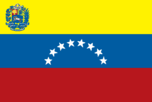
description: composed of three equal horizontal stripes of yellow (top), blue, and red, featuring the coat of arms on the left side of the yellow stripe and an arc of eight five-pointed white stars positioned centrally on the blue stripe
meaning: yellow symbolizes the wealth of the land, blue represents the bravery of its citizens, and red stands for the blood lost in the struggle for independence
history: the flag preserves the three equal horizontal bands and primary colors from the Gran Colombia flag, which was a South American republic that dissolved in 1830; in 2006, President Hugo CHAVEZ introduced the eighth star -- the original seven stars denoted the provinces that came together during the war of independence -- aligning it with Simon Bolivar's flag from 1827 and symbolizing the historical province of Guayana
Capital
name
Caracas
etymology
named after the Caracas tribe that initially inhabited the region; the etymology of their name remains uncertain
time difference
UTC-4 (one hour ahead of Washington, DC, during Standard Time)
geographic coordinates
10 29 N, 66 52 W
Suffrage
18 years of age; universal
Citizenship
citizenship by birth
yes
citizenship by descent only
yes
dual citizenship recognized
yes
residency requirement for naturalization
10 years; reduced to five years for applicants from Spain, Portugal, Italy, or any nation in Latin America or the Caribbean
Constitution
history
numerous previous; most recent adopted on 15 December 1999, effective from 30 December 1999
amendment process
proposed through consensus by at least 39% of the National Assembly members, by the president of the republic in conjunction with the cabinet of ministers, or by a petition from at least 15% of registered voters; approval requires a simple majority vote in the Assembly and a simple majority in a referendum
Country name
former
State of Venezuela, Republic of Venezuela, United States of Venezuela
etymology
in 1499, the stilt-houses on Lake Maracaibo reminded explorers Alonso de OJEDA and Amerigo VESPUCCI of structures in Venice, Italy, leading them to name the area "Venezuola," which translates to "Little Venice"
local long form
República Bolivariana de Venezuela
local short form
Venezuela
conventional long form
Bolivarian Republic of Venezuela
conventional short form
Venezuela
Independence
5 July 1811 (from Spain)
Legal system
civil law system rooted in the Spanish civil code
Government type
federal presidential republic
Judicial branch
highest court(s)
Supreme Tribunal of Justice (comprising 32 judges arranged into constitutional, political-administrative, electoral, civil appeals, criminal appeals, and social divisions)
subordinate courts
Superior or Appeals Courts (Tribunales Superiores); District Courts (Tribunales de Distrito); First Instance Courts (Tribunales de Primera Instancia); Parish Courts (Tribunales de Parroquia); Justices of the Peace (Justicia de Paz) Network
judge selection and term of office
judges are nominated by the Committee of Judicial Postulation (an independent body of legal organizations and citizen power entities) and appointed by the National Assembly; judges serve nonrenewable terms of 12 years
Executive branch
cabinet
Council of Ministers appointed by the president
chief of state
Interim President Delcy Eloína RODRÍGUEZ Gómez (since 5 January 2026)
election results
2024: official results contested; Nicolas MADURO Moros was proclaimed the winner by the MADURO-affiliated National Electoral Council; vote percentages - Nicolas MADURO Moros (PSUV) 52%, Edmundo GONZÁLEZ Urrutia (Independent) 43.2%, Luis Eduardo MARTÍNEZ (AD) 1.2%, others 3.6%
2018: Nicolas MADURO Moros reelected as president; vote percentages - Nicolas MADURO Moros (PSUV) 67.9%, Henri FALCON (AP) 20.9%, Javier BERTUCCI 10.8%
head of government
Interim President Delcy Eloína RODRÍGUEZ Gómez (since 5 January 2026)
most recent election date
28 July 2024
election/appointment process
president directly elected by simple-majority popular vote for a 6-year term (no term limits)
expected date of next election
unknown
National holiday
Independence Day, 5 July (1811)
National color(s)
yellow, blue, red
National heritage
total World Heritage Sites
3 (2 cultural, 1 natural)
selected World Heritage Site locales
Coro and its Port (c); Canaima National Park (n); Ciudad Universitaria de Caracas (c)
Political parties
A New Era (Un Nuevo Tiempo) or UNT
Cambiemos Movimiento Ciudadano or CMC
Christian Democrats or COPEI (also referred to as the Social Christian Party)
Citizens Encounter or EC
Clear Accounts or CC
Coalition of parties loyal to Nicolas MADURO - Great Patriotic Pole or GPP
Coalition of opposition parties - Democratic Alliance (Alianza Democratica) (includes AD, EL CAMBIO, COPEI, CMC, and AP)
Come Venezuela (Vente Venezuela) or VV
Communist Party of Venezuela or PCV
Consenso en la Zona or Conenzo
Convergencia
Democratic Action or AD
Fatherland for All (Patria para Todos) or PPT
Fearless People's Alliance or ABP
Fuerza Vecinal or FV
Hope for Change (Esperanza por el Cambio) or EL CAMBIO
Justice First (Primero Justicia) or PJ
LAPIZ
Movement to Socialism (Movimiento al Socialismo) or MAS
Popular Will (Voluntad Popular) or VP
Progressive Advance (Avanzada Progresista) or AP
The Radical Cause or La Causa R
United Socialist Party of Venezuela or PSUV
Venezuela First (Primero Venezuela) or PV
Venezuelan Progressive Movement or MPV
Venezuela Project or PV
Legislative branch
term in office
5 years
number of seats
277 (all directly elected)
electoral system
mixed system
legislature name
National Assembly (Asamblea Nacional)
scope of elections
full renewal
legislative structure
unicameral
most recent election date
12/6/2020
expected date of next election
May 2025
percentage of women in chamber
32.1%
National anthem(s)
title
"Gloria al bravo pueblo" (Glory to the Brave People)
history
adopted in 1881; lyrics penned in 1810; both SALIAS and LANDAETA were executed in 1814 during Venezuela's struggle for independence
lyrics/music
Vicente SALIAS/Juan Jose LANDAETA
National symbol(s)
troupial (bird)
Administrative divisions
23 states (estados, singular - estado), 1 capital district* (distrito capital), and 1 federal dependency** (dependencia federal); Amazonas, Anzoátegui, Apure, Aragua, Barinas, Bolívar, Carabobo, Cojedes, Delta Amacuro, Dependencias Federales (Federal Dependencies)**, Distrito Capital (Capital District)*, Falcón, Guárico, La Guaira, Lara, Mérida, Miranda, Monagas, Nueva Esparta, Portuguesa, Sucre, Táchira, Trujillo, Yaracuy, Zulia
Diplomatic representation in the US
none
note: the embassy, previously managed by the Venezuelan political opposition, announced on 5 January 2023, that it had ceased all embassy operations
Diplomatic representation from the US
embassy
Venezuela Affairs Unit, US Embassy, Carrera 45 N. 24B-27, Bogotá, Colombia
telephone
1-888-407-4747
mailing address
3140 Caracas Place, Washington DC 20521-3140
chief of mission
Ambassador (position currently vacant); Chargé d’Affaires John McNAMARA (since 1 February 2025); note - serves as the head of the Venezuela Affairs Unit, situated within the US Embassy in Bogotá
email address and website
[email protected]
https://ve.usembassy.gov/
International organization participation
ACS, Caricom (observer), CD, CDB, CELAC, FAO, G-15, G-24, G-77, IADB, IAEA, IBRD, ICAO, ICC (national committees), ICCt (signatory), ICRM, IDA, IFAD, IFC, IFRCS, IHO, ILO, IMF, IMO, IMSO, Interpol, IOC, IOM, IPU, ITSO, ITU, ITUC (NGOs), LAES, LAIA, LAS (observer), MIGA, NAM, OAS, OPANAL, OPCW, OPEC, PCA, Petrocaribe, UN, UNASUR, UNCTAD, UNESCO, UNHCR, UNHRC, UNIDO, Union Latina, UNOOSA, UNWTO, UPU, WCO, WFTU (NGOs), WHO, WIPO, WMO, WTO
International law organization participation
has not provided a declaration regarding ICJ jurisdiction; consents to ICCt jurisdiction
Economy
Budget
revenues
$30 million (2017 est.)
expenditures
$76 million (2017 est.)
Exports
Exports 2016
$28.684 billion (2016 est.)
Exports 2017
$93.485 billion (2017 est.)
Exports 2018
$83.401 billion (2018 est.)
Imports
Imports 2016
$25.81 billion (2016 est.)
Imports 2017
$18.376 billion (2017 est.)
Imports 2018
$18.432 billion (2018 est.)
Industries
products from agriculture, livestock, raw materials, machinery and equipment, transportation equipment, construction supplies, medical instruments, pharmaceuticals, chemical products, iron and steel items, crude oil, and petroleum derivatives
Labor force
11.136 million (2024 est.)
Public debt
Public debt 2017
38.9% of GDP (2017 est.)
Exchange rates
Currency
bolivars (VEB) per US dollar -
Exchange rates 2013
6.048 (2013 est.)
Exchange rates 2014
6.284 (2014 est.)
Exchange rates 2015
6.284 (2015 est.)
Exchange rates 2016
9.257 (2016 est.)
Exchange rates 2017
9.975 (2017 est.)
Economic overview
economy of South America; persistent hyperinflation since the mid-2010s; a disordered economy stemming from political corruption, cuts in infrastructure, and violations of human rights; currently in debt default; oil exporter; consumer of hydropower; improving relationships with China
Unemployment rate
Unemployment rate 2022
5.8% (2022 est.)
Unemployment rate 2023
5.5% (2023 est.)
Unemployment rate 2024
5.5% (2024 est.)
Exports - partners
USA 50%, China 10%, Spain 9%, Brazil 6%, Turkey 5% (2023)
Imports - partners
China 35%, USA 24%, Brazil 12%, Colombia 7%, Turkey 4% (2023)
Real GDP per capita
Real GDP per capita 2021
$4,000 (2021 est.)
Real GDP per capita 2022
$4,600 (2022 est.)
Real GDP per capita 2023
$4,900 (2023 est.)
Real GDP growth rate
Real GDP growth rate 2017
-15.76% (2017 est.)
Real GDP growth rate 2018
-19.67% (2018 est.)
Agricultural products
milk, sugarcane, maize, rice, plantains, oil palm fruit, bananas, chicken, pineapples, potatoes (2023)
Exports - commodities
crude oil, petroleum coke, scrap iron, alcohols, fertilizers (2023)
Imports - commodities
refined oil, soybean meal, corn, plastic goods, vehicle parts/accessories (2023)
Current account balance
Current account balance 2015
-$16.051 billion (2015 est.)
Current account balance 2016
-$3.87 billion (2016 est.)
GDP (official exchange rate)
$139.395 billion (2023 est.)
Population below poverty line
33.1% (2015 est.)
Average household expenditures
on food
52% of household expenditures (2023 est.)
on alcohol and tobacco
2.8% of household expenditures (2023 est.)
Inflation rate (consumer prices)
Inflation rate (consumer prices) 2020
2,355.1% (2020 est.)
Inflation rate (consumer prices) 2021
1,588.5% (2021 est.)
Inflation rate (consumer prices) 2022
200.9% (2022 est.)
Real GDP (purchasing power parity)
Real GDP (purchasing power parity) 2021
$98.768 billion (2021 est.)
Real GDP (purchasing power parity) 2022
$106.672 billion (2022 est.)
Real GDP (purchasing power parity) 2023
$110.943 billion (2023 est.)
Youth unemployment rate (ages 15-24)
male
9.3% (2024 est.)
total
10.6% (2024 est.)
female
13.2% (2024 est.)
Reserves of foreign exchange and gold
Reserves of foreign exchange and gold 2015
$15.625 billion (2015 est.)
Reserves of foreign exchange and gold 2016
$10.15 billion (2016 est.)
Reserves of foreign exchange and gold 2017
$9.794 billion (2017 est.)
Energy
Coal
exports
124,000 metric tons (2023 est.)
imports
2,000 metric tons (2023 est.)
production
149,000 metric tons (2023 est.)
consumption
80,000 metric tons (2023 est.)
proven reserves
730.999 million metric tons (2023 est.)
Petroleum
total petroleum production
801,000 bbl/day (2023 est.)
crude oil estimated reserves
303.806 billion barrels (2021 est.)
refined petroleum consumption
203,000 bbl/day (2023 est.)
Electricity
exports
600 million kWh (2023 est.)
consumption
56.493 billion kWh (2023 est.)
installed generating capacity
33.493 million kW (2023 est.)
transmission/distribution losses
25.849 billion kWh (2023 est.)
Natural gas
production
23.873 billion cubic meters (2023 est.)
consumption
23.873 billion cubic meters (2023 est.)
proven reserves
5.674 trillion cubic meters (2021 est.)
Electricity access
electrification - total population
100% (2022 est.)
Energy consumption per capita
Total energy consumption per capita 2023
54.474 million Btu/person (2023 est.)
Electricity generation sources
fossil fuels
21.6% of total installed capacity (2023 est.)
hydroelectricity
78.3% of total installed capacity (2023 est.)
Communications
Internet users
percent of population
62% (2017 est.)
Broadcast media
A combination of government-operated and privately-owned broadcasting media operates under significant regulatory oversight; there are 13 public service television networks, 61 privately-owned television channels, 1 privately-owned news channel with restricted national reach, and a Pan-American channel that has the support of Maduro; approximately 65 news radio stations are governed by 3 radio networks aligned with Maduro, along with an additional 30 stations aimed at niche audiences; community broadcasters funded by Maduro consist of 235 radio stations and 44 television channels; although the quantity of private radio broadcasting stations is diminishing, a considerable number still exist (2021)
Internet country code
.ve
Telephones - fixed lines
total subscriptions
2.683 million (2022 est.)
subscriptions per 100 inhabitants
10 (2022 est.)
Telephones - mobile cellular
total subscriptions
20.2 million (2024 est.)
subscriptions per 100 inhabitants
71 (2024 est.)
Broadband - fixed subscriptions
total
2.7 million (2022 est.)
subscriptions per 100 inhabitants
10 (2022 est.)
Transportation
Ports
large
1
small
11
medium
2
key ports
Amuay (Bahia de Amuay), Bahia de Pertigalete, Ciudad Bolivar, Guanta, La Guaira, La Salina, Las Piedras, Maracaibo, Puerto Cabello, Puerto de Hierro, Puerto la Cruz, Puerto Miranda, Puerto Ordaz, Punta Cardon
very small
17
total ports
31 (2024)
ports with oil terminals
21
Airports
509 (2025)
Railways
total
447 km (2014)
standard gauge
447 km (2014) 1.435-m gauge (41.4 km electrified)
Heliports
88 (2025)
Merchant marine
total
272 (2023)
by type
3 bulk carriers, 1 container ship, 26 general cargo vessels, 17 oil tankers, 225 others
Civil aircraft registration country code prefix
YV
Military & Security
Military - note
The Venezuelan Armed Forces (FANB) are tasked with safeguarding the nation's independence, sovereignty, and territorial integrity. They also play a significant role domestically, which includes aiding in the maintenance of internal security, engaging in counter-narcotics operations, supporting national socio-economic development, and facilitating disaster relief and humanitarian aid. The military has been deployed to counter illegal armed groups in the Colombian border region and other areas to address organized crime syndicates involved in drug trafficking and illicit mining. Furthermore, it has established connections with the armed forces of China, Cuba, Iran, and Russia.
In addition to their military duties, the FANB is influential within the country's economic and political arenas; military personnel occupy critical roles in state-owned enterprises, government ministries, and financial institutions. The FANB oversees corporations that operate in various sectors, including agriculture, banking, communications, energy, insurance, mining, and transportation (2025).
Military expenditures
Military Expenditures 2020
1.6% of GDP (2020 est.)
Military Expenditures 2021
0.3% of GDP (2021 est.)
Military Expenditures 2022
0.6% of GDP (2022 est.)
Military Expenditures 2023
0.5% of GDP (2023 est.)
Military Expenditures 2024
0.6% of GDP (2024 est.)
Military and security forces
Bolivarian National Armed Forces (Fuerza Armada Nacional Bolivariana, FANB): Bolivarian Army (Ejercito Bolivariano, EB), Bolivarian Navy (Armada Bolivariana, AB; includes marines, Coast Guard), Bolivarian Military Aviation (Aviacion Militar Bolivariana, AMB), Bolivarian Militia (Milicia Bolivariana), Bolivarian National Guard (Guardia Nacional Bolivaria, GNB), Presidential Honor Guard
Ministry of Interior, Justice, and Peace: Bolivarian National Police (Policía Nacional Bolivariana, PNB) (2025)
Military service age and obligation
Individuals aged 18-30 (25 for women) are eligible for voluntary service; the minimum term of service is 24 to 30 months. For Militia service, the age range is 17-39. All citizens within the military service age bracket (18-50) are required to register for military service and undergo military training (2025).
Military equipment inventories and acquisitions
The inventory of the FANB comprises a combination of predominantly older and some contemporary weapons sourced from various foreign suppliers, including China, France, Germany, Iran, Italy, Russia/former Soviet Union, Spain, the United Kingdom, and the United States (2025).
Military and security service personnel strengths
Estimates vary; there are approximately 125,000 to 150,000 active personnel in the Armed Forces, with an estimated 200,000 members of the Bolivarian Militia (2025).
Terrorism
Terrorist group(s)
National Liberation Army (ELN); Revolutionary Armed Forces of Colombia-People's Army (FARC-EP); Segundo Marquetalia (SM); Tren de Aragua (TdA)
Transnational Issues
Illicit drugs
USG identification
major illicit drug-producing and/or drug-transit country
major precursor-chemical producer (2025)
Trafficking in persons
tier rating
Tier 3 — Venezuela has not adequately achieved the minimum criteria for the eradication of trafficking and is making no advancements towards this goal, thus, Venezuela continues to be classified as Tier 3; for further information, visit: https://www.state.gov/reports/2025-trafficking-in-persons-report/venezuela/
Refugees and internally displaced persons
IDPs
2,338 (2024 est.)
refugees
20,911 (2024 est.)
Space
Space agency/agencies
Bolivarian Agency for Space Activities (Agencia Bolivariana para Actividades Espaciales, ABAE; established in 2007) (2025)
Space program overview
maintains a modest national program that mainly aims at acquiring satellites and enhancing the nation’s scientific and technological capabilities; manages satellites and operates two satellite ground control facilities; engages in multinational space organizations such as the Latin American and Caribbean Space Agency; its closest bilateral partners include China and Russia; additionally, it has bilateral framework agreements for space collaboration with Argentina, Bolivia, Brazil, and Uruguay (2025)
Key space-program milestones
2005 - initiated a space cooperation agreement with China
2008 - launched the first communications satellite (Venesat-1 or Bolivar) financed, constructed, and launched by China
2012 - saw the launch of its first remote sensing (RS) satellite (VRSS-1 or Miranda) developed and launched by China
2017 - witnessed the launch of the second RS satellite (VRSS-2 or Sucre) also built and launched by China
2021 - entered into an agreement to establish the Latin American and Caribbean Space Agency (officially established in 2022)
2023 - became a participant in the China-Russia initiative to build a permanent lunar base by the 2030s
2025 - expressed intention to join the upcoming Mars sample-return mission (Tianwen-3) spearheaded by China