CapitalBangui
LanguagesFrench , Sangho , various tribal languages
CurrencyCooperation Financiere en Afrique Centrale francs
Governmentpresidential republic
Bamwor Indexes
Central African Republic — Q1 2026
IBEUBamwor Urban Scale Index
14.13%
Rank #123 of 237
View full ranking →
IBCPBamwor Population Concentration Index
28.83%
Rank #122 of 237
View full ranking →
IBDABamwor Settlement Density Index
9.16per 1K km²
Rank #211 of 241
View full ranking →
IBCXBamwor Country Complexity Index
66.56/100
Rank #70 of 234
View full ranking →
IBEEBamwor Economic Stability Index
77.73/100
Rank #204 of 220
View full ranking →
IBFMBamwor Military Strength Index
43.53/100
Rank #90 of 124
View full ranking →
IBDIBamwor Digital Infrastructure Index
10.73/100
Rank #205 of 206
View full ranking →
IBEDBamwor Education Index
13.84/100
Rank #118 of 119
View full ranking →
IBSABamwor Healthcare Index
32.25/100
Rank #218 of 218
View full ranking →
Central African Republic Intelligence Report
Download PDF with 20+ statistics, rankings & proprietary indices
Introduction
Background
The Central African Republic (CAR) is a perennially weak state that sits at the crossroads of ethnic and linguistic groups in the center of the African continent. Among the last areas of Sub-Saharan Africa to be drawn into the world economy, its introduction into trade networks around the early 1700s fostered significant competition among its population. The local population sought to benefit from the lucrative Atlantic, trans-Saharan, and Indian Ocean trade in enslaved people and ivory. Slave raids aided by the local populations fostered animosity between ethnic groups that remains today. The territory was established as a French colony named Ubangui-Shari in 1903, and France modeled its administration of the colony after the Belgian Congo, subcontracting control of the territory to private companies that collected rubber and ivory. Although France banned the domestic slave trade in CAR in the 1910s, the private companies continued to exploit the population through forced labor. The colony of Ubangi-Shari gained independence from France as the Central African Republic in 1960, but the death of independence leader Barthelemy BOGANDA six months prior led to an immediate struggle for power.
CAR’s political history has since been marred by a series of coups, the first of which brought Jean-Bedel BOKASSA to power in 1966. Widespread corruption and intolerance for any political opposition characterized his regime. In an effort to prolong his mandate, BOKASSA named himself emperor in 1976 and changed the country’s name to the Central African Empire. His regime’s economic mismanagement culminated in widespread student protests in 1979 that were violently suppressed by security forces. BOKASSA fell out of favor with the international community and was overthrown in a French-backed coup in 1979. After BOKASSA’s departure, the country’s name once again became the Central African Republic.
CAR’s fifth coup in 2013 unseated President Francois BOZIZE after the Seleka, a mainly Muslim rebel coalition, seized the capital and forced BOZIZE to flee the country. The Seleka's widespread abuses spurred the formation of mainly Christian self-defense groups that called themselves the anti-Balaka, which have also committed human rights abuses against Muslim populations in retaliation. Since the rise of these groups, conflict in CAR has become increasingly ethnoreligious, although focused on identity rather than religious ideology. Elections in 2016 installed independent candidate Faustin-Archange TOUADERA as president; he was reelected in 2020. A peace agreement signed in 2019 between the government and the main armed factions has had little effect, and armed groups remain in control of large swaths of the country's territory. TOUADERA's United Hearts Movement has governed the country since 2016, and a new constitution approved by referendum on 30 July 2023 effectively ended term limits, creating the potential for TOUADERA to extend his rule.
Geography
Area
land
622,984 sq km
water
0 sq km
total
622,984 sq km
Climate
tropical; characterized by hot, dry winters and mild to hot, wet summers
Terrain
extensive, level to undulating plateau; with dispersed hills located in the northeast and southwest
Land use
other
18.4% (2023 est.)
forest
72.5% (2023 est.)
agricultural land
9.1% (2023 est.)
agricultural land: arable land
arable land: 2.9% (2023 est.)
agricultural land: permanent crops
permanent crops: 1.4% (2023 est.)
agricultural land: permanent pasture
permanent pasture: 4.8% (2023 est.)
Location
Situated in Central Africa, to the north of the Democratic Republic of the Congo
Coastline
0 km (landlocked)
Elevation
lowest point
Oubangui River 335 m
highest point
Mont Ngaoui 1,410 m
mean elevation
635 m
Irrigated land
10 sq km (2012)
Major aquifers
Congo Basin, Lake Chad Basin
Map references
Africa
Land boundaries
total
5,920 km
border countries
Borders Cameroon by 901 km; Chad by 1556 km; Democratic Republic of the Congo by 1,747 km; Republic of the Congo by 487 km; South Sudan by 1055 km; and Sudan by 174 km
Maritime claims
none (landlocked)
Natural hazards
Northern regions are influenced by hot, dry, dusty harmattan winds; flooding is a frequent occurrence
Geography - note
A landlocked nation; positioned nearly at the geographical heart of Africa
Natural resources
Natural resources include diamonds, uranium, timber, gold, oil, and hydropower
Area - comparative
Slightly less than the size of Texas; approximately four times larger than Georgia
Geographic coordinates
7 00 N, 21 00 E
Population distribution
The majority of the population resides in the western and central regions, particularly in and around the capital city of Bangui, as illustrated in this population distribution map
Major watersheds (area sq km)
Atlantic Ocean drainage
Congo (3,730,881 sq km), (Mediterranean Sea) Nile (3,254,853 sq km)
Internal (endorheic basin) drainage
Lake Chad (2,497,738 sq km)
Major rivers (by length in km)
Oubangui (Ubangi) river [s] (shared with the Democratic Republic of the Congo and the Republic of the Congo [m]) - 2,270 km
note: [s] following the country name signifies the river source; [m] following the country name denotes the river mouth
People & Society
Literacy
male
59.8% (2019 est.)
female
27.1% (2019 est.)
total population
42.4% (2019 est.)
Languages
French (official), Sangho (national language and lingua franca), various tribal languages
Religions
Roman Catholic 34.6%, Protestant 15.7%, other Christian 22.9%, Muslim 13.8%, adherents of ethnic religions 12%, Baha'i 0.2%, agnostic/atheist 0.7% (2020 estimate)
Sex ratio
at birth
1.03 male(s)/female
0-14 years
1.05 male(s)/female
15-64 years
0.97 male(s)/female
total population
0.99 male(s)/female (2024 est.)
65 years and over
0.79 male(s)/female
Birth rate
31.49 births/1,000 population (2025 est.)
Death rate
11.04 deaths/1,000 population (2025 est.)
Median age
male
19.7 years
total
20.6 years (2025 est.)
female
21.2 years
Population
male
2,864,870
total
5,750,570 (2025 est.)
female
2,885,700
Nationality
noun
Central African(s)
adjective
Central African
Urbanization
urban population
43.6% of total population (2023)
rate of urbanization
3.32% annual rate of change (2020-25 est.)
Age structure
0-14 years
38.5% (male 1,113,795/female 1,063,971)
15-64 years
58% (male 1,613,770/female 1,662,522)
65 years and over
3.5% (2024 est.) (male 86,932/female 109,967)
Ethnic groups
Baya 28.8%, Banda 22.9%, Mandjia 9.9%, Sara 7.9%, M'Baka-Bantu 7.9%, Arab-Fulani (Peuhl) 6%, Mbum 6%, Ngbanki 5.5%, Zande-Nzakara 3%, other Central African Republic ethnic groups 2%, non-Central African Republic ethnic groups .1% (2003 est.)
Child marriage
men married by age 18
17.1% (2019)
women married by age 15
25.8% (2019)
women married by age 18
61% (2019)
Dependency ratios
total dependency ratio
71.7 (2025 est.)
youth dependency ratio
65.7 (2025 est.)
potential support ratio
16.6 (2025 est.)
elderly dependency ratio
6 (2025 est.)
Physician density
0.07 physicians/1,000 population (2023)
Health expenditure
Health expenditure (as % of GDP)
9.1% of GDP (2021)
Health expenditure (as % of national budget)
9% of national budget (2022 est.)
Net migration rate
-3.06 migrant(s)/1,000 population (2025 est.)
Total fertility rate
3.89 children born/woman (2025 est.)
Drinking water source
improved: rural
rural: 27.4% of population (2022 est.)
improved: total
total: 36.3% of population (2022 est.)
improved: urban
urban: 48.1% of population (2022 est.)
unimproved: rural
rural: 72.6% of population (2022 est.)
unimproved: total
total: 63.7% of population (2022 est.)
unimproved: urban
urban: 51.9% of population (2022 est.)
Education expenditure
Education expenditure (% GDP)
1.8% of GDP (2023 est.)
Education expenditure (% national budget)
10% national budget (2023 est.)
Infant mortality rate
male
86.4 deaths/1,000 live births
total
79.3 deaths/1,000 live births (2025 est.)
female
74.5 deaths/1,000 live births
Population growth rate
1.74% (2025 est.)
Gross reproduction rate
1.92 (2025 est.)
Population distribution
the majority of the population resides in the western and central regions of the country, particularly in and around the capital, Bangui, as illustrated in this population distribution map
Life expectancy at birth
male
55.1 years
female
57.7 years
total population
56.4 years (2024 est.)
Maternal mortality ratio
692 deaths/100,000 live births (2023 est.)
Sanitation facility access
improved: rural
rural: 12.4% of population (2022 est.)
improved: total
total: 30.2% of population (2022 est.)
improved: urban
urban: 53.5% of population (2022 est.)
unimproved: rural
rural: 87.6% of population (2022 est.)
unimproved: total
total: 69.8% of population (2022 est.)
unimproved: urban
urban: 46.5% of population (2022 est.)
Alcohol consumption per capita
beer
0.55 liters of pure alcohol (2019 est.)
wine
0.04 liters of pure alcohol (2019 est.)
total
0.94 liters of pure alcohol (2019 est.)
spirits
0.02 liters of pure alcohol (2019 est.)
other alcohols
0.33 liters of pure alcohol (2019 est.)
Major urban areas - population
958,000 BANGUI (capital) (2023)
Obesity - adult prevalence rate
7.5% (2016)
Currently married women (ages 15-49)
65.4% (2019 est.)
Children under the age of 5 years underweight
18.4% (2022 est.)
Environment
Climate
tropical climate; warm, arid winters; temperate to warm, humid summers
Land use
other
18.4% (2023 est.)
forest
72.5% (2023 est.)
agricultural land
9.1% (2023 est.)
agricultural land: arable land
arable land: 2.9% (2023 est.)
agricultural land: permanent crops
permanent crops: 1.4% (2023 est.)
agricultural land: permanent pasture
permanent pasture: 4.8% (2023 est.)
Urbanization
urban population
43.6% of total population (2023)
rate of urbanization
3.32% annual rate of change (2020-25 est.)
Waste and recycling
municipal solid waste generated annually
1.106 million tons (2024 est.)
percent of municipal solid waste recycled
9.1% (2022 est.)
Environmental issues
contamination of water sources; non-potable tap water; illegal hunting; mismanagement of wildlife; land degradation; loss of forest; soil degradation
Total water withdrawal
municipal
60.1 million cubic meters (2022 est.)
industrial
12 million cubic meters (2022 est.)
agricultural
400,000 cubic meters (2022 est.)
Carbon dioxide emissions
total emissions
313,000 metric tonnes of CO2 (2023 est.)
from petroleum and other liquids
313,000 metric tonnes of CO2 (2023 est.)
Particulate matter emissions
25.5 micrograms per cubic meter (2019 est.)
Total renewable water resources
141 billion cubic meters (2022 est.)
International environmental agreements
party to
Biodiversity, Climate Change, Climate Change-Kyoto Protocol, Climate Change-Paris Agreement, Comprehensive Nuclear Test Ban, Desertification, Endangered Species, Hazardous Wastes, Nuclear Test Ban, Ozone Layer Protection, Tropical Timber 2006, Wetlands
signed, but not ratified
Law of the Sea
Government
Flag
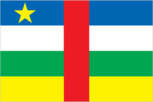
description: the flag consists of four horizontal stripes of equal size in blue (top), white, green, and yellow, with a vertical red band at the center; in the upper left corner of the flag, on the blue stripe, there is a five-pointed yellow star
meaning: integrates the colors of the pan-African movement and the French flag; the red symbolizes the blood shed in the fight for independence, blue represents the sky and liberty, white signifies peace and dignity, green embodies hope and faith, and yellow denotes tolerance; the star symbolizes the aspiration for a prosperous future
Capital
name
Bangui
etymology
founded as a French military post in 1889; its name translates to "rapids" in the local Bobangui dialect, reflecting the city's position above the first major rapids on the Ubangi River
time difference
UTC+1 (6 hours ahead of Washington, DC, during Standard Time)
geographic coordinates
4 22 N, 18 35 E
Suffrage
18 years of age; universal
Citizenship
citizenship by birth
no
citizenship by descent only
least one parent must be a citizen of the Central African Republic
dual citizenship recognized
yes
residency requirement for naturalization
35 years
Constitution
history
multiple previous constitutions exist; the most recent constitution was approved through a national referendum on 30 July 2023 and confirmed by the Constitutional Court on 30 August 2023
amendment process
proposals must receive the support of the government, a two-thirds majority from the National Council of Transition, and approval from the "Mediator of the Central African" crisis; for passage, a minimum of three-fourths majority vote is needed from the National Council members; certain constitutional provisions are non-amendable, including those regarding the secular and republican nature of government, fundamental rights and freedoms, amendment processes, and the powers of various high-level executive, parliamentary, and judicial officials
Country name
former
Ubangi-Shari, Central African Empire
etymology
self-descriptive nomenclature indicating the nation's geographical placement on the continent; the term "Africa" originates from the Roman name for the region that corresponds to modern Tunisia, "Africa terra," which meant "Land of the Afri" (the tribe that inhabited the area), but has since come to refer to the entire continent
abbreviation
CAR
local long form
République centrafricaine
local short form
none
conventional long form
Central African Republic
conventional short form
none
Independence
13 August 1960 (from France)
Legal system
civil law framework modeled after the French system
Government type
presidential republic
Judicial branch
highest court(s)
Supreme Court, known as Cour Supreme (exact number of judges unknown); Constitutional Court comprises 9 judges, with at least 3 being women
subordinate courts
high courts; magistrates' courts
judge selection and term of office
judges of the Supreme Court are appointed by the president; appointments for the Constitutional Court include 2 by the president, 1 by the speaker of the National Assembly, 2 elected by their peers, 2 elected advocates, and 2 law professors elected by their peers; judges serve non-renewable terms of 7 years
Executive branch
cabinet
Council of Ministers appointed by the president
chief of state
President Faustin-Archange TOUADÉRA (in office since 30 March 2016)
election results
2025: Faustin-Archange TOUADÉRA re-elected as president in the first round; vote percentages - Faustin-Archange TOUADÉRA (independent) 76.2%, Anicet Georges DOLOGUELE (URCA) 14.7%, others 9.1%
head of government
Prime Minister Félix MOLOUA (in office since 7 February 2022)
most recent election date
28 December 2025
election/appointment process
the current president was elected directly for a 5-year term; a constitutional referendum held in July 2023 abolished term limits and established 7-year terms
expected date of next election
December 2032
National holiday
Republic Day, 1 December (1958)
National color(s)
blue, white, green, yellow, red
National heritage
total World Heritage Sites
2 (natural)
selected World Heritage Site locales
Manovo-Gounda St. Floris National Park; Sangha Trinational Forest
Political parties
Action Party for Development or PAD
African Party for Radical Transformation and Integration of States or PATRIE
Alliance for Democracy and Progress or ADP
Be Africa ti e Kwe (also known as Central Africa for Us All or BTK)
Central African Democratic Rally or RDC
Central African Party for Integrated Development or PCDI
Democratic Movement for the Renewal and Evolution of Central Africa or MDREC
Kodro Ti Mo Kozo Si Movement or MKMKS
Movement for Democracy and Development or MDD
Movement for the Liberation of the Central African People or MLPC
National Convergence (also known as Kwa Na Kwa or KNK)
National Movement of Independents or MOUNI
National Union for Democracy and Progress or UNDP
National Union of Republican Democrats or UNADER
New Impetus for Central Africa or CANE
Party for Democracy and Solidarity - Kélémba or KPDS
Party for Democratic Governance or PGD
Path of Hope or CDE
Renaissance for Sustainable Development or RDD
Socialist Party or PS
Transformation Through Action Initiative or ITA
Union for Central African Renewal or URCA
Union for Renaissance and Development or URD
United Hearts Movement or MCU
Legislative branch
term in office
5 years
number of seats
140 (all directly elected)
electoral system
plurality/majority
legislature name
National Assembly (Assemblée nationale)
scope of elections
full renewal
legislative structure
unicameral
most recent election date
12/27/2020 to 7/25/2021
expected date of next election
28 December 2025
percentage of women in chamber
11.4%
parties elected and seats per party
United Hearts Movement (MCU) (63); National Movement of Independents (MOUNI) (9); Union for Central African Renewal (URCA) (7); Movement for the Liberation of the Central African People (MLPC) (7); Others (34); Independents (20)
National anthem(s)
title
"La Renaissance" (The Renaissance)
history
adopted in 1960; BOGANDA authored the lyrics of the anthem and served as the first prime minister of the autonomous French territory
lyrics/music
Barthelemy BOGANDA/Herbert PEPPER
National symbol(s)
elephant
Administrative divisions
14 prefectures (préfectures, singular - préfecture), 2 economic prefectures* (préfectures économiques, singular - préfecture économique), and 1 commune**; Bamingui-Bangoran, Bangui**, Basse-Kotto, Haute-Kotto, Haut-Mbomou, Kemo, Lobaye, Mambere-Kadei, Mbomou, Nana-Grebizi*, Nana-Mambere, Ombella-Mpoko, Ouaka, Ouham, Ouham-Pende, Sangha-Mbaere*, Vakaga
Diplomatic representation in the US
FAX
[1] (202) 332-9893
chancery
2704 Ontario Road NW, Washington, DC 20009
telephone
[1] (202) 483-7800
chief of mission
Ambassador Martial NDOUBOU (since 17 September 2018)
email address and website
[email protected]
https://www.usrcaembassy.org/
Diplomatic representation from the US
FAX
[236] 2161-4494
embassy
Avenue David Dacko, Bangui
telephone
[236] 2161-0200
mailing address
2060 Bangui Place, Washington DC 20521-2060
chief of mission
Ambassador (position currently vacant); Chargé d’Affaires Melanie Anne ZIMMERMAN (since July 2025)
email address and website
https://cf.usembassy.gov/
International organization participation
ACP, AfDB, AU, BDEAC, CEMAC, EITI (compliant country) (suspended), FAO, FZ, G-77, IAEA, IBRD, ICAO, ICCt, ICRM, IDA, IFAD, IFC, IFRCS, ILO, IMF, Interpol, IOC, IOM, ITSO, ITU, ITUC (NGOs), LCBC, MIGA, NAM, OIC (observer), OIF, OPCW, UN, UNCTAD, UNESCO, UNIDO, UNWTO, UPU, WCO, WHO, WIPO, WMO, WTO
International law organization participation
has not made an ICJ jurisdiction declaration; accepts ICCt jurisdiction
Economy
Budget
revenues
$360.48 million (2021 est.)
expenditures
$462.104 million (2021 est.)
Exports
Exports 2022
$293.074 million (2022 est.)
Exports 2023
$369.034 million (2023 est.)
Exports 2024
$425.306 million (2024 est.)
Imports
Imports 2022
$784.669 million (2022 est.)
Imports 2023
$742.108 million (2023 est.)
Imports 2024
$890.572 million (2024 est.)
Industries
mining of gold and diamonds, logging, brewing, and sugar refining
Labor force
2 million (2024 est.)
Public debt
Public debt 2016
56% of GDP (2016 est.)
Remittances
Remittances 2021
0% of GDP (2021 est.)
Remittances 2022
0% of GDP (2022 est.)
Remittances 2023
0% of GDP (2023 est.)
Exchange rates
Currency
Cooperation Financiere en Afrique Centrale francs (XAF) per US dollar -
Exchange rates 2020
575.586 (2020 est.)
Exchange rates 2021
554.531 (2021 est.)
Exchange rates 2022
623.76 (2022 est.)
Exchange rates 2023
606.57 (2023 est.)
Exchange rates 2024
606.345 (2024 est.)
Debt - external
Debt - external 2023
$724.179 million (2023 est.)
Economic overview
abundant natural resources; severe poverty; fragile public institutions and infrastructure; political and gender-based violence have resulted in the displacement of approximately 25% of the population; the blockade along the Bangui-Douala corridor has diminished economic activity and tax revenue; robust agricultural output has mitigated the downturn caused by COVID-19
Unemployment rate
Unemployment rate 2022
6% (2022 est.)
Unemployment rate 2023
5.9% (2023 est.)
Unemployment rate 2024
5.9% (2024 est.)
Exports - partners
UAE 54%, China 14%, France 6%, Turkey 5%, Belgium 4% (2023)
Imports - partners
China 16%, Cameroon 14%, France 8%, Belgium 6%, Cote d'Ivoire 5% (2023)
Real GDP per capita
Real GDP per capita 2022
$1,100 (2022 est.)
Real GDP per capita 2023
$1,100 (2023 est.)
Real GDP per capita 2024
$1,100 (2024 est.)
Real GDP growth rate
Real GDP growth rate 2022
0.5% (2022 est.)
Real GDP growth rate 2023
0.7% (2023 est.)
Real GDP growth rate 2024
1.5% (2024 est.)
Agricultural products
cassava, groundnuts, yams, coffee, maize, sesame seeds, taro, sugarcane, beef, milk (2023)
Exports - commodities
gold, wood, diamonds, vehicle parts/accessories, cotton (2023)
Imports - commodities
refined petroleum, cars, packaged medicine, vaccines, tanks and armored vehicles (2023)
Taxes and other revenues
8.2% (of GDP) (2021 est.)
GDP (official exchange rate)
$2.752 billion (2024 est.)
GDP - composition, by end use
household consumption
94.7% (2024 est.)
government consumption
9.7% (2024 est.)
investment in inventories
0% (2024 est.)
investment in fixed capital
15.4% (2024 est.)
exports of goods and services
15.5% (2024 est.)
imports of goods and services
-32.4% (2024 est.)
Population below poverty line
68.8% (2021 est.)
Inflation rate (consumer prices)
Inflation rate (consumer prices) 2021
4.3% (2021 est.)
Inflation rate (consumer prices) 2022
5.6% (2022 est.)
Inflation rate (consumer prices) 2023
3% (2023 est.)
Industrial production growth rate
9.7% (2024 est.)
Real GDP (purchasing power parity)
Real GDP (purchasing power parity) 2022
$5.795 billion (2022 est.)
Real GDP (purchasing power parity) 2023
$5.836 billion (2023 est.)
Real GDP (purchasing power parity) 2024
$5.926 billion (2024 est.)
Youth unemployment rate (ages 15-24)
male
8.5% (2024 est.)
total
9.5% (2024 est.)
female
10.6% (2024 est.)
Reserves of foreign exchange and gold
Reserves of foreign exchange and gold 2021
$483.872 million (2021 est.)
Reserves of foreign exchange and gold 2022
$374.405 million (2022 est.)
Reserves of foreign exchange and gold 2023
$479.593 million (2023 est.)
GDP - composition, by sector of origin
industry
17.8% (2024 est.)
services
40.5% (2024 est.)
agriculture
32.5% (2024 est.)
Household income or consumption by percentage share
lowest 10%
2.1% (2021 est.)
highest 10%
33.1% (2021 est.)
Gini Index coefficient - distribution of family income
Gini Index coefficient - distribution of family income 2021
43 (2021 est.)
Energy
Coal
imports
1 metric tons (2023 est.)
proven reserves
3 million metric tons (2023 est.)
Petroleum
refined petroleum consumption
2,000 bbl/day (2023 est.)
Electricity
consumption
132.105 million kWh (2023 est.)
installed generating capacity
63,000 kW (2023 est.)
transmission/distribution losses
10 million kWh (2023 est.)
Electricity access
electrification - rural areas
1.6%
electrification - urban areas
34.7%
electrification - total population
15.7% (2022 est.)
Energy consumption per capita
Total energy consumption per capita 2023
954,000 Btu/person (2023 est.)
Electricity generation sources
fossil fuels
0.8% of total installed capacity (2023 est.)
hydroelectricity
99.2% of total installed capacity (2023 est.)
Communications
Internet users
percent of population
8% (2019 est.)
Broadcast media
The state-operated network, Radiodiffusion Télévision Centrafricaine, offers a restricted range of television broadcasts; the government-run radio network is augmented by a handful of privately owned radio stations and several community radio outlets; broadcasts from a minimum of 2 international networks can be received (2017)
Internet country code
.cf
Telephones - fixed lines
total subscriptions
2,090 (2022 est.)
subscriptions per 100 inhabitants
(2022 est.) less than 1
Telephones - mobile cellular
total subscriptions
1.98 million (2022 est.)
subscriptions per 100 inhabitants
39 (2022 est.)
Broadband - fixed subscriptions
total
1,000 (2022 est.) Data available for 2019 only.
subscriptions per 100 inhabitants
(2022 est.) less than 1
Transportation
Airports
43 (2025)
Civil aircraft registration country code prefix
TL
Military & Security
Military - note
The Central African Armed Forces (FACA) concentrate on internal security; following the coup in 2013, various armed factions have emerged within the nation, executing assaults, seizing control of regions, and jeopardizing safety; this coup led to the disintegration of the FACA’s institutional framework; its personnel were overpowered and compelled to escape to neighboring nations; it is estimated that merely 10% of the FACA members returned subsequently; throughout the last decade, the FACA has endeavored to reconstruct itself with substantial foreign support, including assistance from France, the EU, Russia, Rwanda, Uganda, and the UN; Russian private military contractors and Rwandan military personnel have provided help to the FACA in its confrontations with rebel factions.
The UN Multidimensional Integrated Stabilization Mission in the Central African Republic (MINUSCA) has been active in the country since 2014; its objectives encompass ensuring security, safeguarding civilians, facilitating humanitarian aid, disarming and demobilizing armed factions, and supporting the nation’s transitional government (2025).
Military expenditures
Military Expenditures 2020
1.8% of GDP (2020 est.)
Military Expenditures 2021
1.8% of GDP (2021 est.)
Military Expenditures 2022
1.7% of GDP (2022 est.)
Military Expenditures 2023
1.8% of GDP (2023 est.)
Military Expenditures 2024
2.5% of GDP (2024 est.)
Military and security forces
Central African Armed Forces (Forces Armees Centrafricaines, FACA): This includes the Army (which features an air squadron, Escadrille Centrafricaine).
Ministry of Interior: National Gendarmerie (Gendarmerie Nationale), National Police (2025).
Military service age and obligation
Voluntary military service is available for individuals aged 18-22, encompassing both men and women; there is no conscription, though the constitution allows for the possibility of conscription in the event of an imminent threat to the nation (2025).
Military equipment inventories and acquisitions
Much of the military's heavy armaments and equipment were lost during the civil conflict from 2012 to 2014; prior to this war, the majority of its inventory was sourced from French, Russian, or Soviet origins; in recent years, it has acquired some donated materials from China and Russia, including armored vehicles, drones, helicopters, jet trainer aircraft, and various light weapons (2025).
Military and security service personnel strengths
estimated 10-15,000 active FACA (2025)
Transnational Issues
Refugees and internally displaced persons
IDPs
469,342 (2024 est.)
refugees
53,378 (2024 est.)