CapitalDjibouti
LanguagesFrench , Arabic , Somali, Afar
CurrencyDjiboutian francs
Governmentpresidential republic
Bamwor Indexes
Djibouti — Q1 2026
IBEUBamwor Urban Scale Index
61.80%
Rank #18 of 237
View full ranking →
IBCPBamwor Population Concentration Index
73.62%
Rank #28 of 237
View full ranking →
IBDABamwor Settlement Density Index
3.02per 1K km²
Rank #231 of 241
View full ranking →
IBCXBamwor Country Complexity Index
45.22/100
Rank #171 of 234
View full ranking →
IBEEBamwor Economic Stability Index
75.57/100
Rank #207 of 220
View full ranking →
IBFMBamwor Military Strength Index
26.46/100
Rank #120 of 124
View full ranking →
IBDIBamwor Digital Infrastructure Index
60.75/100
Rank #151 of 206
View full ranking →
IBSABamwor Healthcare Index
56.86/100
Rank #181 of 218
View full ranking →
Djibouti Intelligence Report
Download PDF with 20+ statistics, rankings & proprietary indices
Introduction
Background
Present-day Djibouti was the site of the medieval Ifat and Adal Sultanates. In the late 19th century, the Afar sultans signed treaties with the French that allowed the latter to establish the colony of French Somaliland in 1862. The French signed additional treaties with the ethnic Somali in 1885.
Tension between the ethnic Afar and Somali populations increased over time, as the ethnic Somalis perceived that the French unfairly favored the Afar and gave them disproportionate influence in local governance. In 1958, the French held a referendum that provided residents of French Somaliland the option to either continue their association with France or to join neighboring Somalia as it established its independence. Ethnic Somali protested the vote, because French colonial leaders did not recognize many Somali as residents, which gave the Afar outsized influence in the decision to uphold ties with France. After a second referendum in 1967, the French changed the territory’s name to the French Territory of the Afars and the Issas, in part to underscore their relationship with the ethnic Afar and downplay the significance of the ethnic Somalis. A final referendum in 1977 established Djibouti as an independent nation and granted ethnic Somalis Djiboutian nationality, formally resetting the balance of power between the majority ethnic Somalis and minority ethnic Afar residents. Upon independence, the country was named after its capital city of Djibouti. Hassan Gouled APTIDON, an ethnic Somali leader, installed an authoritarian one-party state and served as president until 1999. Unrest between the Afar minority and Somali majority culminated in a civil war during the 1990s that ended in 2001 with a peace accord between Afar rebels and the Somali Issa-dominated government. In 1999, Djibouti's first multiparty presidential election resulted in the election of Ismail Omar GUELLEH as president; he was reelected to a second term in 2005 and extended his tenure in office via a constitutional amendment, which allowed him to serve his third and fourth terms, and to begin a fifth term in 2021.
Djibouti occupies a strategic geographic location at the intersection of the Red Sea and the Gulf of Aden. Its ports handle 95% of Ethiopia’s trade. Djibouti’s ports also service transshipments between Europe, the Middle East, and Asia. The government has longstanding ties to France, which maintains a military presence in the country, as do the US, Japan, Italy, Germany, Spain, and China.
Geography
Area
land
23,180 sq km
water
20 sq km
total
23,200 sq km
Climate
arid; hot, parched
Terrain
plateau and coastal plain divided by central mountain ranges
Land use
other
26.2% (2023 est.)
forest
0.3% (2023 est.)
agricultural land
73.5% (2023 est.)
agricultural land: arable land
arable land: 0.1% (2023 est.)
agricultural land: permanent crops
permanent crops: 0% (2023 est.)
agricultural land: permanent pasture
permanent pasture: 73.3% (2023 est.)
Location
Located in Eastern Africa, adjacent to the Gulf of Aden and the Red Sea, lying between Eritrea and Somalia
Coastline
314 km
Elevation
lowest point
Lac Assal -155 m
highest point
Moussa Ali 2,021 m
mean elevation
430 m
Irrigated land
10 sq km (2012)
Map references
Africa
Land boundaries
total
528 km
border countries
Eritrea 125 km; Ethiopia 342 km; Somalia 61 km
Maritime claims
contiguous zone
24 nm
territorial sea
12 nm
exclusive economic zone
200 nm
Natural hazards
natural disasters include earthquakes and droughts; infrequent cyclonic activity from the Indian Ocean results in intense rainfall and flash flooding
volcanic activity: exhibits limited volcanism; Ardoukoba (298 m) last erupted in 1978; Manda-Inakir, situated along the border with Ethiopia, is also known for historical eruptions
Geography - note
holds a vital position near the most active shipping routes globally and in proximity to Arabian oil reserves; Lac Assal (Lake Assal) represents the lowest elevation in Africa and is recognized as the saltiest body of water worldwide
Natural resources
resources include geothermal energy, gold, clay, granite, limestone, marble, salt, diatomite, gypsum, pumice, and petroleum
Area - comparative
slightly less extensive than the state of New Jersey
Geographic coordinates
11 30 N, 43 00 E
Population distribution
the eastern region is the most densely inhabited; Djibouti is the largest urban center, while other cities within the nation are significantly smaller, as depicted in this population distribution map
Major lakes (area sq km)
salt water lake(s)
Abhe Bad/Abhe Bid Hayk (shared with Ethiopia) - 780 sq km
People & Society
Languages
French (official), Arabic (official), Somali, Afar
Religions
The majority of the population is Sunni Muslim, comprising 94% of Djibouti's inhabitants, with the remaining 6% consisting mainly of foreign nationals, including Shia Muslims, Christians, Hindus, Jews, Baha'is, and atheists.
Sex ratio
at birth
1.03 male(s)/female
0-14 years
1.01 male(s)/female
15-64 years
0.77 male(s)/female
total population
0.83 male(s)/female (2024 est.)
65 years and over
0.77 male(s)/female
Birth rate
21.46 births/1,000 population (2025 est.)
Death rate
7 deaths/1,000 population (2025 est.)
Median age
male
24.4 years
total
26.7 years (2025 est.)
female
27.9 years
Population
male
458,988
total
1,013,703 (2025 est.)
female
554,715
Nationality
noun
Djiboutian(s)
adjective
Djiboutian
Urbanization
urban population
78.6% of total population (2023)
rate of urbanization
1.56% annual rate of change (2020-25 est.)
Age structure
0-14 years
28.4% (male 141,829/female 140,696)
15-64 years
67.4% (male 290,654/female 379,778)
65 years and over
4.2% (2024 est.) (male 18,313/female 23,704)
Ethnic groups
The ethnic composition includes 60% Somali, 35% Afar, and 5% from other groups, primarily Yemeni Arabs, along with smaller communities of French, Ethiopian, and Italian descent.
Child marriage
women married by age 15
1.4% (2019)
women married by age 18
6.5% (2019)
Dependency ratios
total dependency ratio
48.1 (2025 est.)
youth dependency ratio
41.7 (2025 est.)
potential support ratio
15.7 (2025 est.)
elderly dependency ratio
6.4 (2025 est.)
Physician density
0.21 physicians/1,000 population (2022)
Health expenditure
Health expenditure (as % of GDP)
2.9% of GDP (2021)
Health expenditure (as % of national budget)
5.2% of national budget (2022 est.)
Net migration rate
3.94 migrant(s)/1,000 population (2025 est.)
Hospital bed density
1.4 beds/1,000 population (2018 est.)
Total fertility rate
2.09 children born/woman (2025 est.)
Drinking water source
improved: rural
rural: 47.3% of population (2022 est.)
improved: total
total: 76.2% of population (2022 est.)
improved: urban
urban: 84.1% of population (2022 est.)
unimproved: rural
rural: 52.7% of population (2022 est.)
unimproved: total
total: 23.8% of population (2022 est.)
unimproved: urban
urban: 15.9% of population (2022 est.)
Education expenditure
Education expenditure (% GDP)
3.8% of GDP (2018 est.)
Education expenditure (% national budget)
14.5% national budget (2018 est.)
Infant mortality rate
male
52.1 deaths/1,000 live births
total
44.3 deaths/1,000 live births (2025 est.)
female
38 deaths/1,000 live births
Population growth rate
1.84% (2025 est.)
Gross reproduction rate
1.03 (2025 est.)
Population distribution
The eastern region contains the most densely populated areas; Djibouti City is the largest urban center, while other cities in the nation are significantly smaller, as illustrated in the accompanying population distribution map.
Life expectancy at birth
male
63.4 years
female
68.5 years
total population
65.9 years (2024 est.)
Maternal mortality ratio
162 deaths/100,000 live births (2023 est.)
Sanitation facility access
improved: rural
rural: 24.2% of population (2022 est.)
improved: total
total: 74% of population (2022 est.)
improved: urban
urban: 87.7% of population (2022 est.)
unimproved: rural
rural: 75.8% of population (2022 est.)
unimproved: total
total: 26% of population (2022 est.)
unimproved: urban
urban: 12.3% of population (2022 est.)
Alcohol consumption per capita
beer
0.05 liters of pure alcohol (2019 est.)
wine
0.02 liters of pure alcohol (2019 est.)
total
0.21 liters of pure alcohol (2019 est.)
spirits
0.14 liters of pure alcohol (2019 est.)
other alcohols
0 liters of pure alcohol (2019 est.)
Major urban areas - population
600,000 DJIBOUTI (capital) (2023)
Obesity - adult prevalence rate
13.5% (2016)
Currently married women (ages 15-49)
46.5% (2017 est.)
Children under the age of 5 years underweight
17.7% (2023 est.)
Environment
Climate
arid; hot, parched
Land use
other
26.2% (2023 est.)
forest
0.3% (2023 est.)
agricultural land
73.5% (2023 est.)
agricultural land: arable land
arable land: 0.1% (2023 est.)
agricultural land: permanent crops
permanent crops: 0% (2023 est.)
agricultural land: permanent pasture
permanent pasture: 73.3% (2023 est.)
Urbanization
urban population
78.6% of total population (2023)
rate of urbanization
1.56% annual rate of change (2020-25 est.)
Waste and recycling
municipal solid waste generated annually
115,000 tons (2024 est.)
percent of municipal solid waste recycled
14.9% (2022 est.)
Environmental issues
insufficient access to drinkable water; contamination of water sources; restricted cultivable land; loss of forests (woodlands at risk due to farming and fuelwood consumption); land degradation; threatened wildlife species
Total water withdrawal
municipal
16 million cubic meters (2022 est.)
industrial
0 cubic meters (2022 est.)
agricultural
3 million cubic meters (2022 est.)
Carbon dioxide emissions
total emissions
685,000 metric tonnes of CO2 (2023 est.)
from coal and metallurgical coke
45,000 metric tonnes of CO2 (2023 est.)
from petroleum and other liquids
640,000 metric tonnes of CO2 (2023 est.)
Particulate matter emissions
21 micrograms per cubic meter (2019 est.)
Total renewable water resources
300 million cubic meters (2022 est.)
International environmental agreements
party to
Biodiversity, Climate Change, Climate Change-Kyoto Protocol, Climate Change-Paris Agreement, Comprehensive Nuclear Test Ban, Desertification, Endangered Species, Hazardous Wastes, Law of the Sea, Ozone Layer Protection, Ship Pollution, Wetlands
signed, but not ratified
none of the selected agreements
Government
Flag
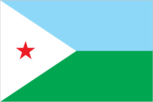
description: consists of two equal horizontal bands in light blue (top) and light green, featuring a white isosceles triangle at the left side, which contains a five-pointed red star at its center
meaning: the blue represents the sea, sky, and the Issa Somali people; green signifies the earth and the Afar people; white symbolizes peace; the red star denotes the fight for independence and unity
Capital
name
Djibouti
etymology
the name is believed to originate from the Afar term gabouri, translating to "plate," which refers to a ceremonial palm-fiber plate
time difference
UTC+3 (8 hours ahead of Washington, DC, during Standard Time)
geographic coordinates
11 35 N, 43 09 E
Suffrage
18 years of age; universal
Citizenship
citizenship by birth
no
citizenship by descent only
the mother must be a citizen of Djibouti
dual citizenship recognized
no
residency requirement for naturalization
10 years
Constitution
history
approved by referendum 4 September 1992
amendment process
proposals are put forward by either the president of the republic or the National Assembly; for the Assembly to consider a proposal, at least one third of its members must agree; a simple majority vote in the Assembly is required for passage, along with approval by a simple majority in a referendum; the president is permitted to bypass a referendum if the proposal is approved by a two-thirds majority in the Assembly; constitutional provisions regarding Djibouti's sovereignty, its republican government structure, and its pluralist democracy are immutable
Country name
former
French Somaliland, French Territory of the Afars and Issas
etymology
the country name derives from the capital city of Djibouti
local long form
République de Djibouti (French)/ Jumhuriyat Jibuti (Arabic)
local short form
Djibouti (French)/ Jibuti (Arabic)
conventional long form
Republic of Djibouti
conventional short form
Djibouti
Independence
27 June 1977 (from France)
Legal system
a mixed legal system primarily based on the French civil code (as it was in 1997), Islamic law (pertaining to family and succession matters), and customary law
Government type
presidential republic
Judicial branch
highest court(s)
Supreme Court or Cour Suprême (comprised of NA magistrates); Constitutional Council (composed of 6 magistrates)
subordinate courts
High Court of Appeal; Courts of First Instance; customary courts; State Court (which took the place of sharia courts in 2003)
judge selection and term of office
magistrates of the Supreme Court are appointed by the president with counsel from the Superior Council of the Magistracy (CSM), a 10-member panel made up of 4 judges, 3 non-parliamentarian members appointed by the president, and 3 appointed by the National Assembly president or speaker; magistrates serve for life, retiring at 65; appointments to the Constitutional Council consist of 2 magistrates chosen by the president, 2 by the National Assembly president, and 2 by the CSM; magistrates serve non-renewable 8-year terms
Executive branch
cabinet
Council of Ministers appointed by the prime minister
chief of state
President Ismail Omar GUELLEH (since 8 May 1999)
election results
2021: Ismail Omar GUELLEH was reelected as president for a fifth term; vote percentages - Ismail Omar GUELLEH (RPP) 97.4%, Zakaria Ismael FARAH (MDEND) 2.7%
head of government
Prime Minister Abdoulkader Kamil MOHAMED (since 1 April 2013)
most recent election date
9 April 2021
election/appointment process
the president is elected directly by an absolute-majority popular vote in up to 2 rounds, if necessary, for a term of 5 years; the prime minister is appointed by the president
expected date of next election
April 2026
National holiday
Independence Day, 27 June (1977)
National color(s)
light blue, green, white, red
Political parties
Front for Restoration of Unity and Democracy (Front pour la Restauration de l'Unite Democratique) or FRUD
National Democratic Party or PND
People's Rally for Progress or RPP
Peoples Social Democratic Party or PPSD
Union for Democracy and Justice or UDJ
Union for the Presidential Majority coalition or UMP
Union of Reform Partisans or UPR
Legislative branch
term in office
5 years
number of seats
65 (all directly elected)
electoral system
mixed system
legislature name
National Assembly (Assemblée nationale)
scope of elections
full renewal
legislative structure
unicameral
most recent election date
2/24/2023
expected date of next election
February 2028
percentage of women in chamber
26.2%
parties elected and seats per party
Union for the Presidential Majority (UMP) (58); Union for Democracy and Justice (UDJ) (7)
National anthem(s)
title
"Jabuuti" (Djibouti)
history
adopted 1977
lyrics/music
Aden ELMI/Abdi ROBLEH
National symbol(s)
red star
Administrative divisions
6 districts (cercles, singular - cercle); Ali Sabieh, Arta, Dikhil, Djibouti, Obock, Tadjourah
Diplomatic representation in the US
FAX
[1] (202) 331-0302
chancery
1156 15th Street NW, Suite 515, Washington, DC 20005
telephone
[1] (202) 331-0270
chief of mission
Ambassador Mohamed Siad DOUALEH (28 January 2016)
email address and website
[email protected]
https://www.djiboutiembassyus.org/
Diplomatic representation from the US
FAX
[253] 21-45-31-29
embassy
Lot 350-B Haramouss, B.P. 185
telephone
[253] 21-45-30-00
mailing address
2150 Djibouti Place, Washington DC 20521-2150
chief of mission
Ambassador Cynthia KIERSCHT (since 17 October 2024)
email address and website
[email protected]
https://dj.usembassy.gov/
International organization participation
ACP, AfDB, AFESD, AMF, ATMIS, AU, CAEU (candidates), COMESA, FAO, G-77, IBRD, ICAO, ICCt, ICRM, IDA, IDB, IFAD, IFC, IFRCS, IGAD, ILO, IMF, IMO, Interpol, IOC, IOM, IPU, ITU, ITUC (NGOs), LAS, MIGA, MINURSO, NAM, OIC, OIF, OPCW, UN, UNCTAD, UNESCO, UNHCR, UNIDO, UNWTO, UPU, WCO, WFTU (NGOs), WHO, WIPO, WMO, WTO
International law organization participation
accepts compulsory ICJ jurisdiction with reservations; accepts ICCt jurisdiction
Economy
Budget
revenues
$725 million (2019 est.)
expenditures
$754 million (2019 est.)
Exports
Exports 2022
$5.674 billion (2022 est.)
Exports 2023
$5.877 billion (2023 est.)
Exports 2024
$5.25 billion (2024 est.)
Imports
Imports 2022
$5.096 billion (2022 est.)
Imports 2023
$5.269 billion (2023 est.)
Imports 2024
$4.765 billion (2024 est.)
Industries
construction, agricultural processing, shipping
Labor force
265,200 (2024 est.)
Public debt
Public debt 2016
33.7% of GDP (2016 est.)
Remittances
Remittances 2022
1.6% of GDP (2022 est.)
Remittances 2023
1.5% of GDP (2023 est.)
Remittances 2024
1.4% of GDP (2024 est.)
Exchange rates
Currency
Djiboutian francs (DJF) per US dollar -
Exchange rates 2020
177.721 (2020 est.)
Exchange rates 2021
177.721 (2021 est.)
Exchange rates 2022
177.721 (2022 est.)
Exchange rates 2023
177.721 (2023 est.)
Exchange rates 2024
177.721 (2024 est.)
Debt - external
Debt - external 2023
$2.531 billion (2023 est.)
Economic overview
The economy of the Horn of Africa is reliant on food imports and is influenced by various national military bases and trade through ports; it has shown considerable resilience to disruptions caused by COVID-19; it serves as a significant re-export hub; relations with Ethiopia and China are on the rise; there is ongoing investment in infrastructure.
Unemployment rate
Unemployment rate 2022
26.4% (2022 est.)
Unemployment rate 2023
26.2% (2023 est.)
Unemployment rate 2024
25.9% (2024 est.)
Exports - partners
Ethiopia 77%, UAE 5%, China 3%, Singapore 2%, France 2% (2023)
Imports - partners
China 32%, India 12%, UAE 10%, Turkey 6%, Morocco 5% (2023)
Real GDP per capita
Real GDP per capita 2022
$6,200 (2022 est.)
Real GDP per capita 2023
$6,500 (2023 est.)
Real GDP per capita 2024
$6,800 (2024 est.)
Real GDP growth rate
Real GDP growth rate 2022
5.2% (2022 est.)
Real GDP growth rate 2023
7.4% (2023 est.)
Real GDP growth rate 2024
6% (2024 est.)
Agricultural products
vegetables, beans, milk, beef, camel milk, lemons/limes, goat meat, lamb/mutton, tomatoes, beef offal (2023)
Exports - commodities
raw sugar, seed oils, cars, palm oil, rice (2023)
Imports - commodities
refined petroleum, palm oil, fertilizers, cars, seed oils (2023)
Current account balance
Current account balance 2022
$656.207 million (2022 est.)
Current account balance 2023
$721.349 million (2023 est.)
Current account balance 2024
$610.124 million (2024 est.)
GDP (official exchange rate)
$4.086 billion (2024 est.)
GDP - composition, by end use
household consumption
73% (2024 est.)
government consumption
18.8% (2024 est.)
investment in inventories
-30.1% (2024 est.)
investment in fixed capital
26.3% (2024 est.)
exports of goods and services
160.8% (2024 est.)
imports of goods and services
-148.3% (2024 est.)
Population below poverty line
21.1% (2017 est.)
Inflation rate (consumer prices)
Inflation rate (consumer prices) 2022
5.2% (2022 est.)
Inflation rate (consumer prices) 2023
1.5% (2023 est.)
Inflation rate (consumer prices) 2024
2.1% (2024 est.)
Industrial production growth rate
9.7% (2024 est.)
Real GDP (purchasing power parity)
Real GDP (purchasing power parity) 2022
$7.028 billion (2022 est.)
Real GDP (purchasing power parity) 2023
$7.546 billion (2023 est.)
Real GDP (purchasing power parity) 2024
$7.995 billion (2024 est.)
Youth unemployment rate (ages 15-24)
male
75.3% (2024 est.)
total
76.3% (2024 est.)
female
77.9% (2024 est.)
Reserves of foreign exchange and gold
Reserves of foreign exchange and gold 2022
$589.437 million (2022 est.)
Reserves of foreign exchange and gold 2023
$502.034 million (2023 est.)
Reserves of foreign exchange and gold 2024
$348.725 million (2024 est.)
GDP - composition, by sector of origin
industry
15.4% (2024 est.)
services
75.5% (2024 est.)
agriculture
2.6% (2024 est.)
Household income or consumption by percentage share
lowest 10%
1.9% (2017 est.)
highest 10%
32.3% (2017 est.)
Gini Index coefficient - distribution of family income
Gini Index coefficient - distribution of family income 2017
41.6 (2017 est.)
Energy
Coal
exports
8 metric tons (2023 est.)
imports
19,000 metric tons (2023 est.)
Petroleum
refined petroleum consumption
5,000 bbl/day (2023 est.)
Electricity
imports
512 million kWh (2023 est.)
consumption
584.997 million kWh (2023 est.)
installed generating capacity
210,000 kW (2023 est.)
transmission/distribution losses
128.74 million kWh (2023 est.)
Electricity access
electrification - rural areas
36.6%
electrification - urban areas
72.8%
electrification - total population
65% (2022 est.)
Energy consumption per capita
Total energy consumption per capita 2023
10.428 million Btu/person (2023 est.)
Electricity generation sources
wind
34.2% of total installed capacity (2023 est.)
solar
0.5% of total installed capacity (2023 est.)
fossil fuels
65.3% of total installed capacity (2023 est.)
Communications
Internet users
percent of population
65% (2023 est.)
Broadcast media
The only terrestrial television station is operated by the state-owned Radiodiffusion-Télévision de Djibouti, alongside two domestic radio networks; there are no private television or radio stations; several international broadcasters' transmissions can be accessed (2019)
Internet country code
.dj
Telephones - fixed lines
total subscriptions
28,700 (2023 est.)
subscriptions per 100 inhabitants
3 (2023 est.)
Telephones - mobile cellular
total subscriptions
559,000 (2023 est.)
subscriptions per 100 inhabitants
49 (2023 est.)
Broadband - fixed subscriptions
total
17,000 (2023 est.)
subscriptions per 100 inhabitants
1 (2023 est.)
Transportation
Ports
large
0
small
2
medium
0
key ports
Djibouti, Doraleh
very small
0
total ports
2 (2024)
ports with oil terminals
2
Airports
10 (2025)
Railways
total
97 km (2017) (Djibouti segment of the 756 km Addis Ababa-Djibouti railway)
standard gauge
97 km (2017) 1.435-m gauge
Heliports
6 (2025)
Merchant marine
total
40 (2023)
by type
1 bulk carrier, 1 container ship, 4 general cargo vessels, 13 oil tankers, 21 others
Civil aircraft registration country code prefix
J2
Military & Security
Military - note
Djibouti's military forces are largely focused on border, coastal, and internal security duties, such as counterterrorism; as recently as February 2025, Djiboutian forces have conducted operations near its border with Ethiopia against members of the Armed Front for the Restoration of Unity and Democracy (FRUD A), which Djibouti considers a terrorist group
China, France, Italy, Japan, and the US maintain bases in Djibouti for regional military missions, including counterterrorism, counter-piracy, crisis response, and security assistance; other countries, such as Germany and Spain, have smaller military contingents; the EU and NATO also maintain a presence in Djibouti to support multinational naval counter-piracy operations and maritime training efforts (2025)
Military deployments
approximately 1,500 Somalia (AUSSOM) (2025)
Military expenditures
Military Expenditures 2015
2.5% of GDP (2015 est.)
Military Expenditures 2016
2.7% of GDP (2016 est.)
Military Expenditures 2017
3.3% of GDP (2017 est.)
Military Expenditures 2018
3.5% of GDP (2018 est.)
Military Expenditures 2019
3.5% of GDP (2019 est.)
Military and security forces
Djibouti Armed Forces (Forces Armées Djiboutiennes or FAD): includes the Djiboutian (or National) Army, Djiboutian Navy (which encompasses the Djiboutian Coast Guard), and the Djiboutian Air Force; Djiboutian National Gendarmerie.
Ministry of Interior: National Police (Police Nationale) (2025)
Military service age and obligation
ages 18-26 are eligible for voluntary military service (2025)
Military equipment inventories and acquisitions
the inventory of the FAD consists largely of older or second-hand equipment sourced from a diverse range of suppliers including China, France, Italy, Japan, the Netherlands, Russia/former Soviet Union, South Africa, Türkiye, and the US (2025)
Military and security service personnel strengths
approximately 10-12,000 personnel in active Armed Forces, including the Gendarmerie (2025)
Terrorism
Terrorist group(s)
al-Shabaab
Transnational Issues
Trafficking in persons
tier rating
Tier 2 Watch List — Although Djibouti does not completely satisfy the minimum criteria for eradicating trafficking, it is making noteworthy efforts in this regard, which has resulted in Djibouti being elevated to the Tier 2 Watch List; for further information, please visit: https://www.state.gov/reports/2025-trafficking-in-persons-report/djibouti/
Refugees and internally displaced persons
refugees
32,636 (2024 est.)