CapitalCairo
LanguagesArabic is the official language
CurrencyEgyptian pounds
Governmentpresidential republic
Bamwor Indexes
Egypt — Q1 2026
IBEUBamwor Urban Scale Index
8.51%
Rank #175 of 237
View full ranking →
IBCPBamwor Population Concentration Index
18.83%
Rank #166 of 237
View full ranking →
IBDABamwor Settlement Density Index
12.07per 1K km²
Rank #203 of 241
View full ranking →
IBCXBamwor Country Complexity Index
74.41/100
Rank #20 of 234
View full ranking →
IBEEBamwor Economic Stability Index
84.25/100
Rank #149 of 220
View full ranking →
IBFMBamwor Military Strength Index
65.20/100
Rank #26 of 124
View full ranking →
IBDIBamwor Digital Infrastructure Index
70.60/100
Rank #122 of 206
View full ranking →
IBEDBamwor Education Index
69.70/100
Rank #54 of 119
View full ranking →
IBSABamwor Healthcare Index
72.55/100
Rank #78 of 218
View full ranking →
Egypt Intelligence Report
Download PDF with 20+ statistics, rankings & proprietary indices
Introduction
Background
The regularity and richness of the annual Nile River flood, coupled with semi-isolation provided by deserts to the east and west, allowed for the development of one of the world's great civilizations in Egypt. A unified kingdom arose circa 3200 B.C., and a series of dynasties ruled in Egypt for the next three millennia. The last native dynasty fell to the Persians in 341 B.C., who in turn were replaced by the Greeks, Romans, and Byzantines. Arab conquerors introduced Islam and the Arabic language in the 7th century and ruled for the next six centuries. The Mamluks, a local military caste, took control around 1250 and continued to govern after the Ottoman Turks conquered Egypt in 1517.
Completion of the Suez Canal in 1869 elevated Egypt as an important world transportation hub. Ostensibly to protect its investments, Britain seized control of Egypt's government in 1882, but the country's nominal allegiance to the Ottoman Empire continued until 1914. Egypt gained partial independence from the UK in 1922 and full sovereignty in 1952. British forces evacuated the Suez Canal Zone in 1956. The completion of the Aswan High Dam in 1971 and the resultant Lake Nasser have reaffirmed the time-honored place of the Nile River in the agriculture and ecology of Egypt. A rapidly growing population (the largest in the Arab world), limited arable land, and dependence on the Nile all continue to overtax resources and stress society. The government has struggled to meet the demands of Egypt's fast-growing population as it implements large-scale infrastructure projects, energy cooperation, and foreign direct investment appeals.
Inspired by the 2010 Tunisian revolution, Egyptian opposition groups led demonstrations and labor strikes countrywide, culminating in President Hosni MUBARAK's ouster in 2011. Egypt's military assumed national leadership until a new legislature was in place in early 2012; later that same year, Muslim Brotherhood candidate Mohamed MORSI won the presidential election. Following protests throughout the spring of 2013 against MORSI's government and the Muslim Brotherhood, the Egyptian Armed Forces intervened and removed MORSI from power in July 2013 and replaced him with interim president Adly MANSOUR. Simultaneously, the government began enacting laws to limit freedoms of assembly and expression. In 2014, voters approved a new constitution by referendum and then elected former defense minister Abdel Fattah EL-SISI president. EL-SISI was reelected to a second four-year term in 2018 and a third term in December 2023.
Geography
Area
land
995,450 sq km
water
6,000 sq km
total
1,001,450 sq km
Climate
arid climate characterized by scorching, dry summers and mild winters
Terrain
extensive desert plateau intersected by the Nile valley and delta
Land use
other
95.9% (2023 est.)
forest
0% (2023 est.)
agricultural land
4.1% (2023 est.)
agricultural land: arable land
arable land: 3.1% (2023 est.)
agricultural land: permanent crops
permanent crops: 1% (2023 est.)
agricultural land: permanent pasture
permanent pasture: 0% (2022 est.)
Location
Located in Northern Africa, adjacent to the Mediterranean Sea, flanked by Libya and the Gaza Strip, and bordered by the Red Sea to the north of Sudan, which includes the Asian Sinai Peninsula
Coastline
2,450 km
Elevation
lowest point
Qattara Depression -133 m
highest point
Mount Catherine 2,629 m
mean elevation
321 m
Irrigated land
36,500 sq km (2012)
Major aquifers
Nubian Aquifer System
Map references
Africa
Land boundaries
total
2,612 km
border countries
Gaza Strip 13 km; Israel 208 km; Libya 1,115 km; Sudan 1,276 km
Maritime claims
contiguous zone
24 nm
territorial sea
12 nm
continental shelf
200 nm
exclusive economic zone
200 nm or the equidistant median line with Cyprus
Natural hazards
experiences intermittent droughts; subject to frequent seismic activity; prone to sudden floods; landslides; seasonal hot windstorms known as khamsin occur during spring; dust storms; sandstorms
Geography - note
controls the Sinai Peninsula, which serves as the sole land connection between Africa and the rest of the Eastern Hemisphere; oversees the Suez Canal, a maritime route linking the Indian Ocean to the Mediterranean Sea
Natural resources
oil, natural gas, iron ore, phosphates, manganese, limestone, gypsum, talc, asbestos, lead, rare earth elements, zinc
Area - comparative
over eight times larger than Ohio; slightly more than three times the area of New Mexico
Geographic coordinates
27 00 N, 30 00 E
Population distribution
around 95% of the populace resides within 20 km (12 mi) of the Nile River and its delta; extensive portions of the nation are either sparsely inhabited or completely uninhabited, as depicted in this population distribution map
Major lakes (area sq km)
salt water lake(s)
Lake Manzala - 1,360 sq km
note - largest of the lakes in the Nile Delta
Major watersheds (area sq km)
Atlantic Ocean drainage
(Mediterranean Sea) Nile (3,254,853 sq km)
Major rivers (by length in km)
An Nīl (Nile) river mouth (shared with Rwanda [s], Tanzania, Uganda, South Sudan, and Sudan) - 6,650 km
note: [s] following a country name indicates the source of the river; [m] following a country name indicates the mouth of the river
People & Society
Literacy
male
85.3% (2022 est.)
female
73.3% (2022 est.)
total population
79.5% (2022 est.)
Languages
Languages
Arabic is the official language; English and French are commonly understood among the educated population.
major-language sample(s)
كتاب حقائق العالم، أفضل مصدر للمعلومات الأساسية (Arabic)
The World Factbook, the indispensable source for basic information.
Religions
Muslims constitute about 90% (predominantly Sunni), while Christians make up approximately 10%, with the majority being Coptic Orthodox and other denominations including Armenian Apostolic, Catholic, Maronite, Orthodox, and Anglican.
Sex ratio
at birth
1.06 male(s)/female
0-14 years
1.06 male(s)/female
15-64 years
1.06 male(s)/female
total population
1.06 male(s)/female (2024 est.)
65 years and over
1.03 male(s)/female
Birth rate
18.63 births/1,000 population (2025 est.)
Death rate
4.33 deaths/1,000 population (2025 est.)
Median age
male
24.3 years
total
24.6 years (2025 est.)
female
24.4 years
Population
male
57,960,635
total
112,870,457 (2025 est.)
female
54,909,822
Nationality
noun
Egyptian(s)
adjective
Egyptian
Tobacco use
male
51% (2025 est.)
total
25.8% (2025 est.)
female
0.3% (2025 est.)
Urbanization
urban population
43.1% of total population (2023)
rate of urbanization
1.9% annual rate of change (2020-25 est.)
Age structure
0-14 years
33.8% (male 19,349,395/female 18,243,571)
15-64 years
60.6% (male 34,646,369/female 32,792,151)
65 years and over
5.6% (2024 est.) (male 3,146,720/female 3,069,042)
Ethnic groups
Egyptian 99.7%, other 0.3% (2006 est.)
Child marriage
women married by age 15
1.8% (2021)
women married by age 18
15.8% (2021)
Dependency ratios
total dependency ratio
63.7 (2025 est.)
youth dependency ratio
54.2 (2025 est.)
potential support ratio
10.5 (2025 est.)
elderly dependency ratio
9.5 (2025 est.)
Physician density
0.67 physicians/1,000 population (2020)
Health expenditure
Health expenditure (as % of GDP)
4.6% of GDP (2021)
Health expenditure (as % of national budget)
7.2% of national budget (2022 est.)
Net migration rate
-0.27 migrant(s)/1,000 population (2025 est.)
Hospital bed density
1.1 beds/1,000 population (2020 est.)
Total fertility rate
2.53 children born/woman (2025 est.)
Drinking water source
improved: rural
rural: 98.4% of population (2022 est.)
improved: total
total: 98.8% of population (2022 est.)
improved: urban
urban: 99.3% of population (2022 est.)
unimproved: rural
rural: 1.6% of population (2022 est.)
unimproved: total
total: 1.2% of population (2022 est.)
unimproved: urban
urban: 0.7% of population (2022 est.)
Education expenditure
Education expenditure (% GDP)
3.9% of GDP (2015 est.)
Education expenditure (% national budget)
12% national budget (2015 est.)
Infant mortality rate
male
17.8 deaths/1,000 live births
total
16.4 deaths/1,000 live births (2025 est.)
female
15.9 deaths/1,000 live births
Population growth rate
1.4% (2025 est.)
Gross reproduction rate
1.23 (2025 est.)
Population distribution
Around 95% of the populace resides within 20 km (12 miles) of the Nile River and its delta; extensive regions of the nation are either sparsely populated or entirely uninhabited, as illustrated in the accompanying population distribution map.
Life expectancy at birth
male
73.8 years
female
76.2 years
total population
75 years (2024 est.)
Maternal mortality ratio
17 deaths/100,000 live births (2023 est.)
Sanitation facility access
improved: rural
rural: 98.5% of population (2022 est.)
improved: total
total: 99.1% of population (2022 est.)
improved: urban
urban: 99.9% of population (2022 est.)
unimproved: rural
rural: 1.5% of population (2022 est.)
unimproved: total
total: 0.9% of population (2022 est.)
unimproved: urban
urban: 0.1% of population (2022 est.)
Alcohol consumption per capita
beer
0.09 liters of pure alcohol (2019 est.)
wine
0.01 liters of pure alcohol (2019 est.)
total
0.14 liters of pure alcohol (2019 est.)
spirits
0.04 liters of pure alcohol (2019 est.)
other alcohols
0 liters of pure alcohol (2019 est.)
Major urban areas - population
22.183 million CAIRO (capital), 5.588 million Alexandria, 778,000 Bur Sa'id (2023)
Obesity - adult prevalence rate
32% (2016)
Mother's mean age at first birth
22.6 years (2014 est.)
Currently married women (ages 15-49)
65.6% (2021 est.)
Children under the age of 5 years underweight
3.7% (2021 est.)
School life expectancy (primary to tertiary education)
male
13 years (2023 est.)
total
13 years (2023 est.)
female
13 years (2023 est.)
Environment
Climate
arid region; extremely warm, dry summers accompanied by mild winters
Land use
other
95.9% (2023 est.)
forest
0% (2023 est.)
agricultural land
4.1% (2023 est.)
agricultural land: arable land
arable land: 3.1% (2023 est.)
agricultural land: permanent crops
permanent crops: 1% (2023 est.)
agricultural land: permanent pasture
permanent pasture: 0% (2022 est.)
Urbanization
urban population
43.1% of total population (2023)
rate of urbanization
1.9% annual rate of change (2020-25 est.)
Methane emissions
other
9.2 kt (2019-2021 est.)
waste
874 kt (2019-2021 est.)
energy
690.8 kt (2022-2024 est.)
agriculture
548.9 kt (2019-2021 est.)
Waste and recycling
municipal solid waste generated annually
21 million tons (2024 est.)
percent of municipal solid waste recycled
26.6% (2022 est.)
Environmental issues
swift population increase putting pressure on natural resources; rising soil salinity beneath the Aswan High Dam; land degradation; oil contamination in coastal habitats; water contamination due to agricultural chemicals, untreated sewage, and industrial waste; constrained natural freshwater resources outside the Nile
Total water withdrawal
municipal
10.75 billion cubic meters (2022 est.)
industrial
5.4 billion cubic meters (2022 est.)
agricultural
61.35 billion cubic meters (2022 est.)
Carbon dioxide emissions
total emissions
236.618 million metric tonnes of CO2 (2023 est.)
from consumed natural gas
115.144 million metric tonnes of CO2 (2023 est.)
from coal and metallurgical coke
6.966 million metric tonnes of CO2 (2023 est.)
from petroleum and other liquids
114.507 million metric tonnes of CO2 (2023 est.)
Particulate matter emissions
66.4 micrograms per cubic meter (2019 est.)
Total renewable water resources
57.5 billion cubic meters (2022 est.)
International environmental agreements
party to
Biodiversity, Climate Change, Climate Change-Kyoto Protocol, Climate Change-Paris Agreement, Desertification, Endangered Species, Environmental Modification, Hazardous Wastes, Law of the Sea, Marine Dumping-London Convention, Marine Dumping-London Protocol, Nuclear Test Ban, Ozone Layer Protection, Ship Pollution, Wetlands
signed, but not ratified
Comprehensive Nuclear Test Ban
Government
Flag
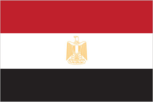
description: consists of three equal horizontal stripes of red (top), white, and black; within the white band lies the national emblem, a golden Eagle of Saladin; it is oriented to the left, adorned with a shield on its chest, above a scroll inscribed with the country's name in Arabic
meaning: the colors of the bands originate from the Arab Liberation flag, symbolizing oppression (black) overcome through a bloody struggle (red), leading to a hopeful future (white)
Capital
name
Cairo
etymology
the ancient Egyptian designation for the original city was Khere-ohe or Kheri-aha; the name of the modern city may also stem from the Arabic al-qahir, which translates to "the victorious;" this term also refers to the planet Mars, which was prominent on the day construction commenced on the new section of the city in 969 A.D.
time difference
UTC+2 (7 hours ahead of Washington, DC, during Standard Time)
daylight saving time
+1 hour, commencing on the last Friday of April and concluding on the last Friday of October
geographic coordinates
30 03 N, 31 15 E
Suffrage
18 years of age; universal and compulsory
Citizenship
citizenship by birth
no
citizenship by descent only
if the father was born in Egypt
dual citizenship recognized
only with prior permission from the government
residency requirement for naturalization
10 years
Constitution
history
numerous prior versions; the most recent was sanctioned by a constitutional committee in December 2013, endorsed by a referendum conducted on 14-15 January 2014, and ratified by the interim president on 19 January 2014
amendment process
put forth by the president of the republic or by one-fifth of the members of the House of Representatives; approval of the proposal requires a majority vote from House members; to pass an amendment, a two-thirds majority vote from House members is necessary, alongside majority approval in a referendum; articles related to the re-election of the president and principles of freedom are immutable unless an amendment "provides additional guarantees"
Country name
former
United Arab Republic (short-lived unification with Syria)
etymology
the English term Egypt is derived from the ancient Greek name "Aguptos," and the Roman name "Aegyptus," with the Greek version originating from the term aia gupos, meaning "land of the vulture;" the Arabic designation for the country, Misr, traces back to the Assyrian word misir, meaning "fort"
local long form
Jumhuriyat Misr al-Arabiyah
local short form
Misr
conventional long form
Arab Republic of Egypt
conventional short form
Egypt
Independence
28 February 1922 (transitioned from British protectorate status; the military-led revolution that commenced on 23 July 1952 resulted in the declaration of a republic on 18 June 1953, with all British forces withdrawn by 18 June 1956)
Legal system
a mixed system that incorporates Napoleonic civil and penal law, Islamic religious law, and remnants of colonial-era legislation; the Supreme Constitutional Court evaluates laws
Government type
presidential republic
Judicial branch
highest court(s)
Supreme Constitutional Court (SCC) (comprising the court president and 10 justices); the SCC acts as the ultimate arbiter regarding the constitutionality of laws and disputes between lower courts on jurisdiction and rulings; Court of Cassation (CC) (includes the court president and 550 judges organized into circuits, with cases adjudicated by panels of 5 judges); the CC represents the highest appeals forum for civil and criminal matters, also referred to as "ordinary justices"; Supreme Administrative Court (SAC) (consists of the court president and an unspecified number of judges, organized into circuits with cases heard by panels of 5 judges); the SAC is the supreme court of the State Council
subordinate courts
Courts of Appeal; Courts of First Instance; courts with limited jurisdiction; Family Court (established in 2004)
judge selection and term of office
according to the 2014 constitution, all judges and justices are chosen and appointed by the Supreme Judiciary Council, with formal approval from the president of the Republic; judges serve for life; under the 2019 amendments, the president holds the authority to appoint heads of judiciary bodies and courts, the prosecutor general, and the president of the Supreme Constitutional Court
Executive branch
cabinet
Cabinet ministers nominated by the executive branch and approved by the House of Representatives
chief of state
President Abdel Fattah EL-SISI (since 8 June 2014)
election results
2023: Abdel Fattah EL-SISI re-elected president in the first round; percentage of valid votes cast - Abdel Fattah EL-SISI (independent) 89.6%, Hazam OMAR (Republican People’s Party) 4.5%, Farid ZAHRAN (Egyptian Social Democratic Party) 4%, Abdel-Samad YAMAMA 1.9%
2018: Abdelfattah ELSISI re-elected president in the first round; percentage of valid votes cast - Abdelfattah ELSISI (independent) 97.1%, Moussa Mostafa MOUSSA (El Ghad Party) 2.9%; note - over 7% of the ballots cast were considered invalid
head of government
Prime Minister Mostafa MADBOULY (since 7 June 2018)
most recent election date
10-12 December 2023
election/appointment process
the president is elected through an absolute-majority popular vote in 2 rounds, if necessary, serving a term of 6 years (eligible for 3 consecutive terms); the prime minister is appointed by the president and must receive approval from the House of Representatives
expected date of next election
2029
National holiday
Revolution Day, 23 July (1952)
National color(s)
red, white, black
National heritage
total World Heritage Sites
7 (6 cultural, 1 natural)
selected World Heritage Site locales
Memphis and its Necropolis (c); Ancient Thebes with its Necropolis (c); Nubian Monuments (c); Saint Catherine Area (c); Abu Mena (c); Historic Cairo (c); Wadi Al-Hitan (Whale Valley) (n)
Political parties
Al-Nour
Arab Democratic Nasserist Party
Congress Party
Conservative Party
Democratic Peace Party
Egyptian National Movement Party
Egyptian Social Democratic Party
El Ghad Party
El Serh El Masry el Hor
Eradet Geel Party
Free Egyptians Party
Freedom Party
Justice Party
Homeland’s Protector Party
Modern Egypt Party
My Homeland Egypt Party
Nation's Future Party (Mostaqbal Watan)
National Progressive Unionist (Tagammu) Party
Reform and Development Party
Republican People’s Party
Revolutionary Guards Party
Wafd Party
Legislative branch
legislative structure
bicameral
National anthem(s)
title
"Bilady, Bilady, Bilady" (My Homeland, My Homeland, My Homeland)
history
adopted in 1979; the current anthem was composed following the peace treaty with Israel in 1979; the composer is regarded as the father of modern Egyptian music; of the three verses, only the first verse is performed, flanked by the chorus
lyrics/music
Younis-al QADI/Sayed DARWISH
National symbol(s)
golden eagle, white lotus
National coat of arms
adopted in 1984, the coat of arms showcases the national emblem, the Eagle of Saladin; the eagle grasps a golden scroll bearing the country's name, “Gumhuriyet Miṣr al-ʿArabiyyah” (Arab Republic of Egypt), in Arabic script; the shield on the eagle’s chest displays the national colors of red, white, and black
Administrative divisions
27 governorates (muhafazat, singular - muhafazat); Ad Daqahliyah, Al Bahr al Ahmar (Red Sea), Al Buhayrah, Al Fayyum, Al Gharbiyah, Al Iskandariyah (Alexandria), Al Isma'iliyah (Ismailia), Al Jizah (Giza), Al Minufiyah, Al Minya, Al Qahirah (Cairo), Al Qalyubiyah, Al Uqsur (Luxor), Al Wadi al Jadid (New Valley), As Suways (Suez), Ash Sharqiyah, Aswan, Asyut, Bani Suwayf, Bur Sa'id (Port Said), Dumyat (Damietta), Janub Sina' (South Sinai), Kafr ash Shaykh, Matruh, Qina, Shamal Sina' (North Sinai), Suhaj
Legislative branch - lower chamber
chamber name
House of Representatives (Majlis Al-Nuwab)
term in office
5 years
number of seats
596 (568 directly elected; 28 appointed)
electoral system
mixed system
scope of elections
full renewal
most recent election date
10/24/2020 to 12/8/2020
expected date of next election
November 2025
percentage of women in chamber
27.7%
parties elected and seats per party
Mostakbal Watan (Future of the Nation) (317); El Shaab el Gomhory (Republican People's Party) (49); Independents (117); Other (109)
Legislative branch - upper chamber
chamber name
Senate (Majlis Al-Shiyoukh)
term in office
5 years
number of seats
300 (200 directly elected; 100 appointed)
electoral system
mixed system
scope of elections
full renewal
most recent election date
8/4/2025 to 8/28/2025
expected date of next election
July 2030
percentage of women in chamber
10.7%
parties elected and seats per party
Mostakbal Watan (Future of the Nation) (148); Republican People's Party (17); Independents (88); Other (47)
Diplomatic representation in the US
FAX
(202) 244-4319
chancery
3521 International Court NW, Washington, DC 20008
telephone
[1] (202) 895-5400
chief of mission
Ambassador Motaz Mounir ZAHRAN (since 17 September 2020)
consulate(s) general
Chicago, Houston, Los Angeles, New York
email address and website
[email protected]
https://www.egyptembassy.net/
Diplomatic representation from the US
FAX
[20-2] 2797-3200
embassy
5 Tawfik Diab St., Garden City, Cairo
telephone
[20-2] 2797-3300
mailing address
7700 Cairo Place, Washington DC 20512-7700
chief of mission
Ambassador Herro MUSTAFA GARG (since 15 November 2023)
consulate(s) general
Alexandria
email address and website
[email protected]
https://eg.usembassy.gov/
International organization participation
ABEDA, AfDB, AFESD, AMF, AU, BRICS, BSEC (observer), CAEU, CD, CICA, COMESA, D-8, EBRD, FAO, G-15, G-24, G-77, IAEA, IBRD, ICAO, ICC (national committees), ICRM, IDA, IDB, IFAD, IFC, IFRCS, IHO, ILO, IMF, IMO, IMSO, Interpol, IOC, IOM, IPU, ISO, ITSO, ITU, LAS, LCBC (observer), MIGA, MINURSO, MONUSCO, NAM, OAPEC, OAS (observer), OIC, OIF, OSCE (partner), PCA, UN, UNAMID, UNCTAD, UNESCO, UNHCR, UNIDO, UNISFA, UNMISS, UNOCI, UNOOSA, UNRWA, UNWTO, UPU, WCO, WFTU (NGOs), WHO, WIPO, WMO, WTO
International law organization participation
acknowledges obligatory ICJ jurisdiction with conditions; non-member state to the ICCt
Economy
Budget
revenues
$69.999 billion (2015 est.)
expenditures
$96.057 billion (2015 est.)
Exports
Exports 2021
$58.339 billion (2021 est.)
Exports 2022
$76.295 billion (2022 est.)
Exports 2023
$68.218 billion (2023 est.)
Imports
Imports 2021
$94.039 billion (2021 est.)
Imports 2022
$97.144 billion (2022 est.)
Imports 2023
$82.265 billion (2023 est.)
Industries
textiles, food processing, tourism, chemicals, pharmaceuticals, hydrocarbons, construction, cement, metals, light manufacturing
Labor force
33.749 million (2024 est.)
Public debt
Public debt 2017
103% of GDP (2017 est.)
Remittances
Remittances 2021
7.4% of GDP (2021 est.)
Remittances 2022
5.9% of GDP (2022 est.)
Remittances 2023
4.9% of GDP (2023 est.)
Exchange rates
Currency
Egyptian pounds (EGP) per US dollar -
Exchange rates 2020
15.759 (2020 est.)
Exchange rates 2021
15.645 (2021 est.)
Exchange rates 2022
19.16 (2022 est.)
Exchange rates 2023
30.626 (2023 est.)
Exchange rates 2024
45.299 (2024 est.)
Debt - external
Debt - external 2023
$117.272 billion (2023 est.)
Economic overview
Africa's second most substantial economy; 2030 Vision aims to diversify market reach and energy infrastructure; focused on enhancing fiscal, external, and current accounts; private sector underperformance; low labor force participation; increased access to credit
Unemployment rate
Unemployment rate 2022
7.4% (2022 est.)
Unemployment rate 2023
7.4% (2023 est.)
Unemployment rate 2024
7.2% (2024 est.)
Exports - partners
Saudi Arabia 10%, Turkey 9%, Italy 6%, USA 5%, UAE 5% (2023)
Imports - partners
China 16%, Saudi Arabia 6%, Russia 6%, USA 6%, Germany 5% (2023)
Real GDP per capita
Real GDP per capita 2022
$16,400 (2022 est.)
Real GDP per capita 2023
$16,700 (2023 est.)
Real GDP per capita 2024
$16,800 (2024 est.)
Real GDP growth rate
Real GDP growth rate 2022
6.6% (2022 est.)
Real GDP growth rate 2023
3.8% (2023 est.)
Real GDP growth rate 2024
2.4% (2024 est.)
Agricultural products
sugarcane, sugar beets, wheat, maize, potatoes, tomatoes, rice, milk, onions, oranges (2023)
Exports - commodities
refined petroleum, natural gas, fertilizers, garments, crude petroleum (2023)
Imports - commodities
refined petroleum, wheat, plastics, natural gas, packaged medicine (2023)
Current account balance
Current account balance 2021
-$18.611 billion (2021 est.)
Current account balance 2022
-$10.537 billion (2022 est.)
Current account balance 2023
-$12.564 billion (2023 est.)
Taxes and other revenues
12.5% (of GDP) (2015 est.)
GDP (official exchange rate)
$389.06 billion (2024 est.)
GDP - composition, by end use
household consumption
87.6% (2024 est.)
government consumption
6.3% (2024 est.)
investment in inventories
1.3% (2024 est.)
investment in fixed capital
11.7% (2024 est.)
exports of goods and services
16.4% (2024 est.)
imports of goods and services
-23.2% (2024 est.)
Population below poverty line
29.7% (2019 est.)
Average household expenditures
on food
36.9% of household expenditures (2023 est.)
on alcohol and tobacco
4.6% of household expenditures (2023 est.)
Inflation rate (consumer prices)
Inflation rate (consumer prices) 2022
13.9% (2022 est.)
Inflation rate (consumer prices) 2023
33.9% (2023 est.)
Inflation rate (consumer prices) 2024
28.3% (2024 est.)
Industrial production growth rate
-1.9% (2024 est.)
Real GDP (purchasing power parity)
Real GDP (purchasing power parity) 2022
$1.842 trillion (2022 est.)
Real GDP (purchasing power parity) 2023
$1.912 trillion (2023 est.)
Real GDP (purchasing power parity) 2024
$1.958 trillion (2024 est.)
Youth unemployment rate (ages 15-24)
male
12.4% (2024 est.)
total
18.7% (2024 est.)
female
47.1% (2024 est.)
Reserves of foreign exchange and gold
Reserves of foreign exchange and gold 2022
$32.144 billion (2022 est.)
Reserves of foreign exchange and gold 2023
$33.07 billion (2023 est.)
Reserves of foreign exchange and gold 2024
$44.921 billion (2024 est.)
GDP - composition, by sector of origin
industry
32.6% (2024 est.)
services
48.9% (2024 est.)
agriculture
13.7% (2024 est.)
Household income or consumption by percentage share
lowest 10%
4.2% (2021 est.)
highest 10%
24.6% (2021 est.)
Gini Index coefficient - distribution of family income
Gini Index coefficient - distribution of family income 2021
28.5 (2021 est.)
Energy
Coal
exports
68,000 metric tons (2023 est.)
imports
3.263 million metric tons (2023 est.)
production
69,000 metric tons (2023 est.)
consumption
3.262 million metric tons (2023 est.)
proven reserves
182 million metric tons (2023 est.)
Petroleum
total petroleum production
667,000 bbl/day (2023 est.)
crude oil estimated reserves
3.3 billion barrels (2021 est.)
refined petroleum consumption
830,000 bbl/day (2023 est.)
Electricity
exports
1.785 billion kWh (2023 est.)
imports
187 million kWh (2023 est.)
consumption
162.026 billion kWh (2023 est.)
installed generating capacity
59.68 million kW (2023 est.)
transmission/distribution losses
45.67 billion kWh (2023 est.)
Natural gas
exports
5.344 billion cubic meters (2023 est.)
imports
9.126 billion cubic meters (2023 est.)
production
57.181 billion cubic meters (2023 est.)
consumption
58.695 billion cubic meters (2023 est.)
proven reserves
1.784 trillion cubic meters (2021 est.)
Nuclear energy
Number of nuclear reactors under construction
4 (2025)
Electricity access
electrification - total population
100% (2022 est.)
Energy consumption per capita
Total energy consumption per capita 2023
34.975 million Btu/person (2023 est.)
Electricity generation sources
wind
2.8% of total installed capacity (2023 est.)
solar
2.2% of total installed capacity (2023 est.)
fossil fuels
87.9% of total installed capacity (2023 est.)
hydroelectricity
7% of total installed capacity (2023 est.)
biomass and waste
0.2% of total installed capacity (2023 est.)
Communications
Internet users
percent of population
73% (2023 est.)
Broadcast media
a combination of government-operated and privately-owned broadcasting outlets; the state-run television network manages 2 national and 6 regional terrestrial channels, in addition to several satellite channels; numerous private satellite channels and a significant variety of Arabic satellite channels can be accessed without charge; certain limited satellite services are offered through subscription; the state-operated radio features approximately 30 stations that are part of 8 different networks; privately-operated radio comprises 8 principal stations (2019)
Internet country code
.eg
Telephones - fixed lines
total subscriptions
13.3 million (2024 est.)
subscriptions per 100 inhabitants
11 (2024 est.)
Telephones - mobile cellular
total subscriptions
113 million (2024 est.)
subscriptions per 100 inhabitants
97 (2024 est.)
Broadband - fixed subscriptions
total
13.6 million (2023 est.)
subscriptions per 100 inhabitants
12 (2023 est.)
Transportation
Ports
large
5
small
8
medium
1
key ports
Ain Sukhna Terminal, Alexandria (Al Iskandariyh), As Suways, Bur Sa'id, Damietta, Ras Shukhier
very small
16
total ports
31 (2024)
size unknown
1
ports with oil terminals
17
Airports
73 (2025)
Railways
total
5,085 km (2014)
standard gauge
5,085 km (2014) 1.435-m gauge (62 km electrified)
Heliports
60 (2025)
Merchant marine
total
441 (2023)
by type
14 bulk carriers, 6 container ships, 23 general cargo vessels, 42 oil tankers, 356 others
Civil aircraft registration country code prefix
SU
Military & Security
Military - note
The Egyptian Armed Forces (EAF) hold the primary responsibility for national defense against external threats but also play a significant role in internal security by supporting police and paramilitary forces during crises and anti-terrorism efforts. Additionally, the EAF engages in international peacekeeping endeavors and various security operations, participating in both bilateral and multinational military exercises. The military enjoys substantial political influence and autonomy, having historically played a pivotal role in Egypt's governance and maintaining significant interests in the civilian economy. This involvement includes managing banks, various enterprises, gas stations, shipping companies, utilities, and producing both consumer and industrial products, while also importing essential goods and overseeing infrastructure projects such as roads, bridges, hospitals, and housing developments.
Key concerns for the EAF encompass Islamist militant factions operating in the Sinai Peninsula, regional issues related to ongoing conflicts and instability, as well as ensuring maritime security. Since 2011, the EAF has collaborated with other security forces in the North Sinai governorate to combat several militant organizations, notably the Islamic State of Iraq and ash-Sham (ISIS). Over the last decade, it has increased troop deployments along the Libyan border, provided air support to the Saudi-led coalition's military intervention in Yemen, and recently augmented its presence along the Gaza border in response to the ongoing HAMAS-Israel conflict. In recent years, the Navy has aimed to modernize and enhance its capabilities and presence in the Eastern Mediterranean and Red Sea, which includes acquiring helicopter carriers, modern frigates, attack submarines, and establishing a joint military base on the Red Sea.
The Multinational Force & Observers (MFO) has been active in the Sinai since 1982, serving as a peacekeeping and monitoring entity to oversee the enforcement of the security provisions outlined in the 1979 Egyptian-Israeli Treaty of Peace. The MFO operates as an independent international organization, established through an agreement between Egypt and Israel, and comprises approximately 1,150 personnel from 13 nations, with Colombia, Fiji, and the United States being the primary contributors of troops to the MFO (2025).
Military deployments
775 (along with nearly 200 police) in the Central African Republic (MINUSCA); 1,100 in Somalia (AUSSOM); additionally, around 200 police are deployed in the Democratic Republic of the Congo under MONUSCO (2025).
Military expenditures
Military Expenditures 2020
1.3% of GDP (2020 est.)
Military Expenditures 2021
1.3% of GDP (2021 est.)
Military Expenditures 2022
1.2% of GDP (2022 est.)
Military Expenditures 2023
1% of GDP (2023 est.)
Military Expenditures 2024
0.7% of GDP (2024 est.)
Military and security forces
Egyptian Armed Forces (EAF): Army (which includes the Republican Guard), Navy (which encompasses the Coast Guard), Air Force, Air Defense Forces, Border Guard Forces.
Interior Ministry: Public Security Sector Police, Central Security Force, National Security Agency (2025).
Military service age and obligation
Voluntary enlistment is available starting at age 16 for men and 17 for women; compulsory service for men occurs between the ages of 18 and 30, with an obligation of 14 to 36 months, followed by a reserve duty of 9 years. The duration of active service varies based on educational background; high school dropouts serve for the full 36 months, whereas college graduates serve for shorter periods, depending on their level of education (2025).
Military equipment inventories and acquisitions
The EAF's arsenal consists of a combination of domestically manufactured, Soviet-era, and more contemporary, primarily Western, weaponry. In recent years, the EAF has initiated a modernization program, acquiring equipment from international suppliers such as China, France, Germany, Italy, Russia, the UAE, the UK, and the US. Egypt's defense sector produces a wide range of products, from small arms to armored vehicles and naval craft. Additionally, it has established licensing and co-production agreements with several nations, including Germany and the US (2025).
Military and security service personnel strengths
estimated 450,000 active Armed Forces (2025)
Terrorism
Terrorist group(s)
Army of Islam; Harakat Sawa'd Misr (HASM); Islamic State of Iraq and ash-Sham – Sinai Province (ISIS-SP); al-Qa’ida
Transnational Issues
Refugees and internally displaced persons
refugees
876,962 (2024 est.)
stateless persons
5 (2024 est.)
Space
Space agency/agencies
The Egyptian Space Agency (EgSA; founded in 2019) and the National Authority for Remote Sensing and Space Science (NARSS; established in 1994 from the Remote Sensing Center, which was created in 1971) (2025)
Space program overview
is developing a robust space program and aims to establish itself as a regional power in space; it operates satellites and collaborates with international partners to build satellites while also fostering local satellite manufacturing and support capabilities; it is acquiring additional space-related technologies through both technology transfers and domestic innovations, which include advancements in communications, Earth imaging/remote sensing (RS), and satellite payloads and components; it collaborates with various foreign governments and commercial space enterprises, including those from Belarus, Canada, China, the European Space Agency (ESA) and its member countries (notably France, Germany, Italy), Ghana, India, Japan, Kazakhstan, Kenya, Nigeria, Russia, South Africa, Sudan, Uganda, Ukraine, the UAE, and the United States; it is also a participant in the Arab Space Coordination Group; the nation has a vibrant commercial space industry (2025)
Key space-program milestones
1960 - commenced a space program
1998 - launched its first communications satellite (NileSat-101), which was constructed in Europe and deployed via a European rocket (making it the first African nation to possess its own communications satellite)
2007 - achieved the launch of its initial remote sensing (RS) satellite (Egypsat-1), built and launched by Russia
2019 - released the first domestically manufactured RS cube satellites (NARSSCube-1 and 2) from the International Space Station; signed a contract with China for the establishment of facilities for satellite assembly, integration, and testing
2020 - unveiled a 10-year national space initiative, which included the launch of an astronaut training program and the collaborative development of an RS satellite with several African nations to monitor climate change
2022 - opened a “space city” that features a satellite manufacturing plant, a research center, a space academy, and the headquarters of the African Space Agency (AfSA; inaugurated 2025); procured the latest NileSat-series communications satellite (NileSat-301) from Europe and launched it with the help of the US
2023 - three RS satellites (Horus-1, Horus-2, and MisrSat-2) were constructed in partnership with China and launched by them; joined the China-led International Lunar Research Station initiative
2024 - launched an experimental RS satellite (Nexsat-1), developed in collaboration with a European commercial entity and launched by China