CapitalLibreville
LanguagesOfficial language is French, with other languages including Fang, Myene, Nzebi, Bapounou/Eschira, and Bandjabi.
CurrencyCoopération Financière en Afrique Centrale francs
Governmentpresidential republic
Bamwor Indexes
Gabon — Q1 2026
IBEUBamwor Urban Scale Index
33.66%
Rank #35 of 237
View full ranking →
IBCPBamwor Population Concentration Index
52.16%
Rank #55 of 237
View full ranking →
IBDABamwor Settlement Density Index
14.70per 1K km²
Rank #198 of 241
View full ranking →
IBCXBamwor Country Complexity Index
59.62/100
Rank #119 of 234
View full ranking →
IBEEBamwor Economic Stability Index
81.96/100
Rank #173 of 220
View full ranking →
IBFMBamwor Military Strength Index
42.04/100
Rank #94 of 124
View full ranking →
IBDIBamwor Digital Infrastructure Index
70.51/100
Rank #123 of 206
View full ranking →
IBEDBamwor Education Index
69.09/100
Rank #57 of 119
View full ranking →
IBSABamwor Healthcare Index
67.74/100
Rank #129 of 218
View full ranking →
Gabon Intelligence Report
Download PDF with 20+ statistics, rankings & proprietary indices
Introduction
Background
Gabon, a sparsely populated country known for its dense rainforests and vast petroleum reserves, is one of the most prosperous and stable countries in central Africa. Approximately 40 ethnic groups are represented, the largest of which is the Fang, a group that covers the northern third of Gabon and expands north into Equatorial Guinea and Cameroon. From about the early 1300s, various kingdoms emerged in present-day Gabon and the surrounding area, including the Kingdoms of Loango and Orungu. Because most early Bantu languages spoken in these kingdoms did not have a written form, much of Gabon's early history was lost over time. Portuguese traders who arrived in the mid-1400s gave the area its name of Gabon. At that time, indigenous trade networks began to engage with European traders, exchanging goods such as ivory and wood. For a century beginning in the 1760s, trade came to focus mostly on enslaved people. While many groups in Gabon participated in the slave trade, the Fang were a notable exception. As the slave trade declined in the late 1800s, France colonized the country and directed a widespread extraction of Gabonese resources. Anti-colonial rhetoric by Gabon’s educated elites increased significantly in the early 1900s, but no widespread rebellion materialized. French decolonization after World War II led to the country’s independence in 1960.
Within a year of independence, the government changed from a parliamentary to a presidential system, and Leon M’BA won the first presidential election in 1961. El Hadj Omar BONGO Ondimba was M’BA’s vice president and assumed the presidency after M’BA’s death in 1967. BONGO went on to dominate the country's political scene for four decades (1967-2009). In 1968, he declared Gabon a single-party state and created the still-dominant Parti Democratique Gabonais (PDG). In the early 1990s, he reintroduced a multiparty system under a new constitution in response to growing political opposition. He was reelected by wide margins in 1995, 1998, 2002, and 2005 against a divided opposition and amidst allegations of fraud. After BONGO's death in 2009, a new election brought his son, Ali BONGO Ondimba, to power, and he was reelected in 2016. He won a third term in the August 2023 election but was overthrown in a military coup a few days later. Gen. Brice OLIGUI Nguema led a military group called the Committee for the Transition and Restoration of Institutions that arrested BONGO, canceled the election results, and dissolved state institutions. In September 2023, OLIGUI was sworn in as transitional president of Gabon.
Geography
Area
land
257,667 sq km
water
10,000 sq km
total
267,667 sq km
Climate
tropical; consistently warm and humid
Terrain
narrow coastal region; undulating interior; savanna in the eastern and southern areas
Land use
other
0.2% (2023 est.)
forest
91.5% (2023 est.)
agricultural land
8.4% (2023 est.)
agricultural land: arable land
arable land: 1.3% (2023 est.)
agricultural land: permanent crops
permanent crops: 0.7% (2023 est.)
agricultural land: permanent pasture
permanent pasture: 6.4% (2023 est.)
Location
Central Africa, adjacent to the Atlantic Ocean at the Equator, situated between the Republic of the Congo and Equatorial Guinea
Coastline
885 km
Elevation
lowest point
Atlantic Ocean 0 m
highest point
Mont Bengoue 1,050 m
mean elevation
377 m
Irrigated land
40 sq km (2012)
Major aquifers
Congo Basin
Map references
Africa
Land boundaries
total
3,261 km
border countries
Cameroon 349 km; Republic of the Congo 2,567 km; Equatorial Guinea 345 km
Maritime claims
contiguous zone
24 nm
territorial sea
12 nm
exclusive economic zone
200 nm
Natural hazards
none
Geography - note
the nation has preserved its unspoiled rainforest and diverse biodiversity
Natural resources
petroleum, natural gas, diamonds, niobium, manganese, uranium, gold, timber, iron ore, hydropower
Area - comparative
slightly less than Colorado in size
Geographic coordinates
1 00 S, 11 45 E
Population distribution
the relatively small populace is dispersed in clusters across the nation; the major urban area is the capital, Libreville, located on the Atlantic coast in the northwest, as illustrated in this population distribution map
Major watersheds (area sq km)
Atlantic Ocean drainage
Congo (3,730,881 sq km)
People & Society
Literacy
male
90.8% (2021 est.)
female
87.1% (2021 est.)
total population
88.9% (2021 est.)
Languages
Official language is French, with other languages including Fang, Myene, Nzebi, Bapounou/Eschira, and Bandjabi.
Religions
Protestantism accounts for 46.4% of the population (with the Revival Church at 37% and other Protestant denominations at 9.4%), Roman Catholicism comprises 29.8%, other Christian faiths make up 4%, Islam represents 10.8%, traditional/animist beliefs are at 1.1%, other religions account for 0.9%, and 7% identify as having no religion (estimates from 2019-21).
Sex ratio
at birth
1.03 male(s)/female
0-14 years
1.02 male(s)/female
15-64 years
1.11 male(s)/female
total population
1.07 male(s)/female (2024 est.)
65 years and over
1.03 male(s)/female
Birth rate
25.51 births/1,000 population (2025 est.)
Death rate
5.44 deaths/1,000 population (2025 est.)
Median age
male
22.5 years
total
22.3 years (2025 est.)
female
21.5 years
Population
male
1,299,085
total
2,513,738 (2025 est.)
female
1,214,653
Nationality
noun
Gabonese (singular and plural)
adjective
Gabonese
Urbanization
urban population
91% of total population (2023)
rate of urbanization
2.27% annual rate of change (2020-25 est.)
Age structure
0-14 years
34.6% (male 429,133/female 421,120)
15-64 years
61.1% (male 787,480/female 711,913)
65 years and over
4.3% (2024 est.) (male 53,410/female 52,049)
Ethnic groups
Fang constitutes 23.5%, Shira-Punu'Vii is at 20.6%, Nzabi-Duma makes up 11.2%, Mbede-Teke is 5.6%, Myene is 4.4%, Kota-Kele stands at 4.3%, Okande-Tsogho is at 1.6%, other groups comprise 12.6%, and foreigners account for 16.2% (estimates for 2021).
Child marriage
men married by age 18
4.8% (2021)
women married by age 15
2.9% (2021)
women married by age 18
13.3% (2021)
Dependency ratios
total dependency ratio
63 (2025 est.)
youth dependency ratio
55.8 (2025 est.)
potential support ratio
13.9 (2025 est.)
elderly dependency ratio
7.2 (2025 est.)
Physician density
0.52 physicians/1,000 population (2022)
Health expenditure
Health expenditure (as % of GDP)
2.7% of GDP (2021)
Health expenditure (as % of national budget)
9.6% of national budget (2022 est.)
Net migration rate
3.42 migrant(s)/1,000 population (2025 est.)
Total fertility rate
3.16 children born/woman (2025 est.)
Drinking water source
improved: rural
rural: 54.9% of population (2022 est.)
improved: total
total: 86.9% of population (2022 est.)
improved: urban
urban: 90.2% of population (2022 est.)
unimproved: rural
rural: 45.1% of population (2022 est.)
unimproved: total
total: 13.1% of population (2022 est.)
unimproved: urban
urban: 9.8% of population (2022 est.)
Education expenditure
Education expenditure (% GDP)
2.3% of GDP (2023 est.)
Education expenditure (% national budget)
13.6% national budget (2023 est.)
Infant mortality rate
male
29.7 deaths/1,000 live births
total
26 deaths/1,000 live births (2025 est.)
female
24 deaths/1,000 live births
Population growth rate
2.35% (2025 est.)
Gross reproduction rate
1.56 (2025 est.)
Population distribution
The population, which is relatively small, is distributed in clusters across the nation; the capital city, Libreville, located on the Atlantic coast in the northwest, serves as the primary urban center, as illustrated in the accompanying population distribution map.
Life expectancy at birth
male
68.6 years
female
72.1 years
total population
70.4 years (2024 est.)
Maternal mortality ratio
233 deaths/100,000 live births (2023 est.)
Sanitation facility access
improved: rural
rural: 55.1% of population (2022 est.)
improved: total
total: 78.9% of population (2022 est.)
improved: urban
urban: 81.3% of population (2022 est.)
unimproved: rural
rural: 44.9% of population (2022 est.)
unimproved: total
total: 21.1% of population (2022 est.)
unimproved: urban
urban: 18.7% of population (2022 est.)
Alcohol consumption per capita
beer
5.31 liters of pure alcohol (2019 est.)
wine
0.62 liters of pure alcohol (2019 est.)
total
6.47 liters of pure alcohol (2019 est.)
spirits
0.5 liters of pure alcohol (2019 est.)
other alcohols
0.04 liters of pure alcohol (2019 est.)
Major urban areas - population
870,000 LIBREVILLE (capital) (2023)
Obesity - adult prevalence rate
15% (2016)
Mother's mean age at first birth
19.6 years (2012 est.)
Currently married women (ages 15-49)
48.5% (2020 est.)
Children under the age of 5 years underweight
5.4% (2020 est.)
Environment
Climate
tropical; consistently warm and humid
Land use
other
0.2% (2023 est.)
forest
91.5% (2023 est.)
agricultural land
8.4% (2023 est.)
agricultural land: arable land
arable land: 1.3% (2023 est.)
agricultural land: permanent crops
permanent crops: 0.7% (2023 est.)
agricultural land: permanent pasture
permanent pasture: 6.4% (2023 est.)
Urbanization
urban population
91% of total population (2023)
rate of urbanization
2.27% annual rate of change (2020-25 est.)
Methane emissions
other
5.4 kt (2019-2021 est.)
waste
18.6 kt (2019-2021 est.)
energy
272.4 kt (2022-2024 est.)
agriculture
4.9 kt (2019-2021 est.)
Waste and recycling
municipal solid waste generated annually
238,100 tons (2024 est.)
percent of municipal solid waste recycled
22.4% (2022 est.)
Environmental issues
deforestation due to logging activities; waste management issues; water contamination from the oil sector; illegal wildlife hunting
Total water withdrawal
municipal
84.7 million cubic meters (2022 est.)
industrial
14.1 million cubic meters (2022 est.)
agricultural
40.3 million cubic meters (2022 est.)
Carbon dioxide emissions
total emissions
3.144 million metric tonnes of CO2 (2023 est.)
from consumed natural gas
908,000 metric tonnes of CO2 (2023 est.)
from coal and metallurgical coke
230,000 metric tonnes of CO2 (2023 est.)
from petroleum and other liquids
2.005 million metric tonnes of CO2 (2023 est.)
Particulate matter emissions
29.6 micrograms per cubic meter (2019 est.)
Total renewable water resources
166 billion cubic meters (2022 est.)
International environmental agreements
party to
Biodiversity, Climate Change, Climate Change-Kyoto Protocol, Climate Change-Paris Agreement, Comprehensive Nuclear Test Ban, Desertification, Endangered Species, Hazardous Wastes, Law of the Sea, Marine Dumping-London Convention, Nuclear Test Ban, Ozone Layer Protection, Ship Pollution, Tropical Timber 2006, Wetlands, Whaling
signed, but not ratified
none of the selected agreements
Government
Flag
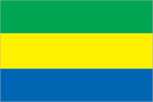
description: three equal horizontal stripes of green (top), yellow, and blue
meaning: green symbolizes the nation's forests and natural wealth, yellow represents the equator and sunlight, while blue stands for the ocean
Capital
name
Libreville
etymology
the city was established in 1849 by emancipated slaves, and its name translates to "free town" in French
time difference
UTC+1 (which is 6 hours ahead of Washington, DC, during Standard Time)
geographic coordinates
0 23 N, 9 27 E
Suffrage
18 years of age; universal
Citizenship
citizenship by birth
no
citizenship by descent only
at least one parent must be a citizen of Gabon
dual citizenship recognized
no
residency requirement for naturalization
10 years
Constitution
history
previously in 1961, 1991; most recent ratified in the referendum of November 2024
amendment process
can be proposed by the president of the republic, the Council of Ministers, or one third of either Parliamentary chamber; to pass, it requires evaluation by the Constitutional Court, a two-thirds majority from two-thirds of the Parliament convened in a joint session, and must be ratified in a referendum; the constitutional articles pertaining to Gabon’s democratic framework are not subject to alteration
Country name
etymology
the name comes from the Portuguese term gabão, meaning "cloak," likely used by early navigators to describe the contour of the Komo River estuary
local long form
République Gabonaise
local short form
Gabon
conventional long form
Gabonese Republic
conventional short form
Gabon
Independence
17 August 1960 (from France)
Legal system
a hybrid legal system that combines French civil law with customary law
Government type
presidential republic
Judicial branch
highest court(s)
Supreme Court (comprises 4 permanent specialized supreme courts - Supreme Court or Cour de Cassation, Administrative Supreme Court or Conseil d'Etat, Accounting Supreme Court or Cour des Comptes, Constitutional Court or Cour Constitutionnelle, and the temporary Court of State Security, which is activated solely for high treason cases involving the president and criminal offenses by executive branch officials)
subordinate courts
Courts of Appeal; county courts; military courts
judge selection and term of office
the appointment and term lengths of judges for the Supreme, Administrative, Accounting, and State Security courts are not applicable; judges of the Constitutional Court are appointed - 3 by the national president, 3 by the president of the Senate, and 3 by the president of the National Assembly; they serve one renewable term of 7 years
Executive branch
cabinet
cabinet appointed by president
chief of state
President Brice OLIGUI Nguema (since 3 May 2025)
election results
2025: Brice OLIGUI Nguema elected as president; percentage of votes - Brice OLIGUI Nguema (Ind.) 90.35%, Alain Claude Bilie By Nze (EPG) 3.02%, others 6.63%
2016: Ali BONGO Ondimba reelected as president; percentage of votes - Ali BONGO Ondimba (PDG) 49.8%, Jean PING (UFC) 48.2%, others 2.0%
head of government
President Brice OLIGUI Nguema (since 3 May 2025)
most recent election date
12 April 2025
election/appointment process
the president directly elected by plurality vote to a 7-year term (no term limits)
National holiday
Independence Day, 17 August (1960)
National color(s)
green, yellow, blue
National heritage
total World Heritage Sites
2 (1 natural, 1 mixed)
selected World Heritage Site locales
Ecosystem and Relict Cultural Landscape of Lopé-Okanda (m); Ivindo National Park (n)
Political parties
Gabonese Democratic Party or PDG
Restoration of Republican Values or RV
The Democrats or LD
Legislative branch
legislature name
Parliament
legislative structure
bicameral
National anthem(s)
title
"La Concorde" (The Concorde)
history
adopted 1960
lyrics/music
Georges Aleka DAMAS
National symbol(s)
black panther
National coat of arms
the panthers symbolize vigilance and bravery, supporting a shield that features a ship and an okoume tree, emblematic of the timber industry; the ribbon beneath the shield displays the national motto in French, Union, Travail, Justice ("Union, Work, Justice"), while the ribbon above showcases the Latin phrase Uniti Progrediemur ("We shall go forward united")
Administrative divisions
9 provinces; Estuaire, Haut-Ogooue, Moyen-Ogooue, Ngounie, Nyanga, Ogooue-Ivindo, Ogooue-Lolo, Ogooue-Maritime, Woleu-Ntem
Legislative branch - lower chamber
chamber name
National Assembly (Assemblée nationale)
term in office
5 years
number of seats
145 (all directly elected)
electoral system
plurality/majority
scope of elections
full renewal
most recent election date
10/6/2023
expected date of next election
November 2030
percentage of women in chamber
21.6%
Legislative branch - upper chamber
chamber name
Senate (Senate)
term in office
5 years
number of seats
70 (all indirectly elected)
scope of elections
full renewal
most recent election date
9/27/2025 to 10/11/2025
expected date of next election
November 2025
percentage of women in chamber
20.3%
Diplomatic representation in the US
FAX
[1] (301) 332-0668
chancery
2034 20th Street NW, Suite 200, Washington, DC 20009
telephone
[1] (202) 797-1000
chief of mission
Ambassador Noël Nelson MESSONE (12 December 2022)
consulate(s) general
New York
email address and website
[email protected]
https://gabonembassyusa.org/en/
Diplomatic representation from the US
FAX
[241] 011-45-71-05
embassy
Sabliere, B.P. 4000, Libreville
telephone
[241] 011-45-71-00
mailing address
2270 Libreville Place, Washington, DC 20521-2270
chief of mission
Ambassador Vernelle Trim FITZPATRICK (since 26 January 2024); also accredited to Sao Tome and Principe
email address and website
[email protected]
https://ga.usembassy.gov/
International organization participation
ACP, AfDB, AU (suspended), BDEAC, CEMAC, FAO, FZ, G-24, G-77, IAEA, IBRD, ICAO, ICCt, ICRM, IDA, IDB, IFAD, IFC, IFRCS, ILO, IMF, IMO, IMSO, Interpol, IOC, IOM, IPU, ISO, ITSO, ITU, ITUC (NGOs), MIGA, MINUSCA, NAM, OIC, OIF, OPCW, UN, UNCTAD, UNESCO, UNIDO, UNWTO, UPU, WCO, WHO, WIPO, WMO, WTO
International law organization participation
has not made an ICJ jurisdiction declaration; accepts ICCt jurisdiction
Economy
Budget
revenues
$2.939 billion (2021 est.)
expenditures
$3.226 billion (2021 est.)
Exports
Exports 2022
$13.814 billion (2022 est.)
Exports 2023
$12.869 billion (2023 est.)
Exports 2024
$13.622 billion (2024 est.)
Imports
Imports 2022
$5.005 billion (2022 est.)
Imports 2023
$5.38 billion (2023 est.)
Imports 2024
$6.094 billion (2024 est.)
Industries
extraction and refining of petroleum; manganese, gold; chemicals, ship repair, food and beverages, textiles, lumber, plywood, and cement
Labor force
824,400 (2024 est.)
Public debt
Public debt 2016
64.2% of GDP (2016 est.)
Remittances
Remittances 2021
0.1% of GDP (2021 est.)
Remittances 2022
0.1% of GDP (2022 est.)
Remittances 2023
0.1% of GDP (2023 est.)
Exchange rates
Currency
Coopération Financière en Afrique Centrale francs (XAF) per US dollar -
Exchange rates 2020
575.586 (2020 est.)
Exchange rates 2021
554.531 (2021 est.)
Exchange rates 2022
623.76 (2022 est.)
Exchange rates 2023
606.57 (2023 est.)
Exchange rates 2024
606.345 (2024 est.)
Debt - external
Debt - external 2023
$6.442 billion (2023 est.)
Economic overview
a resource-rich, upper-middle-income economy in Central Africa; considerable dependence on oil and mineral exports; a highly urban population; elevated levels of poverty and unemployment; uncertainty regarding institutional and developmental reforms after the military coup in 2023
Unemployment rate
Unemployment rate 2022
20.4% (2022 est.)
Unemployment rate 2023
20.3% (2023 est.)
Unemployment rate 2024
20.1% (2024 est.)
Exports - partners
China 26%, Indonesia 8%, Spain 7%, Israel 6%, Republic of the Congo 5% (2023)
Imports - partners
France 14%, China 13%, South Korea 13%, USA 7%, India 4% (2023)
Real GDP per capita
Real GDP per capita 2022
$18,700 (2022 est.)
Real GDP per capita 2023
$18,700 (2023 est.)
Real GDP per capita 2024
$18,900 (2024 est.)
Real GDP growth rate
Real GDP growth rate 2022
3% (2022 est.)
Real GDP growth rate 2023
2.4% (2023 est.)
Real GDP growth rate 2024
3.4% (2024 est.)
Agricultural products
oil palm fruit, plantains, cassava, sugarcane, yams, taro, vegetables, maize, groundnuts, game meat (2023)
Exports - commodities
crude petroleum, ships, manganese ore, refined petroleum, wood (2023)
Imports - commodities
ships, refined petroleum, iron pipes, automobiles, packaged medicines (2023)
Current account balance
Current account balance 2013
$1.463 billion (2013 est.)
Current account balance 2014
$1.112 billion (2014 est.)
Current account balance 2015
$140.996 million (2015 est.)
Taxes and other revenues
9.5% (of GDP) (2021 est.)
GDP (official exchange rate)
$20.867 billion (2024 est.)
GDP - composition, by end use
household consumption
33.7% (2024 est.)
government consumption
12.2% (2024 est.)
investment in inventories
0% (2024 est.)
investment in fixed capital
18.1% (2024 est.)
exports of goods and services
65.3% (2024 est.)
imports of goods and services
-29.2% (2024 est.)
Population below poverty line
33.4% (2017 est.)
Inflation rate (consumer prices)
Inflation rate (consumer prices) 2022
4.2% (2022 est.)
Inflation rate (consumer prices) 2023
3.6% (2023 est.)
Inflation rate (consumer prices) 2024
1.2% (2024 est.)
Industrial production growth rate
2.8% (2024 est.)
Real GDP (purchasing power parity)
Real GDP (purchasing power parity) 2022
$45.363 billion (2022 est.)
Real GDP (purchasing power parity) 2023
$46.472 billion (2023 est.)
Real GDP (purchasing power parity) 2024
$48.045 billion (2024 est.)
Youth unemployment rate (ages 15-24)
male
31.1% (2024 est.)
total
36% (2024 est.)
female
42.3% (2024 est.)
Reserves of foreign exchange and gold
Reserves of foreign exchange and gold 2021
$1.304 billion (2021 est.)
Reserves of foreign exchange and gold 2022
$1.415 billion (2022 est.)
Reserves of foreign exchange and gold 2023
$1.447 billion (2023 est.)
GDP - composition, by sector of origin
industry
50.9% (2024 est.)
services
37.5% (2024 est.)
agriculture
6.2% (2024 est.)
Household income or consumption by percentage share
lowest 10%
2.2% (2017 est.)
highest 10%
27.7% (2017 est.)
Gini Index coefficient - distribution of family income
Gini Index coefficient - distribution of family income 2017
38 (2017 est.)
Energy
Coal
imports
75,000 metric tons (2023 est.)
Petroleum
total petroleum production
204,000 bbl/day (2023 est.)
crude oil estimated reserves
2 billion barrels (2021 est.)
refined petroleum consumption
14,000 bbl/day (2023 est.)
Electricity
imports
584.039 million kWh (2023 est.)
consumption
3.173 billion kWh (2023 est.)
installed generating capacity
785,000 kW (2023 est.)
transmission/distribution losses
604 million kWh (2023 est.)
Natural gas
production
463 million cubic meters (2023 est.)
consumption
463 million cubic meters (2023 est.)
proven reserves
25.995 billion cubic meters (2021 est.)
Electricity access
electrification - rural areas
29%
electrification - urban areas
98.5%
electrification - total population
93.5% (2022 est.)
Energy consumption per capita
Total energy consumption per capita 2023
22.101 million Btu/person (2023 est.)
Electricity generation sources
fossil fuels
51.9% of total installed capacity (2023 est.)
hydroelectricity
47.7% of total installed capacity (2023 est.)
biomass and waste
0.3% of total installed capacity (2023 est.)
Communications
Internet users
percent of population
72% (2023 est.)
Broadcast media
Two television stations and two radio stations operated by the government; several privately owned radio and television stations; broadcasts from a minimum of two international media outlets are obtainable; satellite service subscriptions can be acquired.
Internet country code
.ga
Telephones - fixed lines
total subscriptions
67,100 (2024 est.)
subscriptions per 100 inhabitants
3 (2024 est.)
Telephones - mobile cellular
total subscriptions
3.18 million (2024 est.)
subscriptions per 100 inhabitants
125 (2024 est.)
Broadband - fixed subscriptions
total
80,000 (2022 est.)
subscriptions per 100 inhabitants
3 (2022 est.)
Transportation
Ports
large
0
small
2
medium
2
key ports
Libreville, Oguendjo Terminal, Port Gentil, Port Owendo
very small
5
total ports
9 (2024)
ports with oil terminals
7
Airports
42 (2025)
Railways
total
649 km (2014)
standard gauge
649 km (2014) 1.435-m gauge
Merchant marine
total
87 (2023)
by type
1 bulk carrier, 19 general cargo vessels, 30 oil tankers, 37 others
Civil aircraft registration country code prefix
TR
Military & Security
Military - note
The military of Gabon is a compact and lightly equipped organization tasked with both external and internal security responsibilities; it may also engage in the nation's economic and social development initiatives. Primary defense objectives involve protecting the nation's borders and maritime areas; it has played a role in regional peacekeeping and collaborative security missions. In August 2023, members of the Republican Guard assumed control of the government and detained the president (2025)
Military expenditures
Military Expenditures 2020
1.8% of GDP (2020 est.)
Military Expenditures 2021
1.7% of GDP (2021 est.)
Military Expenditures 2022
1.3% of GDP (2022 est.)
Military Expenditures 2023
1.3% of GDP (2023 est.)
Military Expenditures 2024
1.5% of GDP (2024 est.)
Military and security forces
Gabonese Armed Forces (Force Armées Gabonaise or FAG; also known as National Defense and Security Forces of Gabon or des Forces Nationales de Défense et de Sécurité (FNDS) du Gabon): Army, Navy, Air Force, Light Aviation, Fire Brigade; Gabon National Gendarmerie (GENA); Republican Guard (GR); Military Health Service; Military Engineering (2025)
Military service age and obligation
Voluntary military service is available for individuals aged 18-24; there is no conscription (2025)
Military equipment inventories and acquisitions
The Gabonese military possesses a combination of older equipment and a limited number of more contemporary weapons; sources of supply include Brazil, China, France, Germany, Russia/former Soviet Union, South Africa, and Spain (2025)
Military and security service personnel strengths
The active-duty Armed Forces number approximately 7,000, including personnel from the Republican Guard and Gendarmerie (2025)
Transnational Issues
Refugees and internally displaced persons
refugees
261 (2024 est.)
Space
Space agency/agencies
Gabonese Studies and Space Observations Agency (Agence Gabonaise d’Etudes et d’Observations Spatiales or AGEOS; founded in 2015) (2025)
Space program overview
operates a modest space initiative aimed at utilizing information from remote sensing (RS) satellites for the purposes of environmental and natural resource management, mapping, land-use planning, maritime monitoring, and scientific research; is affiliated with the African Space Agency; maintains partnerships with Brazil, China, the European Space Agency (ESA), various ESA member nations (notably France), and the United States, as well as other African nations including Kenya, Niger, Rwanda, and South Africa; provides RS satellite data to neighboring countries (2025)
Key space-program milestones
1986 - The ESA set up a ground station in Gabon
2018 - Successfully completed the mapping of Gabon’s forests
2019 - Became a founding member of the Space Climate Observatory
2021 - Initiated the acquisition process for its inaugural satellite in a collaborative project with Japan, named BIRDs
2025 - Joined the newly established African Space Agency