CapitalDamascus
LanguagesArabic , Kurdish, Armenian, Aramaic, Circassian, French, English
CurrencySyrian pounds
Governmenttransitional presidential republic
Bamwor Indexes
Syria — Q1 2026
IBEUBamwor Urban Scale Index
8.65%
Rank #172 of 237
View full ranking →
IBCPBamwor Population Concentration Index
23.43%
Rank #142 of 237
View full ranking →
IBDABamwor Settlement Density Index
62.64per 1K km²
Rank #148 of 241
View full ranking →
IBCXBamwor Country Complexity Index
66.43/100
Rank #71 of 234
View full ranking →
IBEEBamwor Economic Stability Index
75.49/100
Rank #208 of 220
View full ranking →
IBDIBamwor Digital Infrastructure Index
50.52/100
Rank #166 of 206
View full ranking →
IBEDBamwor Education Index
65.30/100
Rank #68 of 119
View full ranking →
IBSABamwor Healthcare Index
66.31/100
Rank #136 of 218
View full ranking →
Syria Intelligence Report
Download PDF with 20+ statistics, rankings & proprietary indices
Introduction
Background
Following World War I, France obtained a mandate to govern the northern section of Syria, which was previously part of the Ottoman Empire. French administration of the region continued until Syria gained its independence in 1946. The newly established nation faced political turmoil and underwent several military coups. In 1958, Syria merged with Egypt to create the United Arab Republic, but this union dissolved in 1961, leading to the reinstatement of the Syrian Arab Republic. During the 1967 Arab-Israeli War, Syria lost the Golan Heights to Israel. Throughout the 1990s, Syria and Israel engaged in sporadic peace negotiations regarding the return of the territory, all of which were unsuccessful. In 1970, Hafiz al-ASAD, a member of the socialist Ba'ath Party and belonging to the minority Alawi sect, took control through a bloodless coup, establishing a period of political stability. After Hafiz al-ASAD's death, his son, Bashar al-ASAD, was endorsed as president by a popular referendum in 2000. Syrian military forces, which had been deployed in Lebanon since 1976 for what was claimed to be peacekeeping purposes, were withdrawn in 2005. During the 2006 confrontation between Israel and Hizballah, Syria placed its military on alert but refrained from intervening directly on Hizballah's behalf. In 2007, Bashar al-ASAD's presidency was reaffirmed through another referendum.
In 2011, amid significant uprisings across the region, protests against the government erupted in the southern province of Dar'a. Demonstrators demanded the legalization of political parties, the removal of corrupt local officials, and the repeal of the oppressive Emergency Law, which permitted arrests without charges. Protests and violent disturbances spread throughout Syria, prompting the government to respond with both concessions and military force, leading to intense clashes and ultimately civil war. Following 2011, international pressure on the Syrian government increased, with the Arab League, the EU, Turkey, and the US imposing economic sanctions on the ASAD regime and its supporters. By 2012, over 130 nations recognized the Syrian National Coalition as the legitimate representative of the Syrian populace. In 2015, Russia initiated a military intervention supporting the ASAD regime, allowing both domestic and foreign-aligned forces to reclaim significant territories from opposition groups. With foreign assistance, the regime continued to periodically recover opposition-held areas until 2020, when Turkish military action halted the regime's advances and created a stalemate between regime and opposition forces. The government currently lacks control over large sections of northeastern Syria, which are held by the predominantly Kurdish Syrian Democratic Forces (SDF), as well as other smaller territories dominated by Turkey.
Since 2016, Turkey has executed three major military operations to seize territory along Syria's northern border. Certain opposition factions, organized under the Turkish-supported Syrian National Army, along with Turkish forces, have maintained control over northwestern Syria adjacent to the Turkish border, particularly in the Afrin region of Aleppo Province since 2018. The extremist group Hay’at Tahrir al-Sham (formerly known as the Nusrah Front) emerged in 2017 as the leading opposition force in Idlib Province and continues to dominate an area that also hosts Turkish military personnel. Efforts to negotiate a resolution to the conflict have been unsuccessful, and the UN estimated in 2022 that at least 306,000 individuals have lost their lives due to the civil war. By 2022, around 6.7 million Syrians were internally displaced, with 14.6 million people requiring humanitarian aid across the nation. Additionally, approximately 5.6 million Syrians were registered as refugees in Turkey, Jordan, Iraq, Egypt, and North Africa. The ongoing conflict in Syria represents one of the two largest displacement crises globally, alongside the complete invasion of Ukraine.
On 8 December 2024, Syrian Islamist rebels seized control of the capital, Damascus, resulting in the ousting of President Bashar al-ASAD. The former president and his family fled to Moscow, where they were granted political asylum. The al-ASAD regime had governed Syria for over 50 years.
Geography
Area
land
185,887 sq km
water
1,550 sq km
total
187,437 sq km
Climate
predominantly arid land; characterized by hot, dry, and sunny summers (June to August) and mild, wet winters (December to February) along the coastline; cold temperatures with occasional snow or sleet in Damascus
Terrain
mainly a semiarid and desert plateau; a narrow coastal strip; mountainous regions in the west
Land use
other
23% (2023 est.)
forest
2.9% (2023 est.)
agricultural land
74.1% (2023 est.)
agricultural land: arable land
arable land: 24% (2023 est.)
agricultural land: permanent crops
permanent crops: 5.7% (2023 est.)
agricultural land: permanent pasture
permanent pasture: 44.5% (2023 est.)
Location
Middle East, situated along the Mediterranean Sea, between Lebanon and Turkey
Coastline
193 km
Elevation
lowest point
Yarmuk River -66 m
highest point
Mount Hermon (Jabal a-Shayk) 2,814 m
mean elevation
514 m
Irrigated land
9,820 sq km (2022)
Map references
Middle East
Land boundaries
total
2,363 km
border countries
Iraq 599 km; Israel 83 km; Jordan 379 km; Lebanon 403 km; Turkey 899 km
Maritime claims
contiguous zone
24 nm
territorial sea
12 nm
Natural hazards
dust storms, sandstorms
volcanism: Syria's two historically active volcanoes, Es Safa and an unnamed volcano adjacent to the Turkish border, have remained dormant for centuries
Geography - note
the capital city, Damascus, is positioned at an oasis nourished by the Barada River and is regarded as one of the oldest cities in continuous habitation; in the Golan Heights controlled by Israel, there exist Israeli settlements and civilian land-use areas (2017)
Natural resources
petroleum, phosphates, chrome and manganese ores, asphalt, iron ore, rock salt, marble, gypsum, hydropower
Area - comparative
slightly larger than 1.5 times the area of Pennsylvania
Geographic coordinates
35 00 N, 38 00 E
Population distribution
notable population density along the Mediterranean shoreline; significant groups are located in the principal cities of Damascus, Aleppo (the largest city in the country), and Hims (Homs); over half of the populace resides in the coastal plain, the Halab province, and the Euphrates River valley
Major watersheds (area sq km)
Indian Ocean drainage
(Persian Gulf) Tigris and Euphrates (918,044 sq km)
Major rivers (by length in km)
Euphrates (shared with Turkey [s], Iran, and Iraq [m]) - 3,596 km; Tigris (shared with Turkey, Iran, and Iraq [m]) - 1,950 km
note: [s] following country name denotes river source; [m] following country name denotes river mouth
People & Society
Literacy
male
97.2% (2021 est.)
female
91.8% (2021 est.)
total population
94.4% (2021 est.)
Languages
Languages
Arabic (official), Kurdish, Armenian, Aramaic, Circassian, French, English
major-language sample(s)
كتاب حقائق العالم، المصدر الذي لا يمكن الاستغناء عنه للمعلومات الأساسية (Arabic)
ڕاستییەکانی جیهان، باشترین سەرچاوەیە بۆ زانیارییە بنەڕەتییەکان (Kurdish)
The World Factbook, the indispensable source for basic information.
Religions
Muslim 87% (official; comprising Sunni 74% and Alawi, Ismaili, and Shia 13%), Christian 10% (encompassing Orthodox, Uniate, and Nestorian), Druze 3%
Sex ratio
at birth
1.06 male(s)/female
0-14 years
1.05 male(s)/female
15-64 years
0.99 male(s)/female
total population
1.01 male(s)/female (2024 est.)
65 years and over
0.88 male(s)/female
Birth rate
21.26 births/1,000 population (2025 est.)
Death rate
3.97 deaths/1,000 population (2025 est.)
Median age
male
23.6 years
total
24.5 years (2025 est.)
female
24.7 years
Population
male
12,183,128
total
24,261,882 (2025 est.)
female
12,078,754
Nationality
noun
Syrian(s)
adjective
Syrian
Urbanization
urban population
57.4% of total population (2023)
rate of urbanization
5.38% annual rate of change (2020-25 est.)
Age structure
0-14 years
33% (male 4,037,493/female 3,828,777)
15-64 years
62.8% (male 7,475,355/female 7,522,797)
65 years and over
4.2% (2024 est.) (male 468,730/female 532,271)
Ethnic groups
Arab ~50%, Alawite ~15%, Kurd ~10%, Levantine ~10%, other ~15% (includes Druze, Ismaili, Imami, Nusairi, Assyrian, Turkoman, Armenian)
Dependency ratios
total dependency ratio
58.1 (2025 est.)
youth dependency ratio
51.2 (2025 est.)
potential support ratio
14.5 (2025 est.)
elderly dependency ratio
6.9 (2025 est.)
Physician density
1.52 physicians/1,000 population (2021)
Health expenditure
7.8% of national budget (2022 est.)
Net migration rate
-1.03 migrant(s)/1,000 population (2025 est.)
Hospital bed density
1.4 beds/1,000 population (2021 est.)
Total fertility rate
2.64 children born/woman (2025 est.)
Drinking water source
improved: rural
rural: 92.1% of population (2022 est.)
improved: total
total: 94.1% of population (2022 est.)
improved: urban
urban: 95.6% of population (2022 est.)
unimproved: rural
rural: 7.9% of population (2022 est.)
unimproved: total
total: 5.9% of population (2022 est.)
unimproved: urban
urban: 4.4% of population (2022 est.)
Infant mortality rate
male
16.6 deaths/1,000 live births
total
14.7 deaths/1,000 live births (2025 est.)
female
13.5 deaths/1,000 live births
Population growth rate
1.63% (2025 est.)
Gross reproduction rate
1.28 (2025 est.)
Population distribution
notable population density exists along the Mediterranean coastline; larger groups are located in the principal cities of Damascus, Aleppo (the largest city in the country), and Hims (Homs); over half of the populace resides in the coastal plain, the province of Halab, and the Euphrates River valley
Life expectancy at birth
male
73.4 years
female
76.4 years
total population
74.8 years (2024 est.)
Maternal mortality ratio
20 deaths/100,000 live births (2023 est.)
Sanitation facility access
improved: rural
rural: 99.3% of population (2022 est.)
improved: total
total: 99.6% of population (2022 est.)
improved: urban
urban: 99.8% of population (2022 est.)
unimproved: rural
rural: 0.7% of population (2022 est.)
unimproved: total
total: 0.4% of population (2022 est.)
unimproved: urban
urban: 0.2% of population (2022 est.)
Alcohol consumption per capita
beer
0.02 liters of pure alcohol (2019 est.)
wine
0 liters of pure alcohol (2019 est.)
total
0.13 liters of pure alcohol (2019 est.)
spirits
0.11 liters of pure alcohol (2019 est.)
other alcohols
0 liters of pure alcohol (2019 est.)
Major urban areas - population
2.585 million DAMASCUS (capital), 2.203 million Aleppo, 1.443 million Hims (Homs), 996,000 Hamah (2023)
Obesity - adult prevalence rate
27.8% (2016)
Environment
Climate
predominantly arid; characterized by hot, dry, and sunny summers (June to August) as well as mild, wet winters (December to February) near the coastline; cold conditions with occasional snow or sleet in Damascus
Land use
other
23% (2023 est.)
forest
2.9% (2023 est.)
agricultural land
74.1% (2023 est.)
agricultural land: arable land
arable land: 24% (2023 est.)
agricultural land: permanent crops
permanent crops: 5.7% (2023 est.)
agricultural land: permanent pasture
permanent pasture: 44.5% (2023 est.)
Urbanization
urban population
57.4% of total population (2023)
rate of urbanization
5.38% annual rate of change (2020-25 est.)
Methane emissions
other
1.3 kt (2019-2021 est.)
waste
138 kt (2019-2021 est.)
energy
519.8 kt (2022-2024 est.)
agriculture
144.7 kt (2019-2021 est.)
Waste and recycling
municipal solid waste generated annually
4.5 million tons (2024 est.)
percent of municipal solid waste recycled
2.5% (2010 est.)
Environmental issues
deforestation; excessive grazing; soil degradation; desert encroachment; exhaustion of water supplies; contamination of water sources due to untreated sewage and petroleum refining byproducts; insufficient drinking water
Total water withdrawal
municipal
1.475 billion cubic meters (2022 est.)
industrial
615.4 million cubic meters (2022 est.)
agricultural
14.67 billion cubic meters (2022 est.)
Carbon dioxide emissions
total emissions
20.243 million metric tonnes of CO2 (2023 est.)
from consumed natural gas
5.42 million metric tonnes of CO2 (2023 est.)
from coal and metallurgical coke
33,000 metric tonnes of CO2 (2023 est.)
from petroleum and other liquids
14.79 million metric tonnes of CO2 (2023 est.)
Particulate matter emissions
25.3 micrograms per cubic meter (2019 est.)
Total renewable water resources
16.802 billion cubic meters (2022 est.)
International environmental agreements
party to
Biodiversity, Climate Change, Climate Change-Kyoto Protocol, Climate Change-Paris Agreement, Desertification, Endangered Species, Hazardous Wastes, Marine Dumping-London Convention, Nuclear Test Ban, Ozone Layer Protection, Ship Pollution, Wetlands
signed, but not ratified
Environmental Modification
Government
Flag
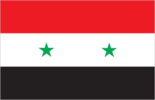
description: consists of three horizontal stripes of equal size: green at the top, followed by white, and black at the bottom; features three five-pointed red stars aligned horizontally and centered within the white stripe
meaning: this flag design mirrors a prior Syrian national flag utilized from 1932 to 1958 and again from 1961 to 1963; however, it remains ambiguous if the symbols will carry the same significance; the colors historically symbolized Syria’s previous rulers: white (Umayyad Caliphate), black (Abbasid Caliphate), and green (Rashidun Caliphate); the first star represented Damascus, Aleppo, and Deir ez-Zor, which were the three administrative regions in Syria during the 1930s; the second star denoted Jabal Druze (the Mountain of the Druze), while the third star signified the Alawite Mountains
history: in 2011, the flag was adopted by those opposing the Asad regime; it was officially established as the national flag in 2025, superseding the previous two-star design
Capital
name
Damascus
etymology
the city possesses an ancient name of pre-Semitic origin that is not clearly understood
time difference
UTC+3 (8 hours ahead of Washington, DC, in Standard Time)
geographic coordinates
33 30 N, 36 18 E
Suffrage
18 years of age; universal
Citizenship
citizenship by birth
no
citizenship by descent only
the father must hold Syrian citizenship; if the father is unknown or lacks citizenship, the mother must be a citizen of Syria
dual citizenship recognized
yes
residency requirement for naturalization
10 years
Constitution
history
Syria's constitution from 2012 was annulled by the Hayat Tahrir al-Sham-led government in January 2025; in March 2025, transitional authorities introduced a provisional constitution intended to be in effect for up to five years
Country name
former
United Arab Republic (with Egypt)
etymology
the origin of the name is not definitively known; it appears as "Suri" in Babylonian cuneiform texts dating back to approximately 4000 B.C.
local long form
Al Jumhuriyah al Arabiyah as Suriyah
local short form
Suriyah
conventional long form
Syrian Arab Republic
conventional short form
Syria
Independence
17 April 1946 (from League of Nations mandate under French administration)
Legal system
a mixed legal system that incorporates civil law and Islamic (sharia) law for family court matters
Government type
transitional presidential republic
Judicial branch
highest court(s)
Court of Cassation (divided into civil, criminal, religious, and military divisions, each comprising 3 judges); Supreme Constitutional Court (composed of 7 members)
subordinate courts
courts of first instance; magistrate courts; religious and military tribunals; Economic Security Court; Counterterrorism Court
judge selection and term of office
judges of the Court of Cassation are appointed by the Supreme Judicial Council (SJC), which is a judicial management entity led by the minister of justice and includes 7 members, one of whom is the national president; terms for judges are not applicable; judges of the Supreme Constitutional Court are nominated by the president and appointed by the SJC; they serve renewable terms of 4 years
Executive branch
cabinet
Council of Ministers appointed by the president
chief of state
Ahmad al-Shara'; former President Bashar al-ASAD was ousted by Islamist rebels on 8 December 2024
election results
2021: Bashar al-ASAD was elected president with a vote percentage of - Bashar al-ASAD (Ba'th Party) 95.2%, Mahmoud Ahmad MAREI (Democratic Arab Socialist Union) 3.3%, other candidates 1.5%
2014: Bashar al-ASAD was elected president with a vote percentage of - Bashar al-ASAD (Ba'th Party) 88.7%, Hassan al-NOURI (independent) 4.3%, Maher HAJJER (independent) 3.2%, other or invalid votes 3.8%
head of government
Prime Minister Muhammad al-BASHIR (since 8 December 2024)
most recent election date
26 May 2021
election/appointment process
the president is elected directly through a simple-majority popular vote for a term of 7 years (eligible for re-election); the president is responsible for appointing the vice president and the prime minister
expected date of next election
2028
National holiday
Independence Day (Evacuation Day), 17 April (1946)
National color(s)
red, white, black, green
National heritage
total World Heritage Sites
6 (all cultural)
selected World Heritage Site locales
Ancient City of Damascus; Ancient City of Bosra; Site of Palmyra; Ancient City of Aleppo; Crac des Chevaliers and Qal’at Salah El-Din; Ancient Villages of Northern Syria
Political parties
legal parties/alliances:
Arab Socialist Ba'ath Party
Arab Socialist (Ba'ath) Party – Syrian Regional
Arab Socialist Ba'ath Party – Syrian Regional Branch, Socialist Unionist Democratic Party
Arab Socialist Union of Syria or ASU
Democratic Arab Socialist Union
National Progressive Front or NPF
Socialist Unionist Democratic Party
Socialist Unionist Party
Syrian Communist Party (two branches)
Syrian Social Nationalist Party or SSNP
Unionist Socialist Party
major political organizations:
Kurdish Democratic Union Party or PYD
Kurdish National Council or KNC
Syriac Union Party
Syrian Democratic Council or SDC
Syrian Democratic Party
Syrian Opposition Coalition
de facto governance entities:
Democratic Autonomous Administration of Northeast Syria or DAANES
Syrian Interim Government or SIG
Syrian Salvation Government or SSG
Legislative branch
term in office
4 years
number of seats
210 (140 indirectly elected; 70 appointed)
electoral system
plurality/majority
legislature name
People's Assembly (Majlis Al-Chaab)
scope of elections
full renewal
legislative structure
unicameral
most recent election date
10/5/2025
expected date of next election
March 2030
percentage of women in chamber
9.6%
National anthem(s)
title
“Ħumāt ad-Diyār (Guardians of the Homeland)
history
adopted in 1936, restored in 1961; the nation had a different anthem during the period from 1958 to 1961 when Syria was integrated into the United Arab Republic
lyrics/music
Khalil Mardam BEY/Mohammad Salim FLAYFEL and Ahmad Salim FLAYFEL
National symbol(s)
northern bald ibis
Administrative divisions
14 provinces (muhafazat, singular - muhafazah); Al Hasakah, Al Ladhiqiyah (Latakia), Al Qunaytirah, Ar Raqqah, As Suwayda', Dar'a, Dayr az Zawr, Dimashq (Damascus), Halab (Aleppo), Hamah, Hims (Homs), Idlib, Rif Dimashq (Damascus Countryside), Tartus
Diplomatic representation in the US
none
note: operations at the embassy were suspended on 18 March 2014
Diplomatic representation from the US
mailing address
6110 Damascus Place, Washington DC 20521-6110
chief of mission
Ambassador (currently vacant); note - on 6 February 2012, the United States ceased operations at its embassy in Damascus; Czechia acts as a protecting power for U.S. interests in Syria
email address and website
[email protected]
https://sy.usembassy.gov/
International organization participation
ABEDA, AFESD, AMF, CAEU, FAO, G-24, G-77, IAEA, IBRD, ICAO, ICC (national committees), ICRM, ICSID, IDA, IDB, IFAD, IFC, IFRCS, IHO, ILO, IMF, IMO, Interpol, IOC, IPU, ISO, ITSO, ITU, LAS, MIGA, NAM, OAPEC, OIC, OPCW, UN, UNCTAD, UNESCO, UNIDO, UNOOSA, UNRWA, UNWTO, UPU, WBG, WCO, WFTU (NGOs), WHO, WIPO, WMO, WTO (observer)
International law organization participation
has not presented a declaration of jurisdiction to the ICJ; is not a party to the ICC
Economy
Budget
revenues
$1.162 billion (2017 est.)
expenditures
$3.211 billion (2017 est.)
Exports
Exports 2020
$1.649 billion (2020 est.)
Exports 2021
$2.227 billion (2021 est.)
Exports 2022
$1.609 billion (2022 est.)
Imports
Imports 2020
$3.751 billion (2020 est.)
Imports 2021
$6.56 billion (2021 est.)
Imports 2022
$6.803 billion (2022 est.)
Industries
petroleum, textiles, food processing, beverages, tobacco, phosphate rock extraction, cement, oilseed crushing, automobile manufacturing
Labor force
6.617 million (2024 est.)
Public debt
Public debt 2016
91.3% of GDP (2016 est.)
Remittances
Remittances 2021
0% of GDP (2021 est.)
Remittances 2022
0% of GDP (2022 est.)
Remittances 2023
0% of GDP (2023 est.)
Exchange rates
Currency
Syrian pounds (SYP) per US dollar -
Exchange rates 2018
436.5 (2018 est.)
Exchange rates 2019
436.5 (2019 est.)
Exchange rates 2020
877.945 (2020 est.)
Exchange rates 2021
1,256 (2021 est.)
Exchange rates 2022
2,505.747 (2022 est.)
Debt - external
Debt - external 2023
$4.573 billion (2023 est.)
Economic overview
low-income economy in the Middle East; prior infrastructure and economy ravaged by an 11-year civil conflict; ongoing US sanctions; intermittent migration during the conflict; currently receiving support from a World Bank trust fund; persistent hyperinflation
Unemployment rate
Unemployment rate 2022
13.3% (2022 est.)
Unemployment rate 2023
13.2% (2023 est.)
Unemployment rate 2024
13% (2024 est.)
Exports - partners
Turkey 29%, Saudi Arabia 16%, Lebanon 10%, India 10%, UAE 5% (2023)
Imports - partners
Turkey 49%, UAE 11%, China 8%, Egypt 7%, Lebanon 3% (2023)
Real GDP per capita
Real GDP per capita 2021
$4,600 (2021 est.)
Real GDP per capita 2022
$4,500 (2022 est.)
Real GDP per capita 2023
$4,200 (2023 est.)
Real GDP growth rate
Real GDP growth rate 2021
1.9% (2021 est.)
Real GDP growth rate 2022
0.7% (2022 est.)
Real GDP growth rate 2023
-1.2% (2023 est.)
Agricultural products
wheat, barley, milk, sheep milk, tomatoes, olives, potatoes, maize, oranges, grapes (2023)
Exports - commodities
olive oil, phosphates, spice seeds, cotton, tomatoes (2023)
Imports - commodities
tobacco, plastics, wheat flour, plastic goods, seed oils (2023)
GDP (official exchange rate)
$19.993 billion (2023 est.)
GDP - composition, by end use
household consumption
114.8% (2022 est.)
government consumption
2.7% (2022 est.)
investment in fixed capital
4.5% (2022 est.)
exports of goods and services
6.8% (2022 est.)
imports of goods and services
-28.8% (2022 est.)
Inflation rate (consumer prices)
Inflation rate (consumer prices) 2020
114.2% (2020 est.)
Inflation rate (consumer prices) 2021
98.3% (2021 est.)
Inflation rate (consumer prices) 2022
94.1% (2022 est.)
Industrial production growth rate
-13.4% (2022 est.)
Real GDP (purchasing power parity)
Real GDP (purchasing power parity) 2021
$99.338 billion (2021 est.)
Real GDP (purchasing power parity) 2022
$100.066 billion (2022 est.)
Real GDP (purchasing power parity) 2023
$98.858 billion (2023 est.)
Youth unemployment rate (ages 15-24)
male
27.8% (2024 est.)
total
31.5% (2024 est.)
female
47.9% (2024 est.)
GDP - composition, by sector of origin
industry
12% (2022 est.)
services
44.9% (2022 est.)
agriculture
43.1% (2022 est.)
Household income or consumption by percentage share
lowest 10%
3.8% (2022 est.)
highest 10%
21.1% (2022 est.)
Gini Index coefficient - distribution of family income
Gini Index coefficient - distribution of family income 2022
26.6 (2022 est.)
Energy
Coal
imports
15,000 metric tons (2023 est.)
consumption
15,000 metric tons (2023 est.)
Petroleum
total petroleum production
65,000 bbl/day (2023 est.)
crude oil estimated reserves
2.5 billion barrels (2021 est.)
refined petroleum consumption
102,000 bbl/day (2023 est.)
Electricity
exports
358.723 million kWh (2023 est.)
consumption
15.522 billion kWh (2023 est.)
installed generating capacity
9.636 million kW (2023 est.)
transmission/distribution losses
4.214 billion kWh (2023 est.)
Natural gas
production
2.763 billion cubic meters (2023 est.)
consumption
2.763 billion cubic meters (2023 est.)
proven reserves
240.693 billion cubic meters (2021 est.)
Electricity access
electrification - rural areas
75%
electrification - urban areas
100%
electrification - total population
89% (2022 est.)
Energy consumption per capita
Total energy consumption per capita 2023
13.569 million Btu/person (2023 est.)
Electricity generation sources
solar
0.5% of total installed capacity (2023 est.)
fossil fuels
95.6% of total installed capacity (2023 est.)
hydroelectricity
3.8% of total installed capacity (2023 est.)
biomass and waste
0.2% of total installed capacity (2023 est.)
Communications
Internet users
percent of population
35% (2019 est.)
Broadcast media
The television landscape includes two state-operated networks and five satellite channels; approximately two-thirds of households possess a satellite dish that allows access to international television; there are three state-operated radio stations; the inaugural private radio station commenced operations in 2005; as of 2018, private radio entities are banned from airing news or political material.
Internet country code
.sy
Telephones - fixed lines
total subscriptions
2.816 million (2023 est.)
subscriptions per 100 inhabitants
12 (2023 est.)
Telephones - mobile cellular
total subscriptions
17.6 million (2024 est.)
subscriptions per 100 inhabitants
71 (2024 est.)
Broadband - fixed subscriptions
total
1.62 million (2023 est.)
subscriptions per 100 inhabitants
7 (2023 est.)
Transportation
Ports
large
1
small
1
medium
1
key ports
Al Ladhiqiyah, Baniyas, Tartus
very small
0
total ports
3 (2024)
ports with oil terminals
3
Airports
42 (2025)
Railways
total
2,052 km (2014)
narrow gauge
251 km (2014) 1.050-m gauge
standard gauge
1,801 km (2014) 1.435-m gauge
Heliports
13 (2025)
Merchant marine
total
24 (2023)
by type
1 bulk carrier, 1 container ship, 8 general cargo vessels, 1 oil tanker, 13 others
Civil aircraft registration country code prefix
YK
Military & Security
Military - note
as of September 2025, the Syrian government did not maintain control over the entirety of the country; regions in the northeast were governed by forces led by ethnic Kurds, and areas to the south of Damascus were held by members of the Druze religious community. Turkish military presence persisted in certain northern regions, while Israeli troops had entered previously demilitarized zones between Syria and Israel, as well as into some Syrian land adjacent to the border.
The UN Disengagement Observer Force (UNDOF) has been active in the Golan Heights between Israel and Syria since 1974, tasked with overseeing the ceasefire that followed the 1973 Arab-Israeli War and managing the separation zones between the two nations. As of 2025, UNDOF comprises approximately 1,300 personnel.
Military expenditures
Military Expenditures 2015
7.2% of GDP (2015 est.)
Military Expenditures 2016
6.9% of GDP (2016 est.)
Military Expenditures 2017
6.8% of GDP (2017 est.)
Military Expenditures 2018
6.7% of GDP (2018 est.)
Military Expenditures 2019
6.5% of GDP (2019 est.)
Military and security forces
the interim governmental authorities in Syria have created a Ministry of Defense and are striving to consolidate the numerous armed groups operating within the country into a unified, state-affiliated military. Additionally, a Ministry of Interior has been formed to oversee police and various security forces (2025).
Military service age and obligation
under the rule of Bashar al-ASAD, all Syrian males aged 18 to 38 were mandated to serve between 18 to 21 months in military service. This conscription policy remained in effect until ASAD's ousting, at which point the interim government declared that compulsory military service would be eliminated, with reinstatement only to occur in severe circumstances, such as national emergencies related to warfare (2025).
Military equipment inventories and acquisitions
the military forces of Syria are armed with equipment primarily sourced from Russian and Soviet-era stockpiles (2025).
Military and security service personnel strengths
not available
Terrorism
Terrorist group(s)
Abdallah Azzam Brigades; Ansar al-Islam; Asa’ib Ahl Al-Haq; Hizballah; Hurras al-Din; Islamic Jihad Union; Islamic Revolutionary Guard Corps (IRGC)/Qods Force; Islamic State of Iraq and ash-Sham (ISIS); Kata'ib Hizballah; Kurdistan Workers' Party (PKK); al-Qa'ida; Palestine Liberation Front (PLF); Popular Front for the Liberation of Palestine (PFLP); PFLP-General Command (PLFP-GC)
Transnational Issues
Trafficking in persons
tier rating
Tier 3 — Syria fails to fully comply with the minimum requirements for the eradication of trafficking and is not making considerable efforts towards this goal, consequently, Syria continues to be classified as Tier 3; for further information, visit: https://www.state.gov/reports/2025-trafficking-in-persons-report/syria/
Refugees and internally displaced persons
IDPs
7,408,809 (2024 est.)
refugees
16,402 (2024 est.)
stateless persons
160,000 (2024 est.)
Space
Space agency/agencies
Established in 2014, the Syrian Space Agency's current status remains uncertain following the collapse of the ASAD Government in 2025.
Space program overview
The agency's status is ambiguous; it has been adversely affected by the civil war, notably due to the exodus of students and scientists from the nation. Previously, it concentrated on the development of satellites and associated space technologies, along with scientific research. Additionally, it maintains connections with Russia's space agency and its space industries as of 2024.
Key space-program milestones
1987 - first and only Syrian astronaut into space as part of a Soviet-crewed mission to the Mir Space Station under the Intercosmos program
2016 - signed a scientific cooperation agreement in the field of space technology and remote sensing with Russia
2018 - announced that developing a satellite would be a primary goal of the space program