CapitalKampala
LanguagesThe official language is English, while Ganda, also known as Luganda, is the most prevalent of the Niger-Congo languages and is commonly spoken in the capital. Other languages in use include various Niger-Congo languages, Nilo-Saharan languages, as well as Swahili and Arabic, both of which hold official status.
CurrencyUgandan shillings
Governmenta presidential republic.
Bamwor Indexes
Uganda — Q1 2026
IBEUBamwor Urban Scale Index
3.30%
Rank #227 of 237
View full ranking →
IBCPBamwor Population Concentration Index
6.64%
Rank #230 of 237
View full ranking →
IBDABamwor Settlement Density Index
47.52per 1K km²
Rank #162 of 241
View full ranking →
IBCXBamwor Country Complexity Index
62.01/100
Rank #112 of 234
View full ranking →
IBEEBamwor Economic Stability Index
81.96/100
Rank #174 of 220
View full ranking →
IBFMBamwor Military Strength Index
57.75/100
Rank #41 of 124
View full ranking →
IBDIBamwor Digital Infrastructure Index
29.22/100
Rank #197 of 206
View full ranking →
IBEDBamwor Education Index
49.05/100
Rank #92 of 119
View full ranking →
IBSABamwor Healthcare Index
59.27/100
Rank #173 of 218
View full ranking →
Uganda Intelligence Report
Download PDF with 20+ statistics, rankings & proprietary indices
Introduction
Background
As a historical meeting point for numerous migrations, Uganda is home to approximately 65 ethnic groups that communicate in languages from three of Africa's four primary linguistic families. By 1200, the southern regions, characterized by fertile land and consistent rainfall, facilitated the emergence of several substantial, centralized kingdoms, notably Buganda, which lends its name to the nation. In the 1820s, Muslim traders from Egypt made their way to northern Uganda, while Swahili merchants from the Indian Ocean coast reached the southern part by the 1840s. The region caught the interest of British explorers in the 1860s, who were in search of the Nile River's source, and this British influence grew in subsequent years with the arrival of Christian missionaries and various trade agreements; Uganda was officially designated a British protectorate in 1894. Southern kingdoms such as Buganda negotiated with Britain to obtain certain privileges and a degree of autonomy that were uncommon during Africa's colonial era. The colonial borders of Uganda unified a diverse array of ethnic groups, each with distinct political frameworks and cultural practices, and the differences in British governance between the southern and northern territories further exacerbated these variations, hindering the establishment of a unified independent nation.
In 1962, Uganda achieved independence with one of the more advanced economies and a robust educational system in Sub-Saharan Africa; however, within a few years, it plunged into political unrest and internal strife that persisted for over two decades. In 1966, Prime Minister Milton OBOTE suspended the constitution and forcibly removed President Edward MUTESA, who was concurrently the king of Buganda. In 1971, Idi AMIN took control through a military coup, leading the nation into severe economic decline and widespread human rights violations resulting in the deaths of up to 500,000 civilians. AMIN’s invasion of Tanzanian territory in 1979 prompted Tanzania to retaliate by invading Uganda, ousting AMIN, and establishing a coalition government. Following this, Uganda continued to endure atrocities, looting, and political chaos, with four different leaders between 1979 and 1980. OBOTE reclaimed the presidency in 1980 through a contentious election that ignited renewed guerrilla conflict, claiming an estimated 300,000 civilian lives. Gen. Tito OKELLO took control in a coup in 1985, but his tenure was brief, as Yoweri MUSEVENI assumed the presidency in 1986 after his insurgency captured the capital. MUSEVENI is often credited with bringing relative stability and economic improvement to Uganda, yet he has resisted pressures to step down from power. In 2017, the parliament eliminated presidential age restrictions, allowing MUSEVENI the possibility of remaining in office indefinitely.
Geography
Area
land
197,100 sq km
water
43,938 sq km
total
241,038 sq km
Climate
tropical; typically experiences rainfall with two dry periods (from December to February, and June to August); semi-arid conditions exist in the northeast
Terrain
predominantly a plateau surrounded by mountain ranges
Land use
other
16% (2023 est.)
forest
12.1% (2023 est.)
agricultural land
71.9% (2023 est.)
agricultural land: arable land
arable land: 34.4% (2023 est.)
agricultural land: permanent crops
permanent crops: 11% (2023 est.)
agricultural land: permanent pasture
permanent pasture: 26.5% (2023 est.)
Location
Located in East-Central Africa, bordered to the west by Kenya and to the east by the Democratic Republic of the Congo
Coastline
0 km (landlocked)
Elevation
lowest point
Albert Nile 614 m
highest point
Margherita Peak on Mount Stanley 5,110 m
Irrigated land
105 sq km (2013)
Map references
Africa
Land boundaries
total
2,729 km
border countries
The borders include the Democratic Republic of the Congo at 877 km; Kenya at 814 km; Rwanda at 172 km; South Sudan at 475 km; and Tanzania at 391 km
Maritime claims
none (landlocked)
Natural hazards
experiences droughts; flooding; seismic activity; landslides; and hailstorms
Geography - note
a landlocked nation, it is a fertile, well-irrigated area abundant in lakes and rivers; Lake Victoria, recognized as the largest tropical lake globally and the second-largest freshwater lake, is jointly owned by three nations: Kenya, Tanzania, and Uganda
Natural resources
resources include copper, cobalt, hydropower, limestone, salt, arable land, and gold
Area - comparative
approximately two times larger than Pennsylvania; slightly smaller than Oregon
Geographic coordinates
1 00 N, 32 00 E
Population distribution
the population density is comparatively high relative to other African countries; the majority of the populace is found in the central and southern regions, particularly along the banks of Lake Victoria and Lake Albert; the northeast is the least populated area, as depicted in the population distribution map
Major lakes (area sq km)
fresh water lake(s)
Lake Victoria (co-owned with Tanzania and Kenya) - 62,940 sq km; Lake Albert (jointly occupied with the Democratic Republic of Congo) - 5,590 sq km; Lake Kyoga - 4,430 sq km; Lake Edward (shared with the Democratic Republic of Congo) - 2,150 sq km
Major watersheds (area sq km)
Atlantic Ocean drainage
Congo (3,730,881 sq km), (Mediterranean Sea) Nile (3,254,853 sq km)
Major rivers (by length in km)
Nile (shared with Rwanda [s], Tanzania, South Sudan, Sudan, and Egypt [m]) - 6,650 km
note: [s] after country name denotes river source; [m] after country name signifies river mouth
People & Society
Literacy
male
78.5% (2016 est.)
female
61% (2016 est.)
total population
69.1% (2016 est.)
Languages
The official language is English, while Ganda, also known as Luganda, is the most prevalent of the Niger-Congo languages and is commonly spoken in the capital. Other languages in use include various Niger-Congo languages, Nilo-Saharan languages, as well as Swahili and Arabic, both of which hold official status.
Religions
Protestants make up 45.1% of the population (with Anglicans at 32.0%, Pentecostals/Born Again/Evangelicals at 11.1%, Seventh Day Adventists at 1.7%, and Baptists at 0.3%), Roman Catholics account for 39.3%, Muslims represent 13.7%, others comprise 1.6%, and those with no affiliation are at 0.2% (estimates from 2014).
Sex ratio
at birth
1.03 male(s)/female
0-14 years
1.03 male(s)/female
15-64 years
0.9 male(s)/female
total population
0.95 male(s)/female (2024 est.)
65 years and over
0.74 male(s)/female
Birth rate
38.91 births/1,000 population (2025 est.)
Death rate
4.61 deaths/1,000 population (2025 est.)
Median age
male
15.5 years
total
16.4 years (2025 est.)
female
17.1 years
Population
male
24,835,513
total
50,863,850 (2025 est.)
female
26,028,337
Nationality
noun
Ugandan(s)
adjective
Ugandan
Tobacco use
male
7.8% (2025 est.)
total
4.5% (2025 est.)
female
1.5% (2025 est.)
Urbanization
urban population
26.8% of total population (2023)
rate of urbanization
5.41% annual rate of change (2020-25 est.)
Age structure
0-14 years
47% (male 11,747,745/female 11,427,932)
15-64 years
50.6% (male 11,788,483/female 13,131,051)
65 years and over
2.4% (2024 est.) (male 504,332/female 683,498)
Ethnic groups
Baganda 16.5%, Banyankole 9.6%, Basoga 8.8%, Bakiga 7.1%, Iteso 7%, Langi 6.3%, Bagisu 4.9%, Acholi 4.4%, Lugbara 3.3%, other 32.1% (2014 est.)
Child marriage
men married by age 18
5.5% (2016)
women married by age 15
7.3% (2016)
women married by age 18
34% (2016)
Dependency ratios
total dependency ratio
96.9 (2025 est.)
youth dependency ratio
92.1 (2025 est.)
potential support ratio
20.8 (2025 est.)
elderly dependency ratio
4.8 (2025 est.)
Physician density
0.19 physicians/1,000 population (2022)
Health expenditure
Health expenditure (as % of GDP)
4.7% of GDP (2021)
Health expenditure (as % of national budget)
4.9% of national budget (2022 est.)
Net migration rate
-2.96 migrant(s)/1,000 population (2025 est.)
Total fertility rate
5.08 children born/woman (2025 est.)
Drinking water source
improved: rural
rural: 51.8% of population (2022 est.)
improved: total
total: 59.3% of population (2022 est.)
improved: urban
urban: 80.3% of population (2022 est.)
unimproved: rural
rural: 48.2% of population (2022 est.)
unimproved: total
total: 40.7% of population (2022 est.)
unimproved: urban
urban: 19.7% of population (2022 est.)
Education expenditure
Education expenditure (% GDP)
2.6% of GDP (2022 est.)
Education expenditure (% national budget)
8.5% national budget (2022 est.)
Infant mortality rate
male
31.8 deaths/1,000 live births
total
27.5 deaths/1,000 live births (2025 est.)
female
25.1 deaths/1,000 live births
Population growth rate
3.13% (2025 est.)
Gross reproduction rate
2.5 (2025 est.)
Population distribution
The population density is notably high relative to other countries in Africa; the majority of residents are located in the central and southern regions, especially near the banks of Lake Victoria and Lake Albert. Conversely, the northeast region has the lowest population density, as illustrated in the accompanying population distribution map.
Life expectancy at birth
male
67.5 years
female
72 years
total population
69.7 years (2024 est.)
Maternal mortality ratio
170 deaths/100,000 live births (2023 est.)
Sanitation facility access
improved: rural
rural: 27.9% of population (2022 est.)
improved: total
total: 38.2% of population (2022 est.)
improved: urban
urban: 67.1% of population (2022 est.)
unimproved: rural
rural: 72.1% of population (2022 est.)
unimproved: total
total: 61.8% of population (2022 est.)
unimproved: urban
urban: 32.9% of population (2022 est.)
Alcohol consumption per capita
beer
0.85 liters of pure alcohol (2019 est.)
wine
0.01 liters of pure alcohol (2019 est.)
total
6.82 liters of pure alcohol (2019 est.)
spirits
0.5 liters of pure alcohol (2019 est.)
other alcohols
5.46 liters of pure alcohol (2019 est.)
Major urban areas - population
3.846 million KAMPALA (capital) (2023)
Obesity - adult prevalence rate
5.3% (2016)
Mother's mean age at first birth
19.4 years (2016 est.)
Currently married women (ages 15-49)
57.8% (2022 est.)
Children under the age of 5 years underweight
9.7% (2022 est.)
School life expectancy (primary to tertiary education)
male
10 years (2016 est.)
total
9 years (2016 est.)
female
9 years (2016 est.)
Environment
Climate
tropical; typically experiences rainfall with two distinct dry periods (December to February, June to August); semiarid conditions in the northeastern region
Land use
other
16% (2023 est.)
forest
12.1% (2023 est.)
agricultural land
71.9% (2023 est.)
agricultural land: arable land
arable land: 34.4% (2023 est.)
agricultural land: permanent crops
permanent crops: 11% (2023 est.)
agricultural land: permanent pasture
permanent pasture: 26.5% (2023 est.)
Urbanization
urban population
26.8% of total population (2023)
rate of urbanization
5.41% annual rate of change (2020-25 est.)
Waste and recycling
municipal solid waste generated annually
7.045 million tons (2024 est.)
percent of municipal solid waste recycled
24.1% (2022 est.)
Environmental issues
conversion of wetlands for farming purposes; deforestation; excessive grazing; erosion of soil; contamination of water due to industrial waste and water hyacinth proliferation in Lake Victoria; extensive poaching activities
Total water withdrawal
municipal
328 million cubic meters (2022 est.)
industrial
50 million cubic meters (2022 est.)
agricultural
259 million cubic meters (2022 est.)
Carbon dioxide emissions
total emissions
6.354 million metric tonnes of CO2 (2023 est.)
from coal and metallurgical coke
-398 metric tonnes of CO2 (2023 est.)
from petroleum and other liquids
6.354 million metric tonnes of CO2 (2023 est.)
Particulate matter emissions
31.3 micrograms per cubic meter (2019 est.)
Total renewable water resources
60.1 billion cubic meters (2022 est.)
International environmental agreements
party to
Biodiversity, Climate Change, Climate Change-Kyoto Protocol, Climate Change-Paris Agreement, Comprehensive Nuclear Test Ban, Desertification, Endangered Species, Hazardous Wastes, Law of the Sea, Marine Life Conservation, Nuclear Test Ban, Ozone Layer Protection, Ship Pollution, Wetlands
signed, but not ratified
Environmental Modification
Government
Flag
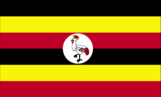
description: six equal horizontal stripes in black (top), yellow, red, black, yellow, and red; at the center is a white disc featuring a grey crowned crane, which serves as the national emblem.
meaning: black symbolizes the African populace, yellow represents sunlight and energy, while red denotes African unity.
Capital
name
Kampala
etymology
the name is believed to be derived from the impala, an African antelope.
time difference
UTC+3 (8 hours ahead of Washington, DC, during Standard Time)
geographic coordinates
0 19 N, 32 33 E
Suffrage
18 years of age; universal
Citizenship
citizenship by birth
no
citizenship by descent only
at least one parent or grandparent must be a native-born citizen of Uganda
dual citizenship recognized
yes
residency requirement for naturalization
an aggregate of 20 years and continuously for the last 2 years prior to applying for citizenship
Constitution
history
multiple prior versions; the most recent was adopted on 27 September 1995, and promulgated on 8 October 1995.
amendment process
proposed by the National Assembly; for passage, a minimum of two-thirds majority vote from Assembly members is required in the second and third readings; proposals that impact "entrenched clauses," which include the sovereignty of the populace, constitutional supremacy, human rights and freedoms, the democratic and multiparty governmental structure, presidential term limits, judicial independence, and institutions of traditional or cultural leaders, necessitate approval via referendum, ratification by a two-thirds majority vote from district council members in at least two-thirds of Uganda's districts, and presidential assent.
Country name
etymology
the name originates from the Swahili term u, signifying "land" or "country," along with the Ganda people; the etymology of the Ganda name remains uncertain.
conventional long form
Republic of Uganda
conventional short form
Uganda
Independence
9 October 1962 (from the UK)
Legal system
a hybrid system combining English common law and customary law.
Government type
a presidential republic.
Judicial branch
highest court(s)
Supreme Court of Uganda (consists of the chief justice and at least 6 justices)
subordinate courts
Court of Appeal (which also functions as the Constitutional Court); High Court (comprising 12 High Court Circuits and 8 High Court Divisions); Industrial Court; Chief Magistrate Courts of Grade One and Grade Two throughout the nation; qadhis courts; local council courts; family and children courts.
judge selection and term of office
justices are appointed by the president of the republic in consultation with the Judicial Service Commission, which is an independent advisory body consisting of 8 members, and are confirmed by the National Assembly; justices are required to retire at the age of 70.
Executive branch
cabinet
Cabinet appointed by the president from among elected members of Parliament or persons who qualify to be elected as members of Parliament
chief of state
President Yoweri Kaguta MUSEVENI (since 26 January 1986)
election results
2021: Yoweri Kaguta MUSEVENI was re-elected president in the first round; vote percentage - Yoweri Kaguta MUSEVENI (NRM) 58.6%, Robert Kyagulanyi SSENTAMU (also known as Bobi WINE) (NUP) 34.8%, Patrick Oboi AMURIAT (FDC) 3.2%, others 3.4%.
head of government
Prime Minister Robinah NABBANJA (since 14 June 2021)
most recent election date
14 January 2021
election/appointment process
the president is directly elected through an absolute-majority popular vote in two rounds, if necessary, for a term of 5 years (without term limits).
expected date of next election
2026
National holiday
Independence Day, 9 October (1962)
National color(s)
black, yellow, red
National heritage
total World Heritage Sites
3 (1 cultural, 2 natural)
selected World Heritage Site locales
Bwindi Impenetrable National Park (n); Rwenzori Mountains National Park (n); Tombs of Buganda Kings at Kasubi (c).
Political parties
Democratic Party or DP
Forum for Democratic Change or FDC
Justice Forum or JEEMA
National Resistance Movement or NRM
National Unity Platform
People's Progressive Party or PPP
Uganda People's Congress or UPC
Legislative branch
term in office
5 years
number of seats
529 (499 directly elected; 30 indirectly elected)
electoral system
plurality/majority
legislature name
Parliament
scope of elections
full renewal
legislative structure
unicameral
most recent election date
1/14/2021 to 1/18/2021
expected date of next election
January 2026
percentage of women in chamber
34.1%
parties elected and seats per party
National Resistance Movement (NRM) (336); National Unity Platform (NUP) (57); Forum for Democratic Change (FDC) (32); Independents (74); Others (30).
National anthem(s)
title
"O Uganda, Land of Beauty!"
history
adopted in 1962; it is among the shortest national anthems globally.
lyrics/music
George Wilberforce KAKOMOA
National symbol(s)
grey crowned crane
Administrative divisions
134 districts and 1 capital city*; Abim, Adjumani, Agago, Alebtong, Amolatar, Amudat, Amuria, Amuru, Apac, Arua, Budaka, Bududa, Bugiri, Bugweri, Buhweju, Buikwe, Bukedea, Bukomansimbi, Bukwo, Bulambuli, Buliisa, Bundibugyo, Bunyangabu, Bushenyi, Busia, Butaleja, Butambala, Butebo, Buvuma, Buyende, Dokolo, Gomba, Gulu, Hoima, Ibanda, Iganga, Isingiro, Jinja, Kaabong, Kabale, Kabarole, Kaberamaido, Kagadi, Kakumiro, Kalaki, Kalangala, Kaliro, Kalungu, Kampala*, Kamuli, Kamwenge, Kanungu, Kapchorwa, Kapelebyong, Karenga, Kasese, Kasanda, Katakwi, Kayunga, Kazo, Kibaale, Kiboga, Kibuku, Kikuube, Kiruhura, Kiryandongo, Kisoro, Kitagwenda, Kitgum, Koboko, Kole, Kotido, Kumi, Kwania, Kween, Kyankwanzi, Kyegegwa, Kyenjojo, Kyotera, Lamwo, Lira, Luuka, Luwero, Lwengo, Lyantonde, Madi-Okollo, Manafwa, Maracha, Masaka, Masindi, Mayuge, Mbale, Mbarara, Mitooma, Mityana, Moroto, Moyo, Mpigi, Mubende, Mukono, Nabilatuk, Nakapiripirit, Nakaseke, Nakasongola, Namayingo, Namisindwa, Namutumba, Napak, Nebbi, Ngora, Ntoroko, Ntungamo, Nwoya, Obongi, Omoro, Otuke, Oyam, Pader, Pakwach, Pallisa, Rakai, Rubanda, Rubirizi, Rukiga, Rukungiri, Rwampara, Sembabule, Serere, Sheema, Sironko, Soroti, Tororo, Wakiso, Yumbe, Zombo.
Diplomatic representation in the US
FAX
[1] (202) 726-1727
chancery
5911 16th Street NW, Washington, DC 20011
telephone
[1] (202) 726-7100
chief of mission
Ambassador Robie KAKONGE (since 12 December 2022)
email address and website
[email protected]
https://washington.mofa.go.ug/
Diplomatic representation from the US
FAX
[256] (0) 414-259-794
embassy
1577 Ggaba Road, Kampala
telephone
[256] (0) 312-306-001
mailing address
2190 Kampala Place, Washington DC 20521-2190
chief of mission
Ambassador William W. POPP (since 20 September 2023).
email address and website
[email protected]
https://ug.usembassy.gov/
International organization participation
ACP, AfDB, ATMIS, AU, C, COMESA, EAC, EADB, FAO, G-77, IAEA, IBRD, ICAO, ICC (national committees), ICCt, IDA, IDB, IFAD, IFC, IFRCS, IGAD, ILO, IMF, IMO, Interpol, IOC, IOM, IPU, ISO (correspondent), ITC, ITSO, ITU, ITUC (NGOs), MIGA, NAM, OIC, OPCW, PCA, UN, UNCDF, UNCTAD, UNECA, UNDP, UNFPA, UNESCO, UNHCR, UNICEF, UNIDO, UNISFA, UNOCI, UNOPS, UNSOM, UNWTO, UPU, WCO, WFP, WFTU (NGOs), WHO, WIPO, WMO, WTO
International law organization participation
accepts compulsory ICJ jurisdiction; accepts ICCt jurisdiction.
Economy
Budget
revenues
$7.616 billion (2023 est.)
expenditures
$10.043 billion (2023 est.)
Exports
Exports 2021
$6.231 billion (2021 est.)
Exports 2022
$6.116 billion (2022 est.)
Exports 2023
$9.084 billion (2023 est.)
Imports
Imports 2021
$10.62 billion (2021 est.)
Imports 2022
$11.079 billion (2022 est.)
Imports 2023
$13.853 billion (2023 est.)
Industries
processing of sugar, brewing, tobacco, cotton textiles; production of cement and steel
Labor force
22.829 million (2024 est.)
Public debt
Public debt 2023
53.1% of GDP (2023 est.)
Remittances
Remittances 2021
2.9% of GDP (2021 est.)
Remittances 2022
2.7% of GDP (2022 est.)
Remittances 2023
2.9% of GDP (2023 est.)
Exchange rates
Currency
Ugandan shillings (UGX) per US dollar -
Exchange rates 2020
3,718.249 (2020 est.)
Exchange rates 2021
3,587.052 (2021 est.)
Exchange rates 2022
3,689.817 (2022 est.)
Exchange rates 2023
3,726.14 (2023 est.)
Exchange rates 2024
3,757.263 (2024 est.)
Debt - external
Debt - external 2023
$10.469 billion (2023 est.)
Economic overview
a low-income economy predominantly based on agriculture located in East Africa; the COVID-19 pandemic negatively impacted economic growth and efforts to alleviate poverty; declining oil prices jeopardize previous sector investments; persistent corruption; rich in natural resources; high participation of women in the labor force, though undervalued
Unemployment rate
Unemployment rate 2022
2.9% (2022 est.)
Unemployment rate 2023
2.8% (2023 est.)
Unemployment rate 2024
3% (2024 est.)
Exports - partners
India 21%, UAE 16%, Hong Kong 10%, South Sudan 8%, Kenya 6% (2023)
Imports - partners
China 19%, UAE 12%, Tanzania 11%, India 10%, Kenya 7% (2023)
Real GDP per capita
Real GDP per capita 2022
$2,700 (2022 est.)
Real GDP per capita 2023
$2,800 (2023 est.)
Real GDP per capita 2024
$2,900 (2024 est.)
Real GDP growth rate
Real GDP growth rate 2022
4.6% (2022 est.)
Real GDP growth rate 2023
5.3% (2023 est.)
Real GDP growth rate 2024
6.1% (2024 est.)
Agricultural products
plantains, sugarcane, milk, maize, cassava, sweet potatoes, vegetables, beans, potatoes, tea (2023)
Exports - commodities
gold, coffee, fish, refined petroleum, tobacco (2023)
Imports - commodities
refined petroleum, gold, plastics, packaged medicines, palm oil (2023)
Current account balance
Current account balance 2021
-$3.605 billion (2021 est.)
Current account balance 2022
-$4.064 billion (2022 est.)
Current account balance 2023
-$3.766 billion (2023 est.)
Taxes and other revenues
13% (of GDP) (2023 est.)
GDP (official exchange rate)
$53.652 billion (2024 est.)
GDP - composition, by end use
household consumption
66.3% (2024 est.)
government consumption
10% (2024 est.)
investment in inventories
0.8% (2024 est.)
investment in fixed capital
21.5% (2024 est.)
exports of goods and services
16.9% (2024 est.)
imports of goods and services
-24.6% (2024 est.)
Population below poverty line
20.3% (2019 est.)
Average household expenditures
on food
38.6% of household expenditures (2023 est.)
on alcohol and tobacco
1.5% of household expenditures (2023 est.)
Inflation rate (consumer prices)
Inflation rate (consumer prices) 2022
7.2% (2022 est.)
Inflation rate (consumer prices) 2023
5.4% (2023 est.)
Inflation rate (consumer prices) 2024
3.3% (2024 est.)
Industrial production growth rate
4.9% (2024 est.)
Real GDP (purchasing power parity)
Real GDP (purchasing power parity) 2022
$128.923 billion (2022 est.)
Real GDP (purchasing power parity) 2023
$135.803 billion (2023 est.)
Real GDP (purchasing power parity) 2024
$144.137 billion (2024 est.)
Youth unemployment rate (ages 15-24)
male
3.5% (2024 est.)
total
4.5% (2024 est.)
female
5.5% (2024 est.)
Reserves of foreign exchange and gold
Reserves of foreign exchange and gold 2016
$3.098 billion (2016 est.)
Reserves of foreign exchange and gold 2017
$3.721 billion (2017 est.)
Reserves of foreign exchange and gold 2018
$3.359 billion (2018 est.)
GDP - composition, by sector of origin
industry
24.9% (2024 est.)
services
43.1% (2024 est.)
agriculture
24.7% (2024 est.)
Household income or consumption by percentage share
lowest 10%
2.4% (2019 est.)
highest 10%
34.5% (2019 est.)
Gini Index coefficient - distribution of family income
Gini Index coefficient - distribution of family income 2019
42.7 (2019 est.)
Energy
Coal
exports
100 metric tons (2023 est.)
imports
19 metric tons (2023 est.)
consumption
19 metric tons (2023 est.)
proven reserves
799.999 million metric tons (2023 est.)
Petroleum
crude oil estimated reserves
2.5 billion barrels (2021 est.)
refined petroleum consumption
44,000 bbl/day (2023 est.)
Electricity
exports
400.349 million kWh (2023 est.)
imports
23.289 million kWh (2023 est.)
consumption
4.254 billion kWh (2023 est.)
installed generating capacity
1.452 million kW (2023 est.)
transmission/distribution losses
1.116 billion kWh (2023 est.)
Natural gas
proven reserves
14.158 billion cubic meters (2021 est.)
Electricity access
electrification - rural areas
35.9%
electrification - urban areas
72%
electrification - total population
47.1% (2022 est.)
Energy consumption per capita
Total energy consumption per capita 2023
2.252 million Btu/person (2023 est.)
Electricity generation sources
solar
2.6% of total installed capacity (2023 est.)
fossil fuels
2.6% of total installed capacity (2023 est.)
hydroelectricity
86.6% of total installed capacity (2023 est.)
biomass and waste
8.2% of total installed capacity (2023 est.)
Communications
Internet users
percent of population
15% (2023 est.)
Broadcast media
The Uganda Broadcasting Corporation (UBC), a state-run broadcaster, manages various radio and television networks; it includes 31 Free-To-Air (FTA) television stations, 2 digital terrestrial television stations, 3 cable television stations, and 5 digital satellite television stations; along with 258 FM radio stations.
Internet country code
.ug
Telephones - fixed lines
total subscriptions
116,000 (2023 est.)
subscriptions per 100 inhabitants
(2023 est.) less than 1
Telephones - mobile cellular
total subscriptions
41.6 million (2024 est.)
subscriptions per 100 inhabitants
83 (2024 est.)
Broadband - fixed subscriptions
total
44,000 (2023 est.)
subscriptions per 100 inhabitants
(2023 est.) less than 1
Transportation
Airports
39 (2025)
Railways
total
1,244 km (2014)
narrow gauge
1,244 km (2014) 1.000-m gauge
Civil aircraft registration country code prefix
5X
Military & Security
Military - note
The Uganda People's Defense Force (UPDF) is tasked with safeguarding the sovereignty and territorial integrity of Uganda, providing assistance to civilian authorities during emergencies and natural disasters, fostering regional security, engaging in socio-economic development initiatives, conducting military diplomacy, and maintaining internal security against civil unrest, internal insurgency, and terrorism. In recent years, the UPDF has strengthened its presence along the borders with the Democratic Republic of the Congo and South Sudan. The UPDF is active in African and UN peacekeeping operations and plays a significant role in the East Africa Standby Force. Constitutionally, the UPDF has designated seats in parliament and is perceived as a vital constituency for MUSEVENI. It has been employed to disperse rallies, raid opposition offices, and monitor rival candidates.
The military's origins date back to the establishment of the Uganda Rifles in 1895 under British colonial rule. The Uganda Rifles were integrated with the Central Africa Regiment and the East Africa Rifles to create the King’s African Rifles (KAR) in 1902, which took part in both World Wars and the Mau Mau uprising in Kenya (1952-1960). In 1962, the Ugandan battalion of the KAR was transformed into Uganda's first military force, the Uganda Rifles, which was later renamed the Uganda Army. The UPDF was formed in 1995 from the former rebel National Resistance Army following the adoption of the 1995 Constitution of Uganda (2025).
Military deployments
approximately 3,000 in the Democratic Republic of the Congo; up to 4,500 in Somalia (African Union Support and Stabilization Mission in Somalia or AUSSOM) (2025)
Military expenditures
Military Expenditures 2019
1.7% of GDP (2019 est.)
Military Expenditures 2020
2.5% of GDP (2020 est.)
Military Expenditures 2021
2.5% of GDP (2021 est.)
Military Expenditures 2022
2.2% of GDP (2022 est.)
Military Expenditures 2023
2% of GDP (2023 est.)
Military and security forces
Uganda People's Defense Force (UPDF): Land Force (includes marines), Air Force, Special Forces Command, Reserve Force
Ministry of Internal Affairs: Uganda Police Force (2025)
Military service age and obligation
ages 18-22 for voluntary military service for both men and women; 9-year service commitment (2025)
Military equipment inventories and acquisitions
the majority of the UPDF's weaponry is of Russian/Soviet origin, with smaller quantities sourced from suppliers such as Bulgaria, China, Czechia, Israel, and South Africa, along with some domestically manufactured items; Uganda possesses a modest defense industry that assembles or produces light armored vehicles and conducts maintenance on certain military equipment, including its Russian-made helicopters (2025)
Military and security service personnel strengths
approximately 45,000 active Defense Forces (2025)
Terrorism
Terrorist group(s)
al-Shabaab; Islamic State of Iraq and ash-Sham - Democratic Republic of Congo (ISIS-DRC)
Transnational Issues
Refugees and internally displaced persons
IDPs
22,209 (2024 est.)
refugees
1,796,597 (2024 est.)
stateless persons
10,284 (2024 est.)